
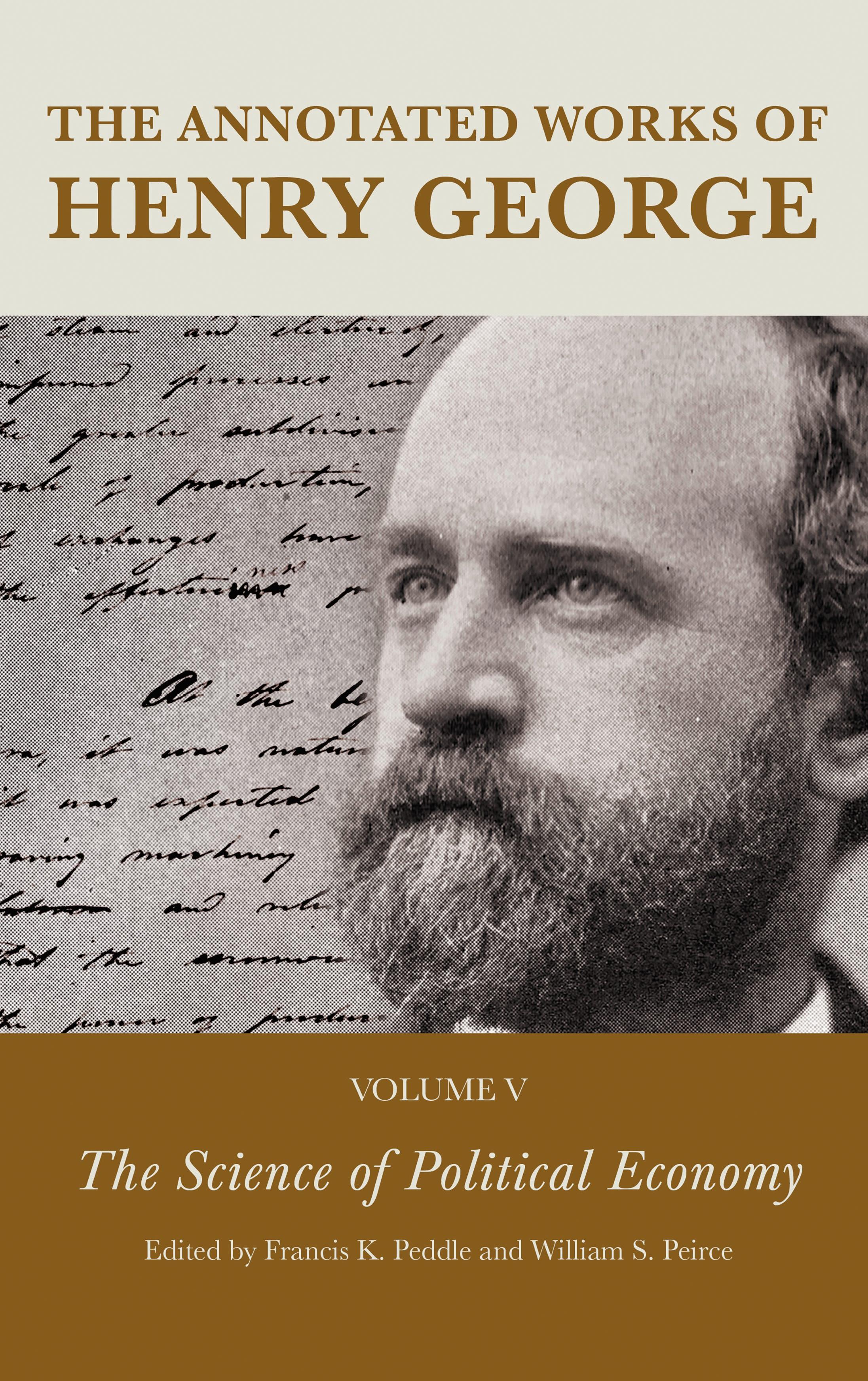
Henry George (1839–1897) rose to fame as a social reformer and economist amid the industrial and intellectual turbulence of the late nineteenth century. His best-selling Progress and Poverty (1879) captures the ravages of privileged monopolies and the woes of industrialization in a language of eloquent indignation. His reform agenda resonates as powerfully today as it did in the Gilded Age, and his impassioned prose and compelling thought inspired such diverse figures as Leo Tolstoy, John Dewey, Sun Yat-Sen, Winston Churchill, and Albert Einstein. This six-volume edition of The Annotated Works of Henry George assembles all his major works for the first time with new introductions, critical annotations, extensive bibliographical material, and comprehensive indexing to provide a wealth of resources for scholars and reformers.
Volume V of this series presents the unabridged and posthumously published text of The Science Political Economy (1898). George’s original text is comprehensively supplemented by annotations which explain his many references to other political economists and writers both well known and obscure. A new index augments accessibility to the text, the critical annotations, and their key terms. The introductory essay by Professor Francis K. Peddle, “Political Economy and the Satisfactions of Wealth,” provides the historical, economic, and primarily philosophical context for George’s debates with the prominent political economists and thinkers of his time.
Henry George, in history books and documentaries, is generally portrayed as a prominent reformer in the Gilded Age, one who ushered in with others the social and economic advances of the Progressive Era in the period from the 1890s to the 1920s. The Science of Political Economy reveals George to be one of the most original and systematic architects of political economy, and its developing self-image as a science, in the nineteenth century, along with David Ricardo, John Stuart Mill, and Alfred Marshall.
Henry George wrote The Science of Political Economy in order to correct the many confusions and myths about the nature and definition of wealth, value, and money, as well as the essential assumptions behind efficient production and the moral basis of the distribution of wealth. He defined political economy as the science that treats of the nature of wealth, and of the laws of production and distribution. It is not, for him, a science of human psychology or the twists and turns of political life. George’s constructive critiques of previous political economists led to fresh insights about the meaning and the limitations of political economy, about the intriguing relation between wealth and value, and about how the proper distribution of wealth in society ought to be understood as a function of the cooperative character of civilization. Volume V of The Annotated Works of Henry George presents the culmination of his life’s work and thought.
Volume V of this series presents the unabridged and posthumously published text of The Science Political Economy (1898). George’s original text is comprehensively supplemented by annotations which explain his many references to other political economists and writers both well known and obscure. A new index augments accessibility to the text, the critical annotations, and their key terms. The introductory essay by Professor Francis K. Peddle, “Political Economy and the Satisfactions of Wealth,” provides the historical, economic, and primarily philosophical context for George’s debates with the prominent political economists and thinkers of his time.
Henry George, in history books and documentaries, is generally portrayed as a prominent reformer in the Gilded Age, one who ushered in with others the social and economic advances of the Progressive Era in the period from the 1890s to the 1920s. The Science of Political Economy reveals George to be one of the most original and systematic architects of political economy, and its developing self-image as a science, in the nineteenth century, along with David Ricardo, John Stuart Mill, and Alfred Marshall.
Henry George wrote The Science of Political Economy in order to correct the many confusions and myths about the nature and definition of wealth, value, and money, as well as the essential assumptions behind efficient production and the moral basis of the distribution of wealth. He defined political economy as the science that treats of the nature of wealth, and of the laws of production and distribution. It is not, for him, a science of human psychology or the twists and turns of political life. George’s constructive critiques of previous political economists led to fresh insights about the meaning and the limitations of political economy, about the intriguing relation between wealth and value, and about how the proper distribution of wealth in society ought to be understood as a function of the cooperative character of civilization. Volume V of The Annotated Works of Henry George presents the culmination of his life’s work and thought.
Sider: 578
Kategori: Ekonomi & Utveckling
e-ISBN: 9781683933397
Forsendelsesvægt: 1.2 kg
Sendes inden for: 1-2 dage
Betal nemt med kort, Klarna, Apple Pay eller Google Pay. Ikke tilfreds? Du har altid 14 dages fortrydelsesret. Læs mere i vores vilkår. Har du spørgsmål, så send os en mail på hello@memmo.org.
Memmo gør det nemmere at studere – uanset hvor du er i verden. Hos os samler du dine kursusbøger og smarte studieværktøjer ét sted: resuméer, quizzer, podcasts og flashcards. Og så er der Ted, din studieven, der svarer på alt, du undrer dig over. Over 50 000 studerende studerer allerede her – bygget til at hjælpe dig med at lære hurtigere og stresse mindre.