
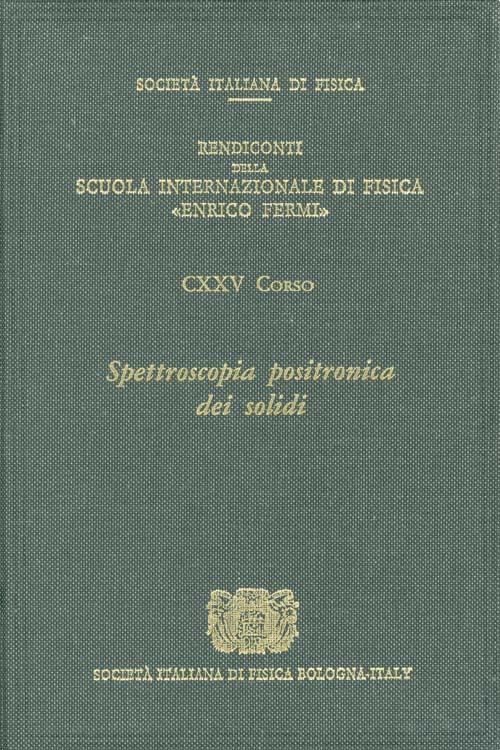
The lifetime of a positron inside a solid is normally less than a fraction of nanosecond. This is a very short time on a human scale, but is long enough to enable the positron to visit an extended region of the material, and to sense the atomic and electronic structure of the environment. Thus, we can inject a positron in a sample to draw from it some signal giving us information on the microscopic properties of the material. This idea has been successfully developed in a number of positron-based techniques of physical analysis, with resolution in energy, momentum, or position. The complex of these techniques is what we call now positron spectroscopy of solids. The field of application of the positron spectroscopy extends from advanced problems of solid-state physics to industrial applications in the area of characterization of high-tech materials. This volume focuses the attention on the physics that can be learned from positron-based methods, but also frames those methods in a wider context including other experimental approaches. It can be considered as a textbook on positron spectroscopy of solids, the sort of book that the newcomer takes for his approach to this field, but also as a useful research tool for the expert.
Betal nemt med kort, Klarna, Apple Pay eller Google Pay. Ikke tilfreds? Du har altid 14 dages fortrydelsesret. Læs mere i vores vilkår. Har du spørgsmål, så send os en mail på hello@memmo.org.
Memmo gør det nemmere at studere – uanset hvor du er i verden. Hos os samler du dine kursusbøger og smarte studieværktøjer ét sted: resuméer, quizzer, podcasts og flashcards. Og så er der Ted, din studieven, der svarer på alt, du undrer dig over. Over 50 000 studerende studerer allerede her – bygget til at hjælpe dig med at lære hurtigere og stresse mindre.