
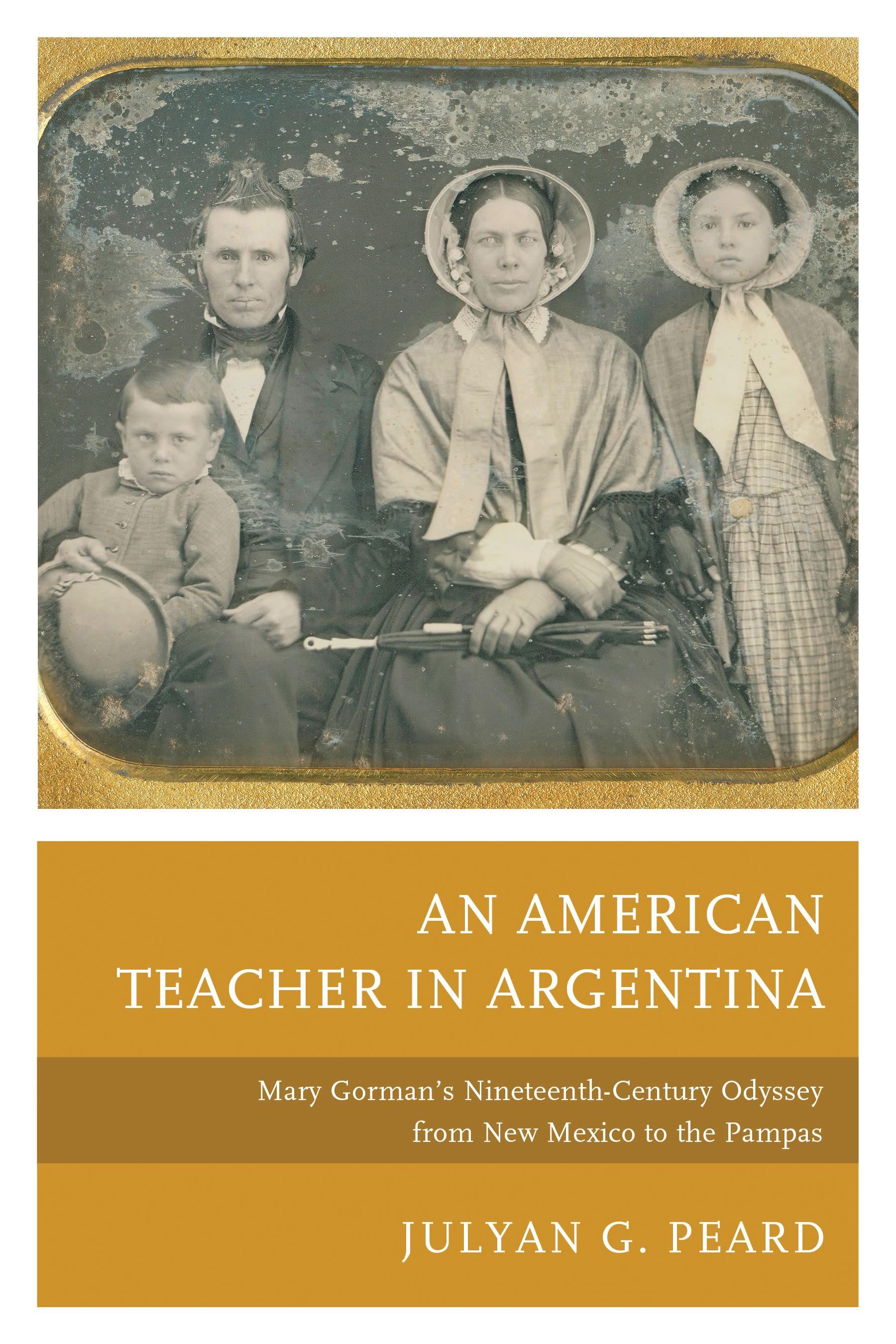
An American Teacher in Argentina tells the story of Mary E. Gorman who in 1869 was the first North American woman to accept President Domingo F. Sarmiento’s invitation to set up normal schools in Argentina, where she eventually settled. An ordinary historical actor whose life only sometimes enters the historical record, she moved along the fault lines of some of the greatest historical dramas and changes in nineteenth-century US and Argentine history: she was a pioneering child on the US-Indian frontier; she participated in the push for US women’s education; she was a single woman traveler at a time when few women traveled alone; she was a player in an Argentine attempt to expand common school education; and a beneficiary of the great primary products export boom in the second half of nineteenth-century Argentina, and thus well positioned to enjoy the country’s Belle Époque.
The book is not a straightforward, biographical narrative of a woman’s life. It charts a life, but, more important, it charts the evolving ideas in a life lived mostly among people pushing boundaries in pursuit of what they considered progress. What emerges is a quintessentially transnational life story that engages with themes of gender, education, religion, contact with indigenous peoples in both the US and Argentina, natural history, and economic and political change in Argentina in the second half of the nineteenth century. Because the book tells a good story about one woman’s rich and eventful life, it will also appeal to an audience beyond academe.
The book is not a straightforward, biographical narrative of a woman’s life. It charts a life, but, more important, it charts the evolving ideas in a life lived mostly among people pushing boundaries in pursuit of what they considered progress. What emerges is a quintessentially transnational life story that engages with themes of gender, education, religion, contact with indigenous peoples in both the US and Argentina, natural history, and economic and political change in Argentina in the second half of the nineteenth century. Because the book tells a good story about one woman’s rich and eventful life, it will also appeal to an audience beyond academe.
Betal nemt med kort, Klarna, Apple Pay eller Google Pay. Ikke tilfreds? Du har altid 14 dages fortrydelsesret. Læs mere i vores vilkår. Har du spørgsmål, så send os en mail på hello@memmo.org.
Memmo gør det nemmere at studere – uanset hvor du er i verden. Hos os samler du dine kursusbøger og smarte studieværktøjer ét sted: resuméer, quizzer, podcasts og flashcards. Og så er der Ted, din studieven, der svarer på alt, du undrer dig over. Over 50 000 studerende studerer allerede her – bygget til at hjælpe dig med at lære hurtigere og stresse mindre.