
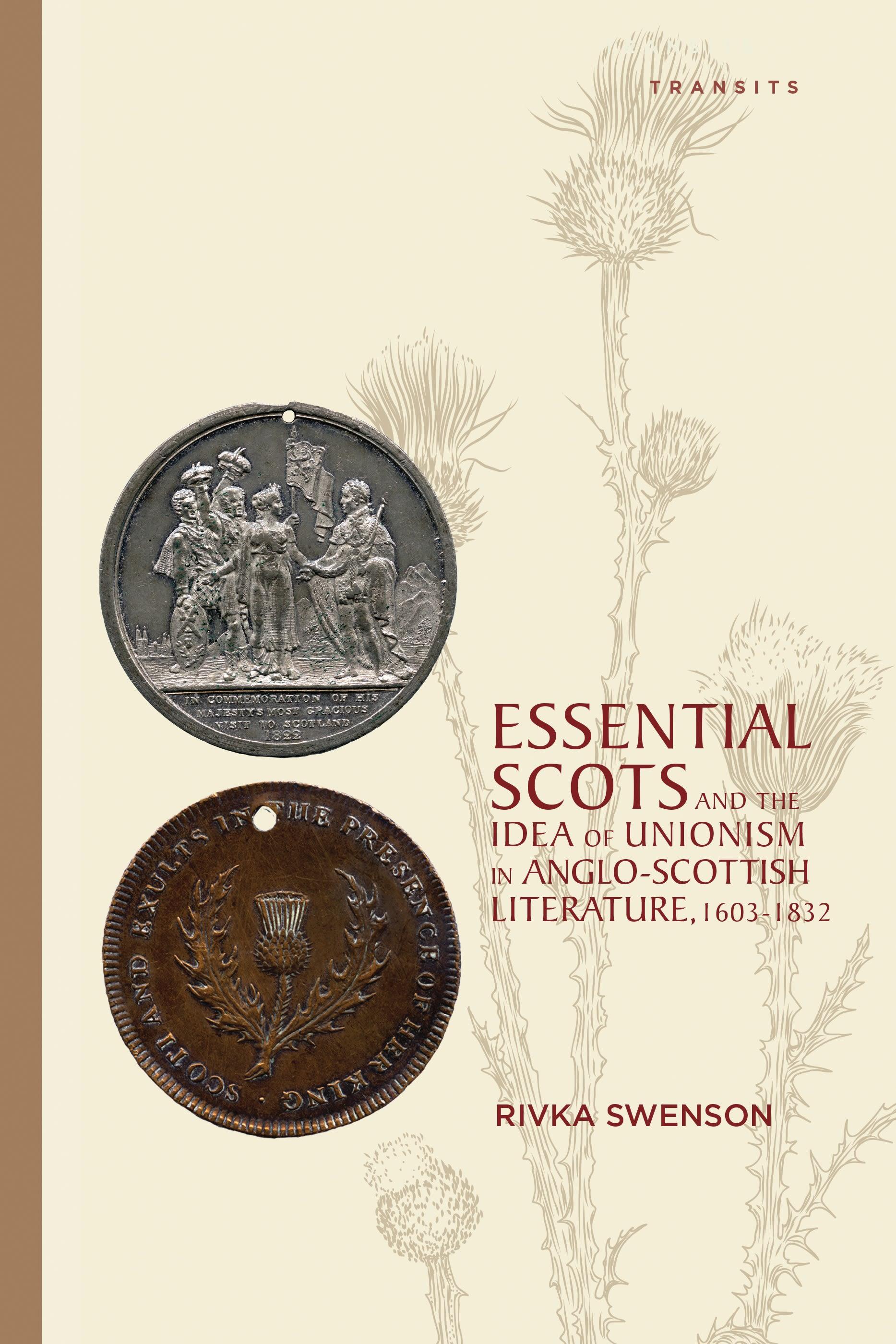
John Locke asked, “since all things that exist are merely particulars, how come we by general terms?” Essential Scots and the Idea of Unionism in Anglo-Scottish Literature, 1603–1832 tells a story about aesthetics and politics that looks back to the 1603 Union of Crowns and James VI/I’s emigration from Edinburgh to London. Considering the emergence of British unionism alongside the literary rise of both description and “the individual,” Rivka Swenson builds on extant scholarship with original close readings that illuminate the inheritances of 1603, a date of considerable but untraced importance in Anglo-Scottish literary and cultural history whose legacies are still being negotiated today. The 1603 Union of Crowns spurred interest in exploring the aesthetic politics of unionism in relation to an alleged Scottish essence that could be manipulated to resist or support “Britishness,” even as the king’s emigration generated a legacy of gendered representations of traveling Scots and “Scotlands-left-behind.”
Discussing writers such as Bacon, Defoe, Smollett, Johnson, Macpherson, Ferrier, and Scott along with lesser-known or forgotten popular authors (and ballads, transparencies, newspapers, joke books, cant dictionaries, political speeches, histories, travel narratives, engravings, material artifacts such as medals and snuffboxes), Essential Scots describes the years 1603 to 1832 as a crucial period in British history. Paradoxically, the political and cultural exploration of ideas about “unionism” in relation to a supposed “essential Scottishness” participated in the increasing prominence of both description and the “individual” in nineteenth-century Scottish literature; Swenson persuasively concludes that essential Scottishness (as both “identity” and symbolism) was refigured to mediate a national synthesis between the emergent individual and the nascent British nation—as well as the naturalized, even de-politicized, literary synthesis of particulars within putatively analogous narrative wholes.
Discussing writers such as Bacon, Defoe, Smollett, Johnson, Macpherson, Ferrier, and Scott along with lesser-known or forgotten popular authors (and ballads, transparencies, newspapers, joke books, cant dictionaries, political speeches, histories, travel narratives, engravings, material artifacts such as medals and snuffboxes), Essential Scots describes the years 1603 to 1832 as a crucial period in British history. Paradoxically, the political and cultural exploration of ideas about “unionism” in relation to a supposed “essential Scottishness” participated in the increasing prominence of both description and the “individual” in nineteenth-century Scottish literature; Swenson persuasively concludes that essential Scottishness (as both “identity” and symbolism) was refigured to mediate a national synthesis between the emergent individual and the nascent British nation—as well as the naturalized, even de-politicized, literary synthesis of particulars within putatively analogous narrative wholes.
Sider: 348
Kategori: Litteraturvetenskap & Teori
e-ISBN: 9781611486797
Forsendelsesvægt: 1.2 kg
Sendes inden for: 1-2 dage
Betal nemt med kort, Klarna, Apple Pay eller Google Pay. Ikke tilfreds? Du har altid 14 dages fortrydelsesret. Læs mere i vores vilkår. Har du spørgsmål, så send os en mail på hello@memmo.org.
Memmo gør det nemmere at studere – uanset hvor du er i verden. Hos os samler du dine kursusbøger og smarte studieværktøjer ét sted: resuméer, quizzer, podcasts og flashcards. Og så er der Ted, din studieven, der svarer på alt, du undrer dig over. Over 50 000 studerende studerer allerede her – bygget til at hjælpe dig med at lære hurtigere og stresse mindre.