
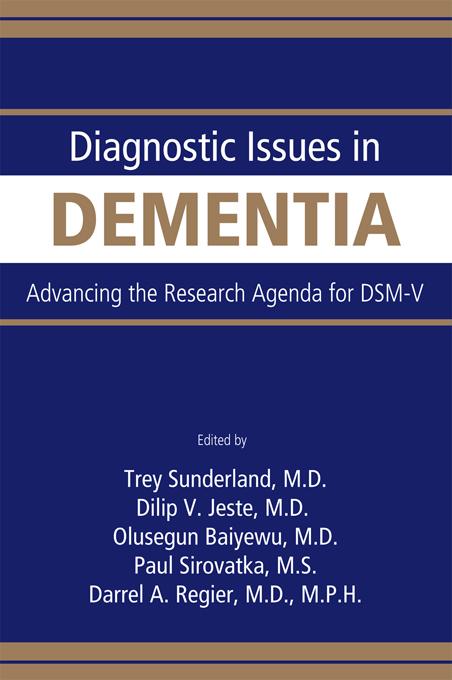
Advancing the Research Agenda for DSM-V, Diagnostic Issues in Dementia comprises nine chapters with research suggestions for consideration for the upcoming DSM-V process, reflecting the nascent effort toward a new diagnostic nomenclature in the still rapidly evolving field of dementia.
Here, 18 experts provide critical pieces of the dementia diagnostic story: The all-important neuropathological criteria of Alzheimer's disease and the aging brain; current epidemiologic literature and the challenges of making even minor changes in the general definition of dementia; and a scholarly review of the diagnostic nomenclature across the existing criteria, with numerous critiques and suggestion for future research The growing evidence for mild cognitive impairment as an identifiable entity suitable for inclusion in DSM-V; the current neuropsychological profiling that serves as the centerpiece of the diagnostic criteria for dementia and suggests that new instruments evaluating even broader aspects of cognition, including executive function, will be important in helping to identify dementia at an earlier stage of development The various behavioral syndromes associated with dementia, with emphasis on the need for great diagnostic clarity to help focus appropriate therapy in this area of increased burden for patients and family caregivers Biomarkers in dementia that may already be appropriate for inclusion in our diagnostic criteria; the current diagnostic utility of specific imaging modalities, which, combined with expanding ligand technology or markers of genetic predisposition, might further enhance diagnostic accuracy A review of the tremendous explosion of information in this field, asserting that, with the exception of the rare Mendelian disorders, genetic profiles are not yet ready to make substantial contributions to nosology
Despite all of these exciting findings, the editors state that we are still dealing with primarily clinical syndromes and therefore are still using clinical diagnostic criteria established at consensus conferences. In the spirit of scientific humility, they assert that these experts' views must be considered within the vast and expanding literature related to the dementias. Given the associated but still generally nonspecific biological mechanisms underlying these syndromes, new scientific developments might occur at any time and immediately affect the interpretations and considerations presented here.
This remarkably concise and insightful collection reviews today's -- and suggests directions for tomorrow's -- important diagnostic and research issues in dementia, and as such is a "must read" for clinicians and researchers alike.
Betal nemt med kort, Klarna, Apple Pay eller Google Pay. Ikke tilfreds? Du har altid 14 dages fortrydelsesret. Læs mere i vores vilkår. Har du spørgsmål, så send os en mail på hello@memmo.org.
Memmo gør det nemmere at studere – uanset hvor du er i verden. Hos os samler du dine kursusbøger og smarte studieværktøjer ét sted: resuméer, quizzer, podcasts og flashcards. Og så er der Ted, din studieven, der svarer på alt, du undrer dig over. Over 50 000 studerende studerer allerede her – bygget til at hjælpe dig med at lære hurtigere og stresse mindre.