
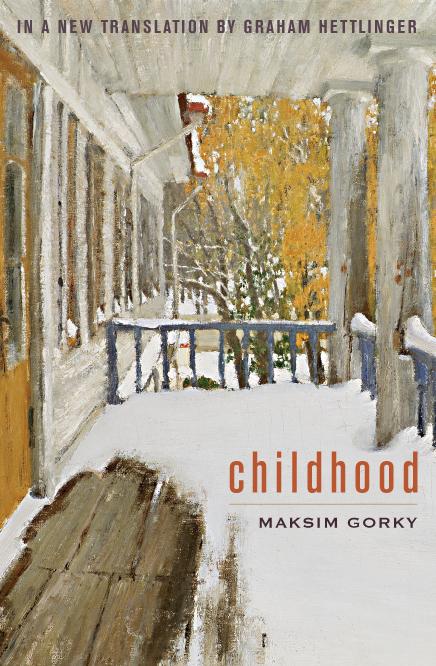
Aleksey Peshkov overcame indigence, violence, and suicidal despair to become Maksim Gorky, one of the most widely read and influential writers of the twentieth century. Childhood, the first book in Gorky's acclaimed autobiographical trilogy, depicts his early years, when after his father's death he was taken to live in the home of his maternal grandfather, a violent and vindictive man who both provided the child with a rudimentary education and subjected him to savage beatings.
With remarkable freshness and candor, Gorky immerses his reader in a young child's world, recreating in dynamic prose a boy's bewilderment at the senseless cruelty that surrounds him, his solace in the quiet beauty of the natural world, and his often funny, guileless observations of the many vivid characters who enter his early life. At the center of this story stands Gorky's grandmother, Akulina Kashirina, one of Russian literature's most remarkable heroines. Her tender love for her grandson serves as a vital antidote to the brutality that threatens to consume him. Her buoyant faith in a merciful, loving, but limited God provides the young Gorky with a life-affirming alternative to the vengeful, omniscient deity his grandfather worships ardently.
Although often unsettling in its portrayal of the poverty and ignorance that gripped nineteenth-century Russia, Childhood is ultimately a heartening account of a young boy's formative struggle to overcome the limitations of a decaying and corrupt society, and the remarkable old woman who enabled him to succeed and instilled in him an abiding, fierce compassion for Russia's destitute and defenseless. Childhood is freshly and beautifully translated by Graham Hettlinger, lauded for his translations of Ivan Bunin.
With remarkable freshness and candor, Gorky immerses his reader in a young child's world, recreating in dynamic prose a boy's bewilderment at the senseless cruelty that surrounds him, his solace in the quiet beauty of the natural world, and his often funny, guileless observations of the many vivid characters who enter his early life. At the center of this story stands Gorky's grandmother, Akulina Kashirina, one of Russian literature's most remarkable heroines. Her tender love for her grandson serves as a vital antidote to the brutality that threatens to consume him. Her buoyant faith in a merciful, loving, but limited God provides the young Gorky with a life-affirming alternative to the vengeful, omniscient deity his grandfather worships ardently.
Although often unsettling in its portrayal of the poverty and ignorance that gripped nineteenth-century Russia, Childhood is ultimately a heartening account of a young boy's formative struggle to overcome the limitations of a decaying and corrupt society, and the remarkable old woman who enabled him to succeed and instilled in him an abiding, fierce compassion for Russia's destitute and defenseless. Childhood is freshly and beautifully translated by Graham Hettlinger, lauded for his translations of Ivan Bunin.
Betal nemt med kort, Klarna, Apple Pay eller Google Pay. Ikke tilfreds? Du har altid 14 dages fortrydelsesret. Læs mere i vores vilkår. Har du spørgsmål, så send os en mail på hello@memmo.org.
Memmo gør det nemmere at studere – uanset hvor du er i verden. Hos os samler du dine kursusbøger og smarte studieværktøjer ét sted: resuméer, quizzer, podcasts og flashcards. Og så er der Ted, din studieven, der svarer på alt, du undrer dig over. Over 50 000 studerende studerer allerede her – bygget til at hjælpe dig med at lære hurtigere og stresse mindre.