
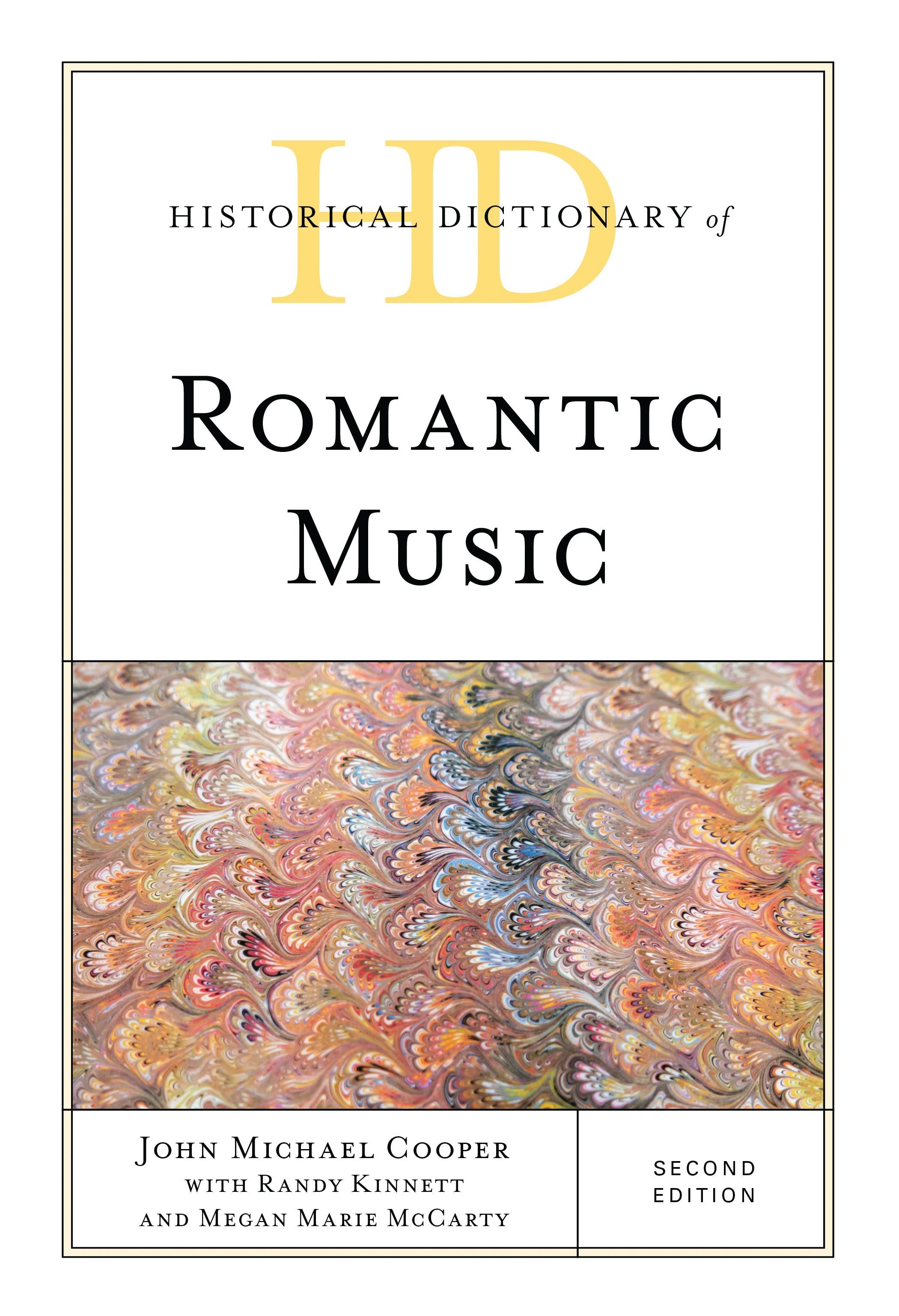
Library Journal praises the book as "an excellent one-volume ready reference resource for students, researchers, and others interested in music history."
Historical Dictionary of Romantic Music, Second Edition covers the persons, ideas, practices, and works that made up the worlds of Western music during the long 19th century (ca. 1780–1918). It’s the first book to recognize that Romantic music was very nearly a global phenomenon. It includes more women, more Black musicians and other musicians of color, and more exponents of musical Romanticism from Central and South America as well as Central and Eastern Europe than any other single-volume study of Romantic music—thus challenging the conventional hegemony of musical Romanticisms by men and by Western European nations. This book includes entries on topics including anti-Semitism, sexism, and racism that were pervasive and defining to the worlds of musical Romanticism but are rarely addressed in general studies of that subject. It includes Romantic musicians who were not primarily composers, as well as topics such as the Haitian Revolution, spirituals, and ragtime that were more important for music in the long 19th century than is generally acknowledged. The result is an expansive, inclusive, diverse, and more richly textured portrayal of Romantic music than is elsewhere available.
Historical Dictionary of Romantic Music, Second Edition contains a chronology, an introduction, an extensive bibliography, and a dictionary section with more than 600 cross-referenced entries on traditions, famous pieces, persons, places, technical terms, and institutions of Romantic music. This book is an excellent resource for students, researchers, and anyone wanting to know more about Romantic music.
Historical Dictionary of Romantic Music, Second Edition covers the persons, ideas, practices, and works that made up the worlds of Western music during the long 19th century (ca. 1780–1918). It’s the first book to recognize that Romantic music was very nearly a global phenomenon. It includes more women, more Black musicians and other musicians of color, and more exponents of musical Romanticism from Central and South America as well as Central and Eastern Europe than any other single-volume study of Romantic music—thus challenging the conventional hegemony of musical Romanticisms by men and by Western European nations. This book includes entries on topics including anti-Semitism, sexism, and racism that were pervasive and defining to the worlds of musical Romanticism but are rarely addressed in general studies of that subject. It includes Romantic musicians who were not primarily composers, as well as topics such as the Haitian Revolution, spirituals, and ragtime that were more important for music in the long 19th century than is generally acknowledged. The result is an expansive, inclusive, diverse, and more richly textured portrayal of Romantic music than is elsewhere available.
Historical Dictionary of Romantic Music, Second Edition contains a chronology, an introduction, an extensive bibliography, and a dictionary section with more than 600 cross-referenced entries on traditions, famous pieces, persons, places, technical terms, and institutions of Romantic music. This book is an excellent resource for students, researchers, and anyone wanting to know more about Romantic music.
Betal nemt med kort, Klarna, Apple Pay eller Google Pay. Ikke tilfreds? Du har altid 14 dages fortrydelsesret. Læs mere i vores vilkår. Har du spørgsmål, så send os en mail på hello@memmo.org.
Memmo gør det nemmere at studere – uanset hvor du er i verden. Hos os samler du dine kursusbøger og smarte studieværktøjer ét sted: resuméer, quizzer, podcasts og flashcards. Og så er der Ted, din studieven, der svarer på alt, du undrer dig over. Over 50 000 studerende studerer allerede her – bygget til at hjælpe dig med at lære hurtigere og stresse mindre.