
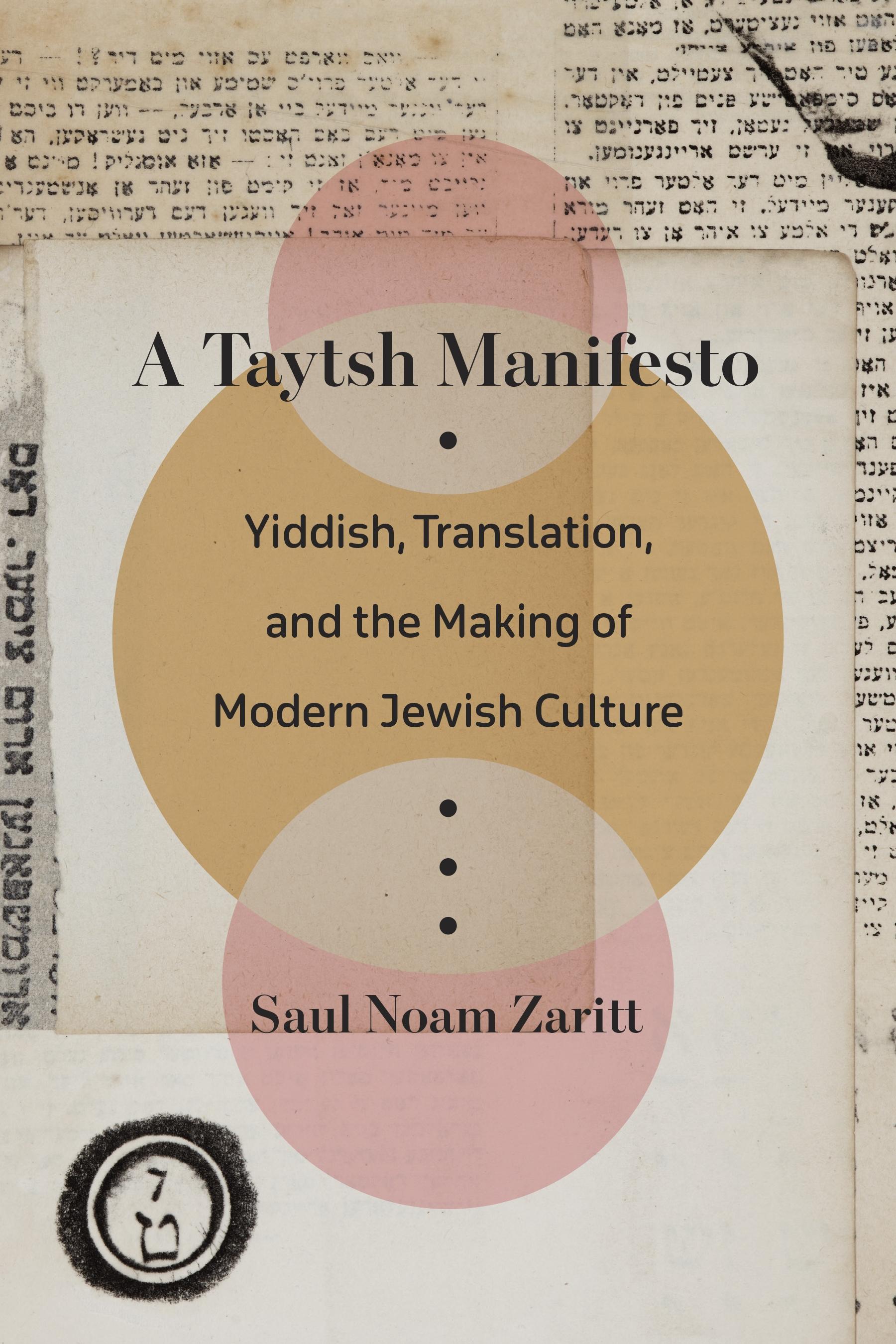
A Taytsh Manifesto calls for a translational paradigm for Yiddish studies and for the study of modern Jewish culture. Saul Noam Zaritt calls for a shift in vocabulary, from Yiddish to taytsh, in order to promote reading strategies that account for the ways texts named as Jewish move between languages and cultures.
Yiddish, a moniker that became dominant only in the early twentieth century, means “Jewish” and thus marks the language with a single identity: of and for a Jewish collective. In contrast, this book calls attention to an earlier and, at one time, more common name for the language: taytsh, which initially means “German.” By using the term taytsh, speakers indicated that they were indeed speaking a Germanic language, a language that was not entirely their own. In time, when the word shifted to a verb, taytshn, it came to mean the act of translation. To write or speak in Yiddish is thus to render into taytsh and inhabit the gap between languages.
A Taytsh Manifesto highlights the cultural porousness that inheres in taytsh and deploys the term as a paradigm that can be applied to a host of modern Jewish cultural formations. The book reads three corpora in modern Yiddish culture through the lens of translation: Yiddish pulp fiction, also known as shund (trash); the genre of the Yiddish monologue as authored by Sholem Aleichem and other prominent Yiddish writers; and the persistence of Yiddish as a language of vulgarity in contemporary U.S. culture. Together these examples help revise current histories of Yiddish while demonstrating the need for new vocabularies to account for the multidirectionality of Jewish culture. A Taytsh Manifesto develops a model for identifying, in Yiddish and beyond, how cultures intertwine, how they become implicated in world systems and empire, and how they might escape such limiting and oppressive structures.
Betal nemt med kort, Klarna, Apple Pay eller Google Pay. Ikke tilfreds? Du har altid 14 dages fortrydelsesret. Læs mere i vores vilkår. Har du spørgsmål, så send os en mail på hello@memmo.org.
Memmo gør det nemmere at studere – uanset hvor du er i verden. Hos os samler du dine kursusbøger og smarte studieværktøjer ét sted: resuméer, quizzer, podcasts og flashcards. Og så er der Ted, din studieven, der svarer på alt, du undrer dig over. Over 50 000 studerende studerer allerede her – bygget til at hjælpe dig med at lære hurtigere og stresse mindre.