
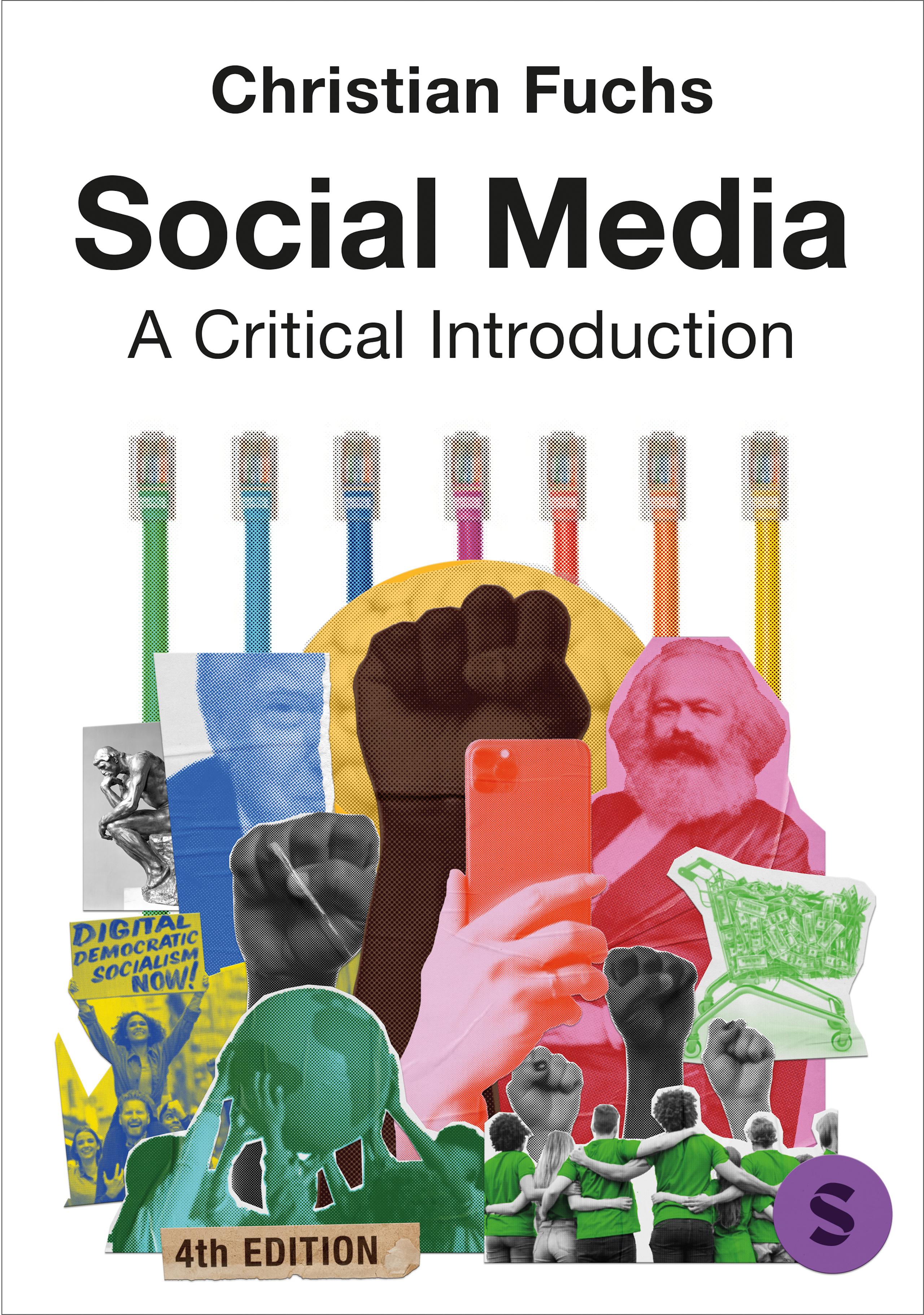
You will never look at social media the same way again.
Social media are an integral part of contemporary society. From news, warfare, politics, advertising, consumption, entertainment, friendships, labour, and economy to friendships, leisure, language, and everyday life, they have changed the way we communicate, use information and understand the world.
Social media shape and are shaped by contemporary society. In order to understand contemporary society we have to ask critical questions about social media. This book is the ultimate guide for digging deeper into issues of ownership, power, class, and (in)justice.
This book equips you with a critical understanding of the complexities and contradictions at the heart of social media’s relationship with society.
The Fourth Edition contains new chapters and has updated and revised versions of other chapters:
- The book includes a new chapter on TikTok in the context of global capitalism and the geopolitical conflict between China and the USA.
- It explores new topics such as information and social media warfare in the context of Russia’s invasion of Ukraine, the implications of Elon Musk’s acquisition of Twitter for democracy and the public sphere, the prospects of Twitter-alternative Mastodon, digital fascism, influencers and the attention economy on TikTok, digital capitalism, the role of big data in digital capitalism, The Public Service Media and Public Service Internet Manifesto, social media’s digital alienation, and Putinism and information warfare.
- It explores populism, racism, nationalism, militant patriarchy in a chapter on right-wing authoritarianism on social media that includes two case studies of Donald Trump and Putinism.
- It analyses the phenomenon of social media influencers in the age of TikTok, Instagram, YouTube, and Snapchat.
- It explains in an updated chapter what digital capitalism is and what role big data plays in it.
- It explores the growing prominence of platforms and platform capitalism.
- It analyses fake news, misinformation, and surveillance capitalism in the context of Facebook, WhatsApp, Cambridge Analytica, and the Internet Research Agency.
- It shows why Google is simultaneously the Internet’s God and Satan.
- It discusses digital democracy and the digital public sphere in the context of Twitter.
- It challenges you to envision and achieve a truly social media that serves the purposes of a just and fair world.
- It introduces platform co-operatives and the Public Service Internet.
There are winners and losers in the age of digital capitalism. This book is an essential guide for anyone who wants to critically understand how we got to digital capitalism and capitalist social media, what we can do about it, and what a democratic public sphere looks like.
Betal nemt med kort, Klarna, Apple Pay eller Google Pay. Ikke tilfreds? Du har altid 14 dages fortrydelsesret. Læs mere i vores vilkår. Har du spørgsmål, så send os en mail på hello@memmo.org.
Memmo gør det nemmere at studere – uanset hvor du er i verden. Hos os samler du dine kursusbøger og smarte studieværktøjer ét sted: resuméer, quizzer, podcasts og flashcards. Og så er der Ted, din studieven, der svarer på alt, du undrer dig over. Over 50 000 studerende studerer allerede her – bygget til at hjælpe dig med at lære hurtigere og stresse mindre.