
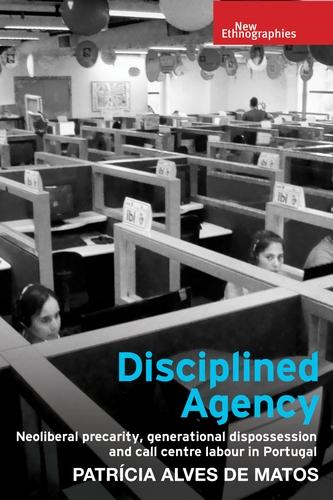
Since the mid-2000s, the harsh reality of call centre employment for a generation of young workers in Portugal has been impossible to ignore. With its endless rows of small cubicles, where human agents endure repetitive telephone conversations with abusive clients under invasive modes of technological surveillance, discipline and control, call centre work remains a striking symbol of labour precarity, a condition particularly associated with the neoliberal generational disenchantment that ‘each generation does better than its predecessor’.
This book describes the emergence of a regime of disciplined agency in the Portuguese call centre sector. Examining the ascendancy of call centres as icons of precarity in contemporary Portugal, this book argues that call centre labour constitutes a new form of commodification of the labouring subject. De Matos argues that call centres represent an advanced system of non-manual labour power exploitation, due to the underestimation of human creativity that lies at the centre of the regimented structures of call centre labour. Call centres can only guarantee profit maintenance, de Matos argues, through the commodification of the human agency arising from the operators’ moral, relational and social embedded agentive linguistic interventions of creative improvisation, decision-making, problem-solving and ethical evaluation.
Betal nemt med kort, Klarna, Apple Pay eller Google Pay. Ikke tilfreds? Du har altid 14 dages fortrydelsesret. Læs mere i vores vilkår. Har du spørgsmål, så send os en mail på hello@memmo.org.
Memmo gør det nemmere at studere – uanset hvor du er i verden. Hos os samler du dine kursusbøger og smarte studieværktøjer ét sted: resuméer, quizzer, podcasts og flashcards. Og så er der Ted, din studieven, der svarer på alt, du undrer dig over. Over 50 000 studerende studerer allerede her – bygget til at hjælpe dig med at lære hurtigere og stresse mindre.