
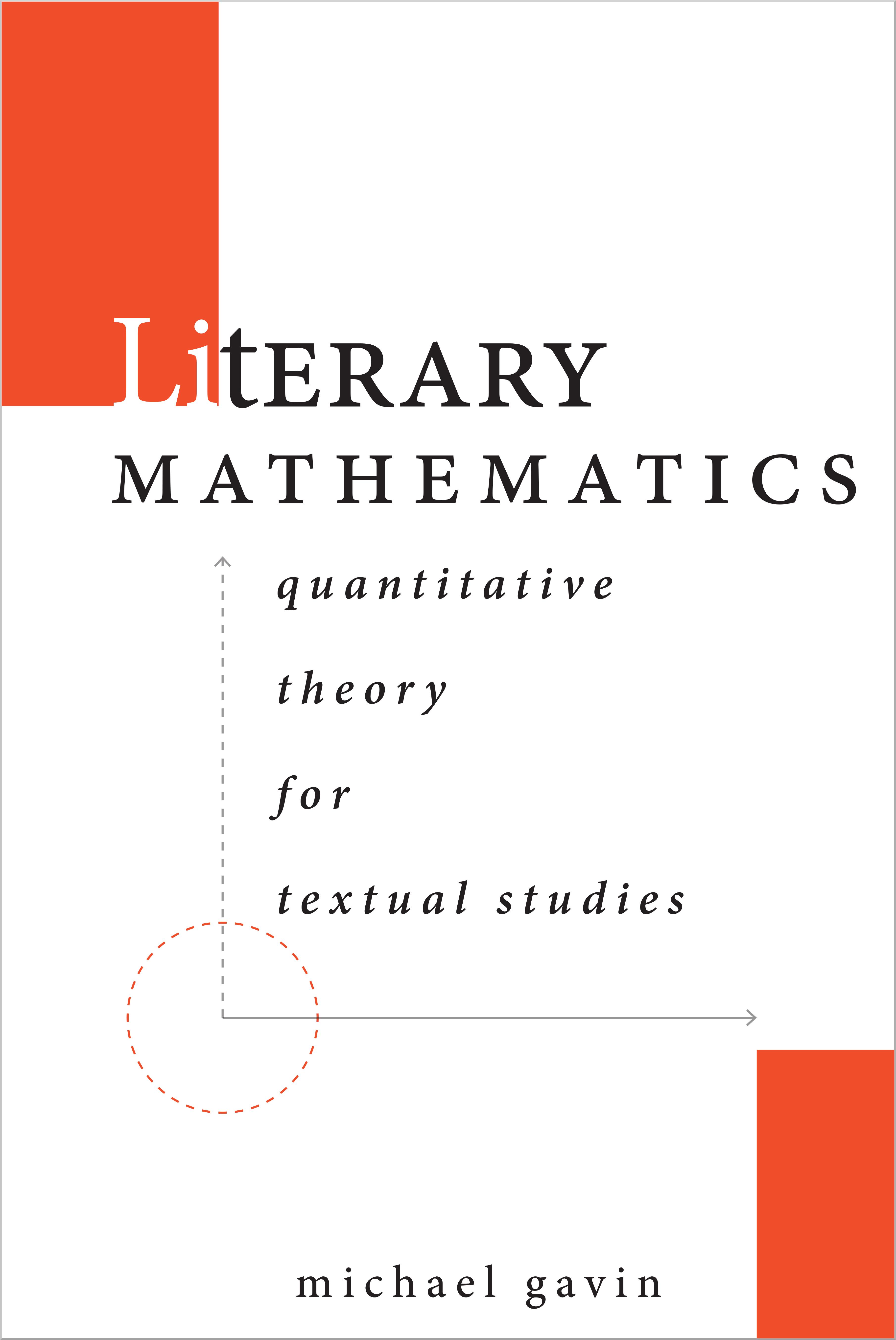
Across the humanities and social sciences, scholars increasingly use quantitative methods to study textual data. Considered together, this research represents an extraordinary event in the long history of textuality. More or less all at once, the corpus has emerged as a major genre of cultural and scientific knowledge. In Literary Mathematics, Michael Gavin grapples with this development, describing how quantitative methods for the study of textual data offer powerful tools for historical inquiry and sometimes unexpected perspectives on theoretical issues of concern to literary studies.
Student-friendly and accessible, the book advances this argument through case studies drawn from the Early English Books Online corpus. Gavin shows how a copublication network of printers and authors reveals an uncannily accurate picture of historical periodization; that a vector-space semantic model parses historical concepts in incredibly fine detail; and that a geospatial analysis of early modern discourse offers a surprising panoramic glimpse into the period's notion of world geography. Across these case studies, Gavin challenges readers to consider why corpus-based methods work so effectively and asks whether the successes of formal modeling ought to inspire humanists to reconsider fundamental theoretical assumptions about textuality and meaning. As Gavin reveals, by embracing the expressive power of mathematics, scholars can add new dimensions to digital humanities research and find new connections with the social sciences.
Betal nemt med kort, Klarna, Apple Pay eller Google Pay. Ikke tilfreds? Du har altid 14 dages fortrydelsesret. Læs mere i vores vilkår. Har du spørgsmål, så send os en mail på hello@memmo.org.
Memmo gør det nemmere at studere – uanset hvor du er i verden. Hos os samler du dine kursusbøger og smarte studieværktøjer ét sted: resuméer, quizzer, podcasts og flashcards. Og så er der Ted, din studieven, der svarer på alt, du undrer dig over. Over 50 000 studerende studerer allerede her – bygget til at hjælpe dig med at lære hurtigere og stresse mindre.