
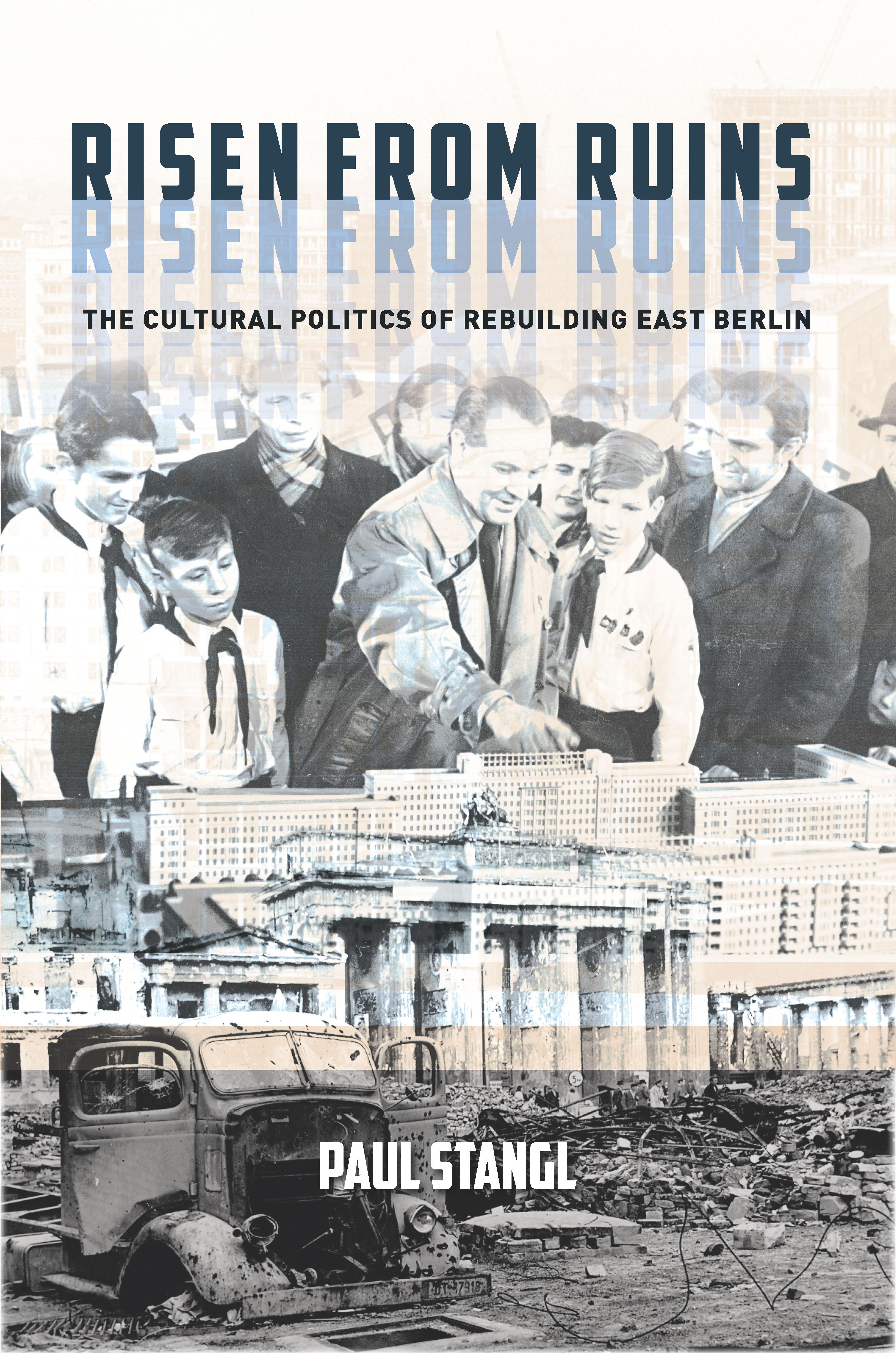
In the aftermath of the Second World War, Berliners grappled with how to rebuild their devastated city. In East Berlin, where the historic core of the city lay, decisions made by the socialist leadership about what should be restored, reconstructed, or entirely reimagined would have a tremendous and lasting impact on the urban landscape. Risen from Ruins examines the cultural politics of the rebuilding of East Berlin from the end of World War II until the construction of the Berlin Wall, combining political analysis with spatial and architectural history to examine how the political agenda of East German elites and the ruling Socialist Unity Party (SED) played out in the built environment.
Following the destruction of World War II, the center of Berlin could have been completely restored and preserved, or razed in favor of a sanitized, modern city. The reality fell somewhere in between, as decision makers balanced historic preservation against the opportunity to model the Socialist future and reject the example of the Nazi dictatorship through architecture and urban design. Paul Stangl's analysis expands our understanding of urban planning, historic preservation, modernism, and Socialist Realism in East Berlin, shedding light on how the contemporary shape of the city was influenced by ideology and politics.
Betal nemt med kort, Klarna, Apple Pay eller Google Pay. Ikke tilfreds? Du har altid 14 dages fortrydelsesret. Læs mere i vores vilkår. Har du spørgsmål, så send os en mail på hello@memmo.org.
Memmo gør det nemmere at studere – uanset hvor du er i verden. Hos os samler du dine kursusbøger og smarte studieværktøjer ét sted: resuméer, quizzer, podcasts og flashcards. Og så er der Ted, din studieven, der svarer på alt, du undrer dig over. Over 50 000 studerende studerer allerede her – bygget til at hjælpe dig med at lære hurtigere og stresse mindre.