
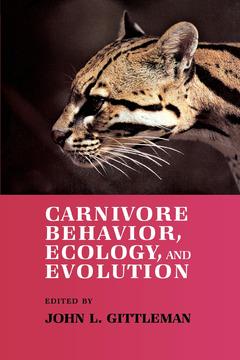
The mammalian order Carnivora is characterized by an incredible range of morphological, ecological, and behavioral variation. Carnivores can be as small as the 100-gram least weasel or as large as the 800-kilogram polar bear. Their reproductive rate can vary from one offspring every five years, as with some black bears, to three litters a year, as with the dwarf mongoose. Group sizes can be traced along a wide continuum, from the solitary ermine to the monogamous golden jackal to the large extended packs of as many as 80 spotted hyenas.
Until recently the general habits of most wild carnivore species were inadequately understood. In the last decade, however, improved technologies, including the use of radiotelemetry and night-vision scopes, have led to many important discoveries. This book is at once a critical summary and an evaluation of current research on carnivores. A worthy successor to R.F. Ewer's monumental volume, The Carnivores (Cornell University Press), it is the work of 30 leading carnivore biologists, who here assemble comparative data on the basic anatomical, behavioral, ecological, physiological, reproductive, and evolutionary characteristics of this group.
After a general introduction to the Carnivora, the volume is divided in three parts, each of which begins with a brief introduction outlining its main themes. Part I, Behavior, covers acoustic and olfactory communication, behavioral development, behavioral ecology of canids and hyaenids, modes of solitary living, and group living. In Part II, Ecology, topics include feeding ecology of the giant panda and Asiatic black bear, adatpations for aquatic living, ecological constraints on predation in felids, consequences of small size in mustelids, rate of basal metabolism and food habits, and reproductive output. Part III, Evolution, deals with the morphological approaches to phylogeny, and the fossil record. An appendix presents a complete classification of the Carnivora, including topics of continuing controversy.
Highlighting recent developments in the study of the Carnivora and areas for further research, this broad synthesis will be of great value of students and researchers in animal behavior, behavioral ecology, wildlife ecology, mammalogy, paleontology, systematics, and evolution theory. It will also encourage realistic conservation programs to manage rapidly diminishing populations and will elucidate particular features of the carnivores for nonspecialist readers.
Betal nemt med kort, Klarna, Apple Pay eller Google Pay. Ikke tilfreds? Du har altid 14 dages fortrydelsesret. Læs mere i vores vilkår. Har du spørgsmål, så send os en mail på hello@memmo.org.
Memmo gør det nemmere at studere – uanset hvor du er i verden. Hos os samler du dine kursusbøger og smarte studieværktøjer ét sted: resuméer, quizzer, podcasts og flashcards. Og så er der Ted, din studieven, der svarer på alt, du undrer dig over. Over 50 000 studerende studerer allerede her – bygget til at hjælpe dig med at lære hurtigere og stresse mindre.