
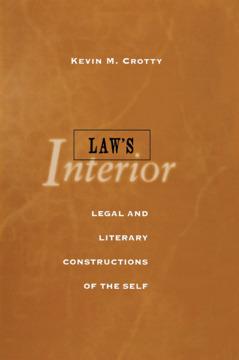
In Law's Interior, Kevin M. Crotty draws on several important literary works to offer a new model of the relationship between citizens and their laws, one that emphasizes the power of law to shape citizens and to foster—or discourage—their autonomy. Crotty maintains that citizens are "inside" the law—they are the law's interior. Literature, he finds, can be relevant to law by emphasizing the connections between law and the world around it—a stance that corrects the tendency of legal theory to treat law as a separate, autonomous entity.
The texts Crotty examines—Aeschylus' Oresteia, St. Augustine's Confessions, and the poetry of Wallace Stevens—question the rationalist optimism that Crotty regards as distorting much recent theorizing about law. Further, he asserts that the inability of courts to state clearly the principles animating their decisions demonstrates the stranglehold the positivist model has on us and our legal imaginations.
Crotty sketches a model of the relation between citizens and laws that supplements the more familiar idea of law as something deliberated and enacted by rational, inherently autonomous citizens. The most important legal decisions of the past fifty years, Crotty says, rest on the perception that the state, far from merely respecting the "innate" autonomy of its citizens, actively shapes that autonomy. Law's Interior should contribute to a better understanding of the real principles underlying some landmark decisions by the Supreme Court.
Betal nemt med kort, Klarna, Apple Pay eller Google Pay. Ikke tilfreds? Du har altid 14 dages fortrydelsesret. Læs mere i vores vilkår. Har du spørgsmål, så send os en mail på hello@memmo.org.
Memmo gør det nemmere at studere – uanset hvor du er i verden. Hos os samler du dine kursusbøger og smarte studieværktøjer ét sted: resuméer, quizzer, podcasts og flashcards. Og så er der Ted, din studieven, der svarer på alt, du undrer dig over. Over 50 000 studerende studerer allerede her – bygget til at hjælpe dig med at lære hurtigere og stresse mindre.