
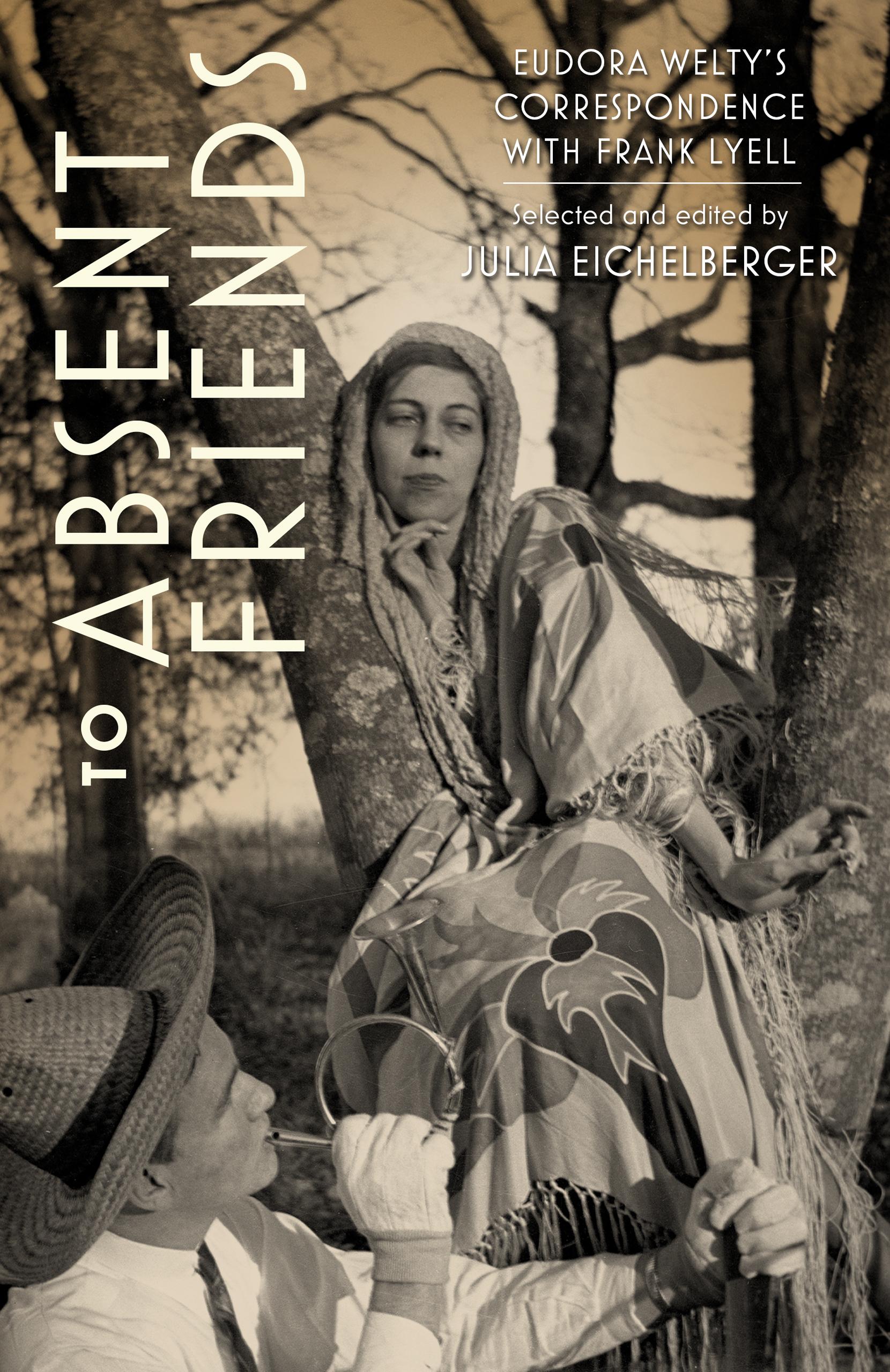
With over 350 complete or excerpted letters, most previously unpublished, To Absent Friends: Eudora Welty's Correspondence with Frank Lyell forms an epistolary narrative of Welty’s writing life and her nearly fifty-year friendship with Frank Lyell, a friend from Jackson, Mississippi. Also included in the text are extensive annotations to explain the letters’ myriad, often telegraphic cultural references. Early letters show both correspondents’ youthful exuberance as Lyell pursued graduate studies at Princeton and Welty, based in Jackson, visited New York whenever she could. They saw much to ridicule in the grown-up world they were entering, but their letters also convey deep admiration for music, literature, art, dance, and other cultural expressions.
Letters from the 1940s discuss Welty’s work in progress, Lyell’s wartime service in the Army Air Forces Intelligence, and his teaching jobs in North Carolina and Texas. In the 1950s, her mother’s health began to fail, and the civil rights movement and other world events hovered in the background of letters reporting on the Weltys’ challenging lives. As Welty’s fame grew, the friends continued to share gossip, descriptions of enjoyably bad movies, and reports on literature that moved them.
The friends’ final decade of correspondence includes playfulness alongside poignant reminders of their own aging. Becoming quieter, calmer versions of their youthful selves, they retained their delight in high and low culture, their veneration of art, and their love of the absurd. Taken together, these letters document a remarkable artist’s responses to her time and place and a sparkling friendship.
Letters from the 1940s discuss Welty’s work in progress, Lyell’s wartime service in the Army Air Forces Intelligence, and his teaching jobs in North Carolina and Texas. In the 1950s, her mother’s health began to fail, and the civil rights movement and other world events hovered in the background of letters reporting on the Weltys’ challenging lives. As Welty’s fame grew, the friends continued to share gossip, descriptions of enjoyably bad movies, and reports on literature that moved them.
The friends’ final decade of correspondence includes playfulness alongside poignant reminders of their own aging. Becoming quieter, calmer versions of their youthful selves, they retained their delight in high and low culture, their veneration of art, and their love of the absurd. Taken together, these letters document a remarkable artist’s responses to her time and place and a sparkling friendship.
Betal nemt med kort, Klarna, Apple Pay eller Google Pay. Ikke tilfreds? Du har altid 14 dages fortrydelsesret. Læs mere i vores vilkår. Har du spørgsmål, så send os en mail på hello@memmo.org.
Memmo gør det nemmere at studere – uanset hvor du er i verden. Hos os samler du dine kursusbøger og smarte studieværktøjer ét sted: resuméer, quizzer, podcasts og flashcards. Og så er der Ted, din studieven, der svarer på alt, du undrer dig over. Over 50 000 studerende studerer allerede her – bygget til at hjælpe dig med at lære hurtigere og stresse mindre.
Du kan måske også lide
Køb bogen0