
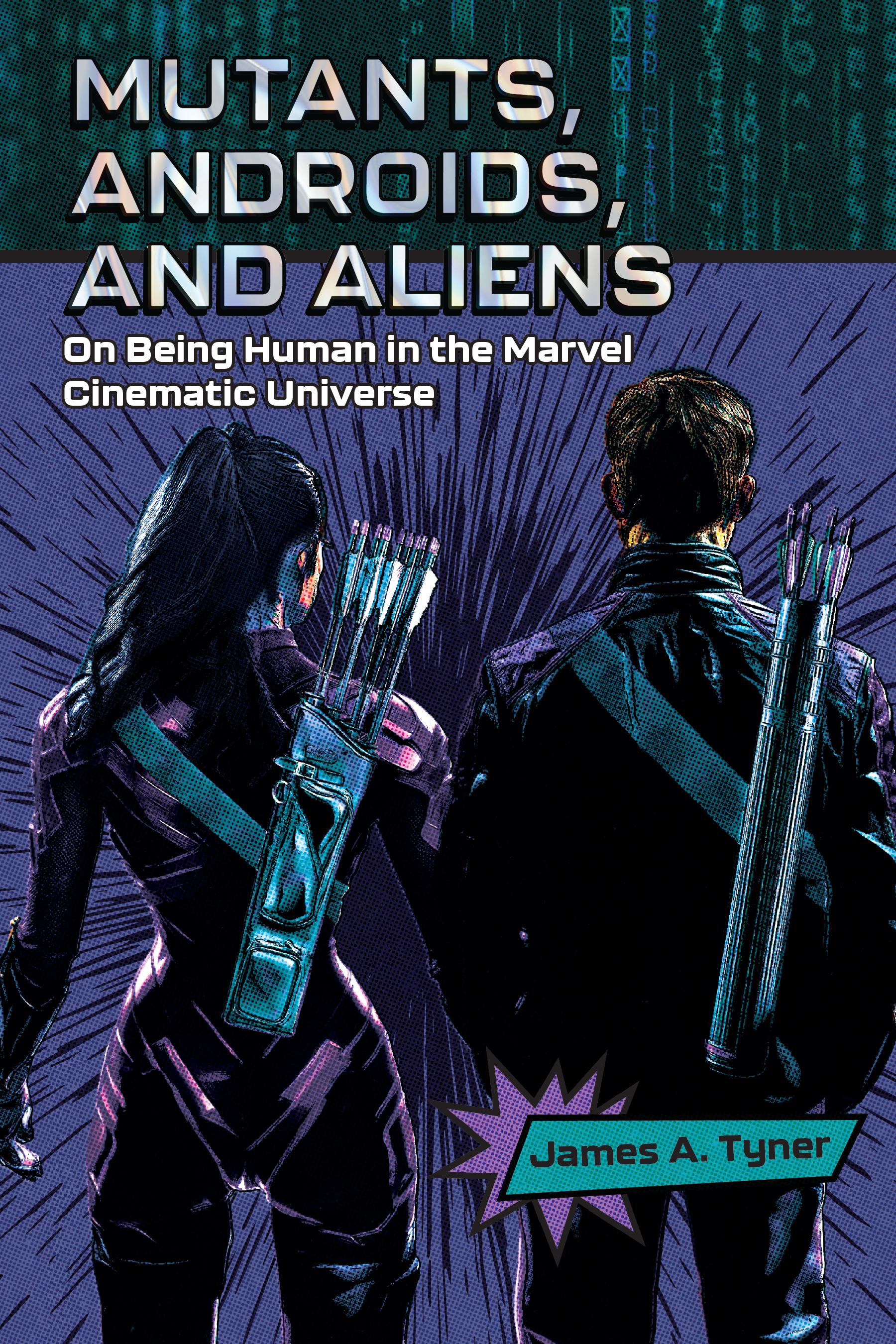
In both literature and film, mutants, androids, and aliens have long functioned as humanity’s Other—nonhuman bodies serving as surrogates to explore humanity’s prejudice, bigotry, and hatred. Scholars working in fields of feminism, ethnic studies, queer studies, and disability studies, among others, have deconstructed representations of the Othered body and the ways these fictional depictions provide insight into the contested terrains of identity, subjectivity, and personhood. In science fiction more broadly and the superhero genre in particular, the fictional Other—often a superhero or a villain—is juxtaposed against the normal human, and such Others have long been the subject of academic investigation.
Author James A. Tyner shifts this scholarly focus to consider the ordinary humans who ally with or oppose Othered superheroes. Law enforcement officers, military officials, politicians, and the countless, nameless civilians are all examples of humans who try to make sense of a rapidly changing more-than-human and other-than-human universe. The resulting volume, Mutants, Androids, and Aliens: On Being Human in the Marvel Cinematic Universe, provides a critical posthumanist reading of being human in the Marvel Cinematic Universe (MCU).
Centering the MCU’s secondary human characters, including Matthew Ellis, Ellen Nadeer, Rosalind Price, as well as Jimmy Woo, Sadie Deever, Holden Radcliffe, and others, Tyner considers how these characters attempt to monitor, incarcerate, or exterminate those beings considered "unnatural" and thus threatening. Placing into conversation posthumanism, environmental ethics, and myriad philosophical and biological ontologies of life and death, Tyner maintains that the superhero genre reflects the current complexities of meaningful life—and of what happens in society when "the human" is no longer the unquestioned normative standard.
Author James A. Tyner shifts this scholarly focus to consider the ordinary humans who ally with or oppose Othered superheroes. Law enforcement officers, military officials, politicians, and the countless, nameless civilians are all examples of humans who try to make sense of a rapidly changing more-than-human and other-than-human universe. The resulting volume, Mutants, Androids, and Aliens: On Being Human in the Marvel Cinematic Universe, provides a critical posthumanist reading of being human in the Marvel Cinematic Universe (MCU).
Centering the MCU’s secondary human characters, including Matthew Ellis, Ellen Nadeer, Rosalind Price, as well as Jimmy Woo, Sadie Deever, Holden Radcliffe, and others, Tyner considers how these characters attempt to monitor, incarcerate, or exterminate those beings considered "unnatural" and thus threatening. Placing into conversation posthumanism, environmental ethics, and myriad philosophical and biological ontologies of life and death, Tyner maintains that the superhero genre reflects the current complexities of meaningful life—and of what happens in society when "the human" is no longer the unquestioned normative standard.
Betal nemt med kort, Klarna, Apple Pay eller Google Pay. Ikke tilfreds? Du har altid 14 dages fortrydelsesret. Læs mere i vores vilkår. Har du spørgsmål, så send os en mail på hello@memmo.org.
Memmo gør det nemmere at studere – uanset hvor du er i verden. Hos os samler du dine kursusbøger og smarte studieværktøjer ét sted: resuméer, quizzer, podcasts og flashcards. Og så er der Ted, din studieven, der svarer på alt, du undrer dig over. Over 50 000 studerende studerer allerede her – bygget til at hjælpe dig med at lære hurtigere og stresse mindre.
Du kan måske også lide
Køb bogen0