
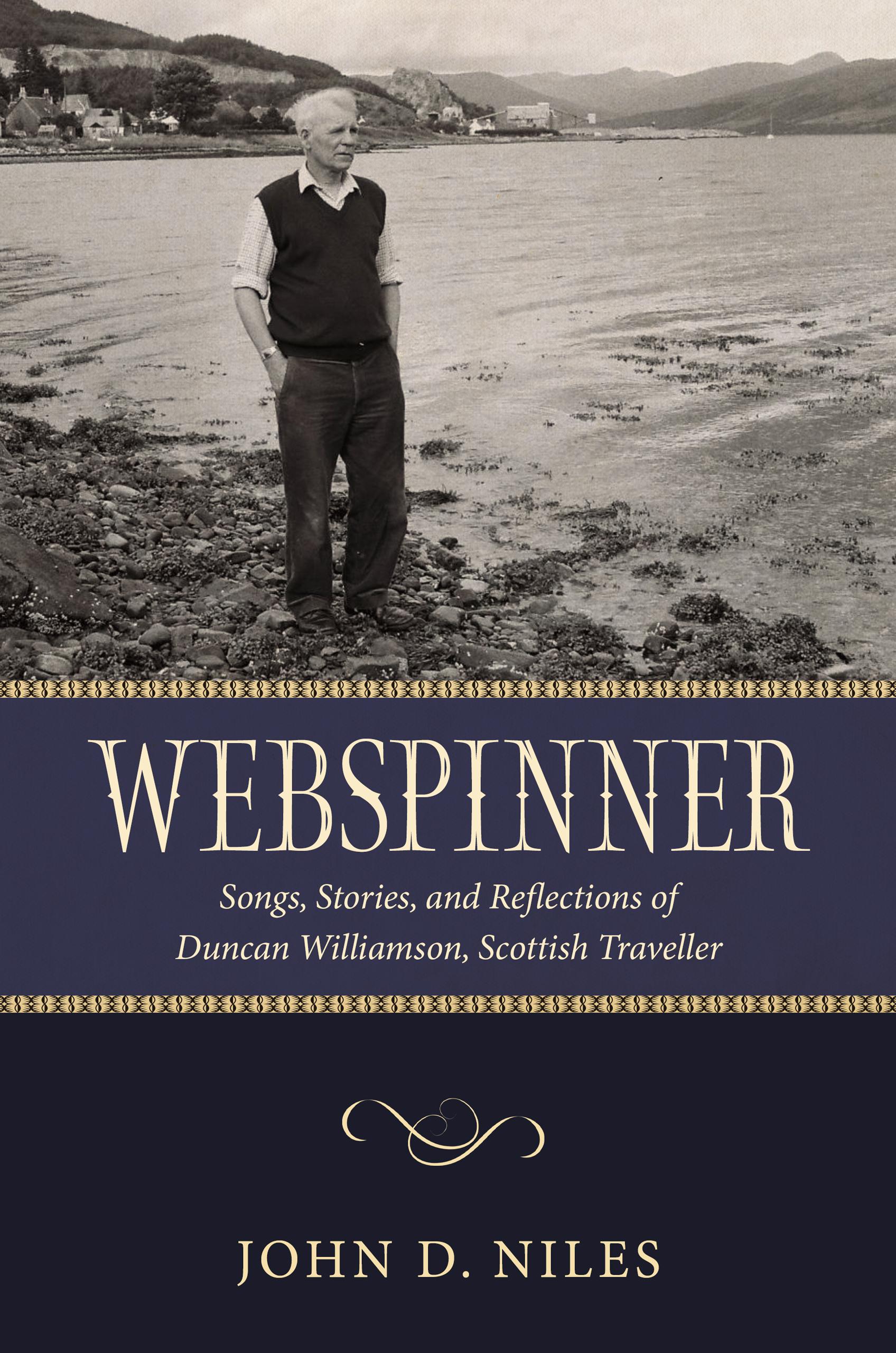
Born in 1928 in a tent on the shore of Loch Fyne, Argyll, Duncan Williamson (d. 2007) eventually came to be recognized as one of the foremost storytellers in Scotland and the world. Webspinner: Songs, Stories, and Reflections of Duncan Williamson, Scottish Traveller is based on more than a hundred hours of tape-recorded interviews undertaken with him in the 1980s. Williamson tells of his birth and upbringing in the west of Scotland, his family background as one of Scotland’s seminomadic travelling people, his varied work experiences after setting out from home at about age fifteen, and the challenges he later faced while raising a family of his own, living on the road for half the year.
The recordings on which the book is based were made by John D. Niles, who was then an associate professor at the University of California, Berkeley. Niles has transcribed selections from his field tapes with scrupulous accuracy, arranging them alongside commentary, photos, and other scholarly aids, making this priceless self-portrait of a brilliant storyteller available to the public. The result is a delight to read. It is also a mine of information concerning a vanished way of life and the place of singing and storytelling in Traveller culture. In chapters that feature many colorful anecdotes and that mirror the spontaneity of oral delivery, readers learn much about how Williamson and other members of his persecuted minority had the resourcefulness to make a living on the outskirts of society, owning very little in the way of material goods but sustained by a rich oral heritage.
The recordings on which the book is based were made by John D. Niles, who was then an associate professor at the University of California, Berkeley. Niles has transcribed selections from his field tapes with scrupulous accuracy, arranging them alongside commentary, photos, and other scholarly aids, making this priceless self-portrait of a brilliant storyteller available to the public. The result is a delight to read. It is also a mine of information concerning a vanished way of life and the place of singing and storytelling in Traveller culture. In chapters that feature many colorful anecdotes and that mirror the spontaneity of oral delivery, readers learn much about how Williamson and other members of his persecuted minority had the resourcefulness to make a living on the outskirts of society, owning very little in the way of material goods but sustained by a rich oral heritage.
Betal nemt med kort, Klarna, Apple Pay eller Google Pay. Ikke tilfreds? Du har altid 14 dages fortrydelsesret. Læs mere i vores vilkår. Har du spørgsmål, så send os en mail på hello@memmo.org.
Memmo gør det nemmere at studere – uanset hvor du er i verden. Hos os samler du dine kursusbøger og smarte studieværktøjer ét sted: resuméer, quizzer, podcasts og flashcards. Og så er der Ted, din studieven, der svarer på alt, du undrer dig over. Over 50 000 studerende studerer allerede her – bygget til at hjælpe dig med at lære hurtigere og stresse mindre.
Du kan måske også lide
Køb bogen0