
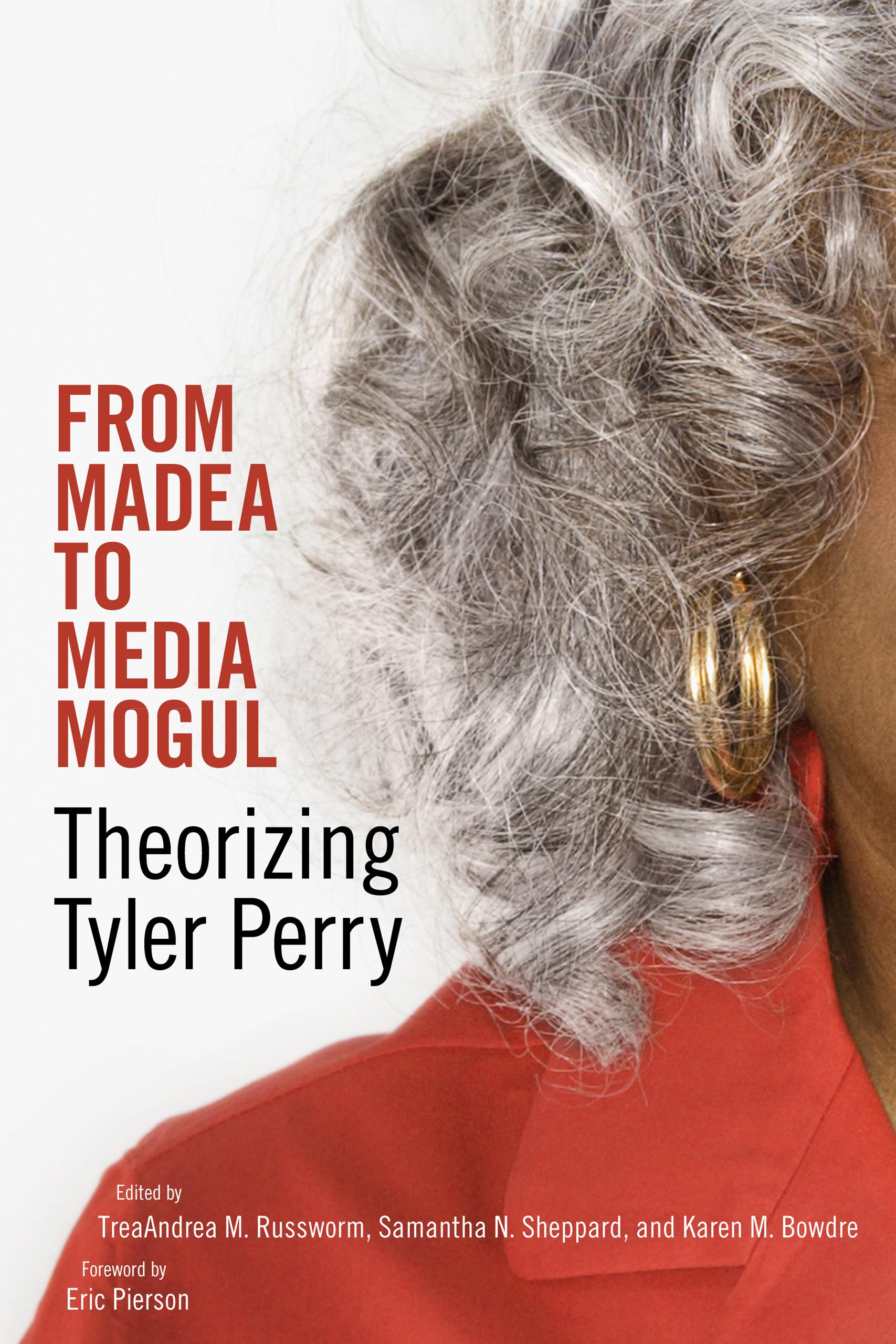
Contributions by Leah Aldridge, Karen M. Bowdre, Aymar Jean Christian, Keith Corson, Rachel Jessica Daniel, Artel Great, Brandeise Monk-Payton, Miriam J. Petty, Eric Pierson, Paul N. Reinsch, TreaAndrea M. Russworm, Rashida Z. Shaw, Samantha N. Sheppard, Ben Raphael Sher, and Khadijah Costley White
For over a decade, Tyler Perry has been a lightning rod for both criticism and praise. To some he is most widely known for his drag performances as Madea, a self-proclaimed "mad black woman," not afraid to brandish a gun or a scalding pot of grits. But to others who watch the film industry, he is the businessman who by age thirty-six had sold more than $100 million in tickets, $30 million in videos, $20 million in merchandise, and was producing 300 projects each year viewed by 35,000 every week.
Is the commercially successful African American actor, director, screenwriter, playwright, and producer "malt liquor for the masses," an "embarrassment to the race!," or is he a genius who has directed the most culturally significant American melodramas since Douglas Sirk? Are his films and television shows even melodramas, or are they conservative Christian diatribes, cheeky camp, or social satires? Do Perry's flattened narratives and character tropes irresponsibly collapse important social discourses into one-dimensional tales that affirm the notion of a "post-racial" society?
In light of these debates, From Madea to Media Mogul makes the argument that Tyler Perry must be understood as a figure at the nexus of converging factors, cultural events, and historical traditions. Contributors demonstrate how a critical engagement with Perry's work and media practices highlights a need for studies to grapple with developing theories and methods on disreputable media. These essays challenge value-judgment criticisms and offer new insights on the industrial and formal qualities of Perry's work.
For over a decade, Tyler Perry has been a lightning rod for both criticism and praise. To some he is most widely known for his drag performances as Madea, a self-proclaimed "mad black woman," not afraid to brandish a gun or a scalding pot of grits. But to others who watch the film industry, he is the businessman who by age thirty-six had sold more than $100 million in tickets, $30 million in videos, $20 million in merchandise, and was producing 300 projects each year viewed by 35,000 every week.
Is the commercially successful African American actor, director, screenwriter, playwright, and producer "malt liquor for the masses," an "embarrassment to the race!," or is he a genius who has directed the most culturally significant American melodramas since Douglas Sirk? Are his films and television shows even melodramas, or are they conservative Christian diatribes, cheeky camp, or social satires? Do Perry's flattened narratives and character tropes irresponsibly collapse important social discourses into one-dimensional tales that affirm the notion of a "post-racial" society?
In light of these debates, From Madea to Media Mogul makes the argument that Tyler Perry must be understood as a figure at the nexus of converging factors, cultural events, and historical traditions. Contributors demonstrate how a critical engagement with Perry's work and media practices highlights a need for studies to grapple with developing theories and methods on disreputable media. These essays challenge value-judgment criticisms and offer new insights on the industrial and formal qualities of Perry's work.
Betal nemt med kort, Klarna, Apple Pay eller Google Pay. Ikke tilfreds? Du har altid 14 dages fortrydelsesret. Læs mere i vores vilkår. Har du spørgsmål, så send os en mail på hello@memmo.org.
Memmo gør det nemmere at studere – uanset hvor du er i verden. Hos os samler du dine kursusbøger og smarte studieværktøjer ét sted: resuméer, quizzer, podcasts og flashcards. Og så er der Ted, din studieven, der svarer på alt, du undrer dig over. Over 50 000 studerende studerer allerede her – bygget til at hjælpe dig med at lære hurtigere og stresse mindre.
Du kan måske også lide
Køb bogen0