
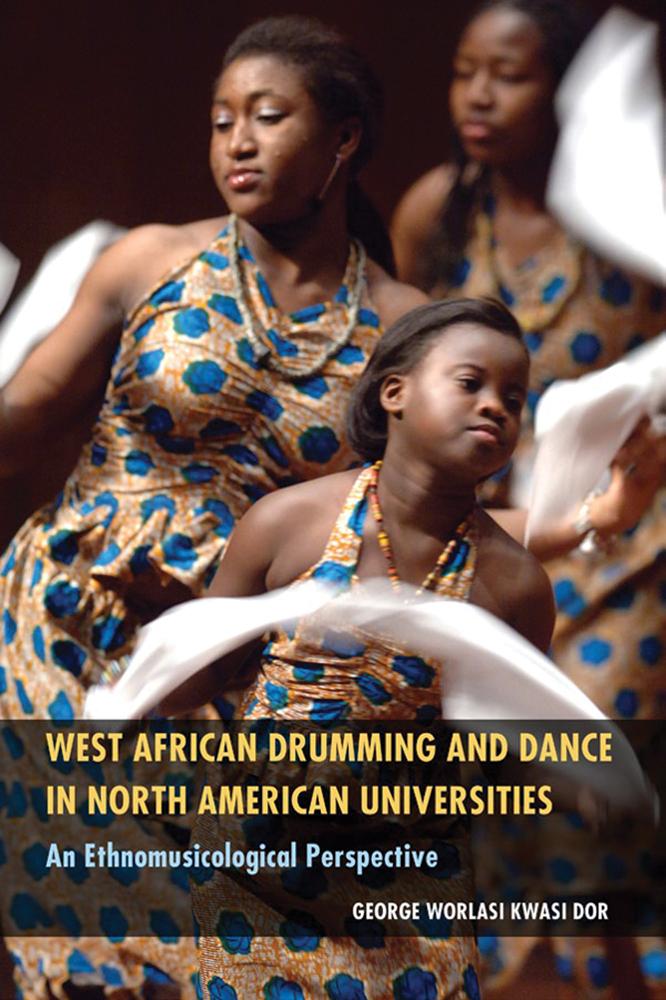
More than twenty universities and twenty other colleges in North America (USA and Canada) offer performance courses on West African ethnic dance drumming. Since its inception in 1964 at both UCLA and Columbia, West African drumming and dance has gradually developed into a vibrant campus subculture in North America. The dances most practiced in the American academy come from the ethnic groups Ewe, Akan, Ga, Dagbamba, Mande, and Wolof, thereby privileging dances mostly from Ghana, Togo, Benin, Senegal, Mali, Guinea, and Burkina Faso. This strong presence and practice of a world music ensemble in the diaspora has captured and engaged the interest of scholars, musicians, dancers, and audiences.
In the first-ever ethnographic study of West African drumming and dance in North American universities, the author documents and acknowledges ethnomusicologists, ensemble directors, students, administrators, and academic institutions for their key roles in the histories of their respective ensembles. Dor collates and shares perspectives including debates on pedagogical approaches that may be instructive as models for both current and future ensemble directors and reveals the multiple impacts that participation in an ensemble or class offers students. He also examines the interplay among historically situated structures and systems, discourse, and practice, and explores the multiple meanings that individuals and various groups of people construct from this campus activity. The study will be of value to students, directors, and scholars as an ethnographic study and as a text for teaching relevant courses in African music, African studies, ethnomusicology/world music, African diaspora studies, and other related disciplines.
In the first-ever ethnographic study of West African drumming and dance in North American universities, the author documents and acknowledges ethnomusicologists, ensemble directors, students, administrators, and academic institutions for their key roles in the histories of their respective ensembles. Dor collates and shares perspectives including debates on pedagogical approaches that may be instructive as models for both current and future ensemble directors and reveals the multiple impacts that participation in an ensemble or class offers students. He also examines the interplay among historically situated structures and systems, discourse, and practice, and explores the multiple meanings that individuals and various groups of people construct from this campus activity. The study will be of value to students, directors, and scholars as an ethnographic study and as a text for teaching relevant courses in African music, African studies, ethnomusicology/world music, African diaspora studies, and other related disciplines.
Betal nemt med kort, Klarna, Apple Pay eller Google Pay. Ikke tilfreds? Du har altid 14 dages fortrydelsesret. Læs mere i vores vilkår. Har du spørgsmål, så send os en mail på hello@memmo.org.
Memmo gør det nemmere at studere – uanset hvor du er i verden. Hos os samler du dine kursusbøger og smarte studieværktøjer ét sted: resuméer, quizzer, podcasts og flashcards. Og så er der Ted, din studieven, der svarer på alt, du undrer dig over. Over 50 000 studerende studerer allerede her – bygget til at hjælpe dig med at lære hurtigere og stresse mindre.
Du kan måske også lide
Køb bogen0