
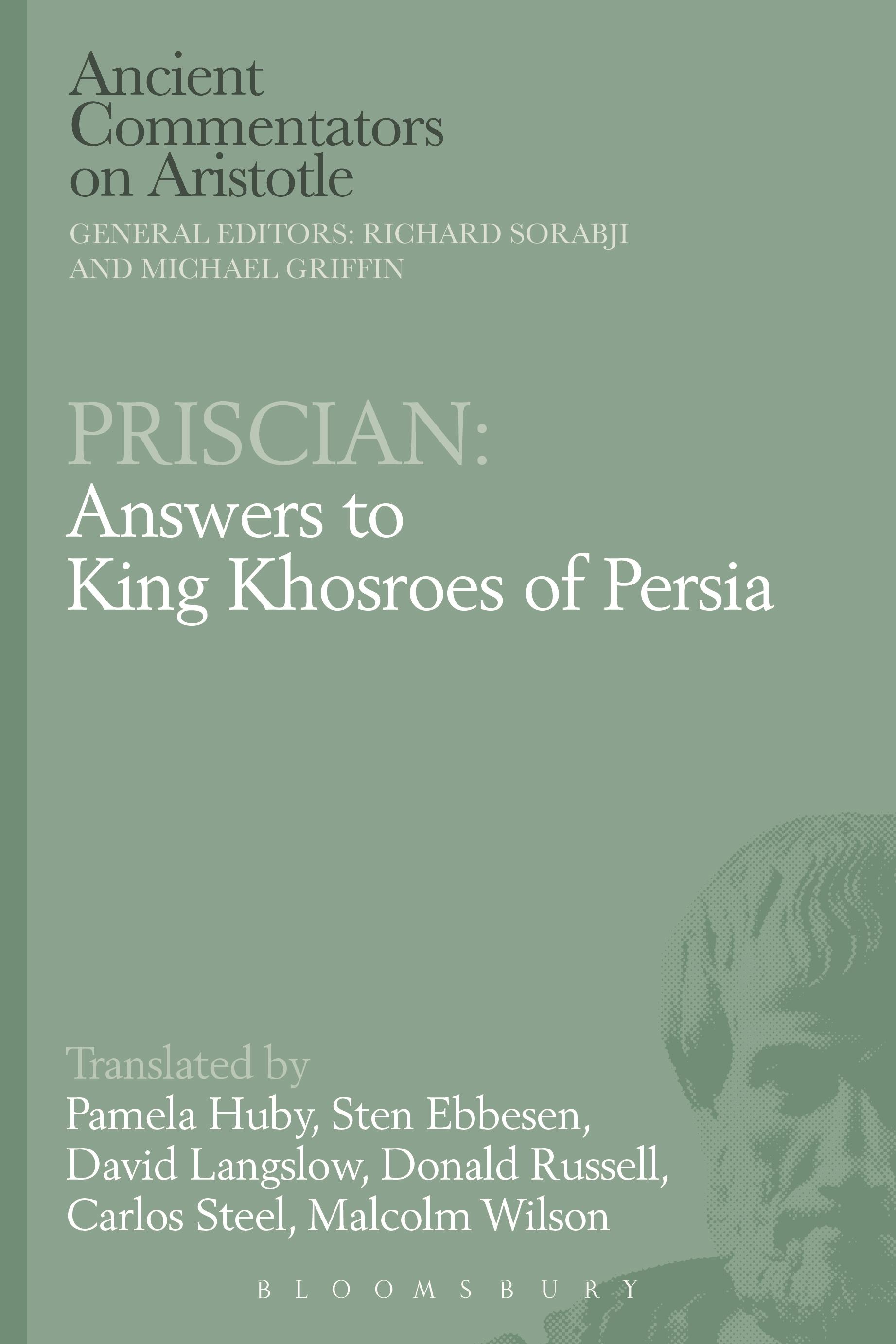
Priscian of Lydia was one of the Athenian philosophers who took refuge in 531 AD with King Khosroes I of Persia, after the Christian Emperor Justinian stopped the teaching of the pagan Neoplatonist school in Athens. This was one of the earliest examples of the sixth-century diffusion of the philosophy of the commentators to other cultures.
Tantalisingly, Priscian fully recorded in Greek the answers provided by the Athenian philosophers to the king's questions on philosophy and science. But these answers survive only in a later Latin translation which understood both the Greek and the subject matter very poorly. Our translators have often had to reconstruct from the Latin what the Greek would have been, in order to recover the original sense.
The answers start with subjects close to the Athenians' hearts: the human soul, on which Priscian was an expert, and sleep and visions. But their interest may have diminished when the king sought their expertise on matters of physical science: the seasons, celestial zones, medical effects of heat and cold, the tides, displacement of the four elements, the effect of regions on living things, why only reptiles are poisonous, and winds. At any rate, in 532 AD, they moved on from the palace, but still under Khosroes' protection. This is the first translation of the record they left into English or any modern language.
This English translation is accompanied by an introduction and comprehensive commentary notes, which clarify and discuss the meaning and implications of the original philosophy. Part of the Ancient Commentators on Aristotle series, the edition makes this philosophical work accessible to a modern readership and includes additional scholarly apparatus such as a bibliography, glossary of translated terms and a subject index.
Tantalisingly, Priscian fully recorded in Greek the answers provided by the Athenian philosophers to the king's questions on philosophy and science. But these answers survive only in a later Latin translation which understood both the Greek and the subject matter very poorly. Our translators have often had to reconstruct from the Latin what the Greek would have been, in order to recover the original sense.
The answers start with subjects close to the Athenians' hearts: the human soul, on which Priscian was an expert, and sleep and visions. But their interest may have diminished when the king sought their expertise on matters of physical science: the seasons, celestial zones, medical effects of heat and cold, the tides, displacement of the four elements, the effect of regions on living things, why only reptiles are poisonous, and winds. At any rate, in 532 AD, they moved on from the palace, but still under Khosroes' protection. This is the first translation of the record they left into English or any modern language.
This English translation is accompanied by an introduction and comprehensive commentary notes, which clarify and discuss the meaning and implications of the original philosophy. Part of the Ancient Commentators on Aristotle series, the edition makes this philosophical work accessible to a modern readership and includes additional scholarly apparatus such as a bibliography, glossary of translated terms and a subject index.
Betal nemt med kort, Klarna, Apple Pay eller Google Pay. Ikke tilfreds? Du har altid 14 dages fortrydelsesret. Læs mere i vores vilkår. Har du spørgsmål, så send os en mail på hello@memmo.org.
Memmo gør det nemmere at studere – uanset hvor du er i verden. Hos os samler du dine kursusbøger og smarte studieværktøjer ét sted: resuméer, quizzer, podcasts og flashcards. Og så er der Ted, din studieven, der svarer på alt, du undrer dig over. Over 50 000 studerende studerer allerede her – bygget til at hjælpe dig med at lære hurtigere og stresse mindre.