
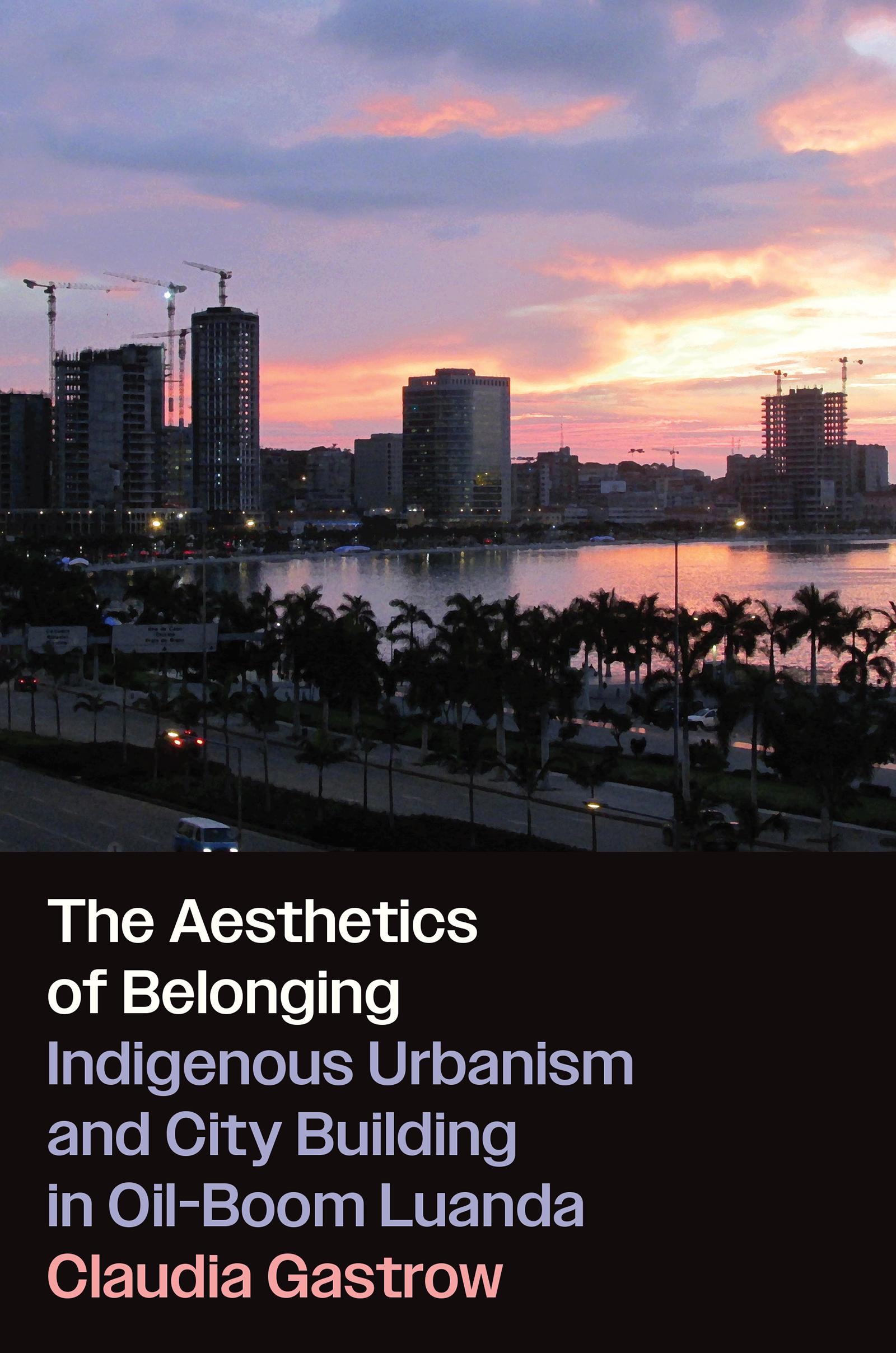
After centuries of colonial rule, the end of Angola’s three-decade civil war in 2002 provided an irresistible opportunity for the government to reimagine the Luanda cityscape. Awash with petrodollars cultivated through strategic foreign relationships, President José Eduardo dos Santos rolled out a national reconstruction program that sought to transform Angola’s capital into what he considered to be a modern, world-class metropolis. Until funds dried up in 2014, the program—in conjunction with sweeping private investments in real estate—involved mass demolitions of vernacular architecture to make way for high-rise buildings, large-scale housing projects, and commercial centers. The program thus underestimated the values enshrined in the materials and designs of Luanda’s existing “informally” constructed neighborhoods, or musseques.
The Aesthetics of Belonging explores the political significance of aesthetics in the remaking of the city. Claudia Gastrow’s archival and ethnographic work, which includes interviews with city planners, architects, nonprofit leaders, and urban dwellers, shows how government infrastructure projects and foreign-inspired designs came to embody displacement and exclusion for many. This, Gastrow argues, catalyzed a countermovement, an aesthetic dissent rooted in critically reframing informal urbanism as Indigenous—a move that enabled the possibility of recognizing the political potential of informal settlements as spaces that produce belonging.
The Aesthetics of Belonging explores the political significance of aesthetics in the remaking of the city. Claudia Gastrow’s archival and ethnographic work, which includes interviews with city planners, architects, nonprofit leaders, and urban dwellers, shows how government infrastructure projects and foreign-inspired designs came to embody displacement and exclusion for many. This, Gastrow argues, catalyzed a countermovement, an aesthetic dissent rooted in critically reframing informal urbanism as Indigenous—a move that enabled the possibility of recognizing the political potential of informal settlements as spaces that produce belonging.
Betal nemt med kort, Klarna, Apple Pay eller Google Pay. Ikke tilfreds? Du har altid 14 dages fortrydelsesret. Læs mere i vores vilkår. Har du spørgsmål, så send os en mail på hello@memmo.org.
Memmo gør det nemmere at studere – uanset hvor du er i verden. Hos os samler du dine kursusbøger og smarte studieværktøjer ét sted: resuméer, quizzer, podcasts og flashcards. Og så er der Ted, din studieven, der svarer på alt, du undrer dig over. Over 50 000 studerende studerer allerede her – bygget til at hjælpe dig med at lære hurtigere og stresse mindre.
Du kan måske også lide
Køb bogen0