
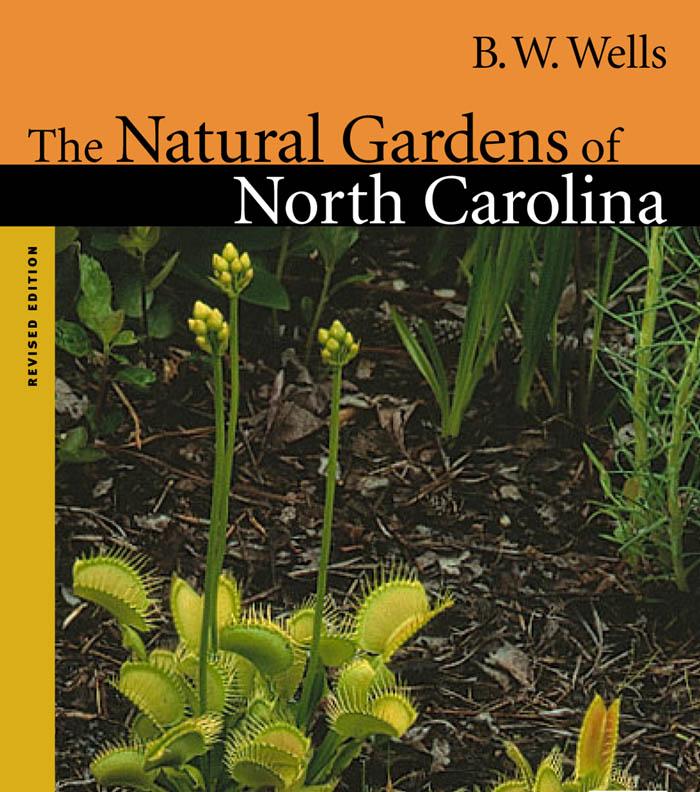
For seventy years, The Natural Gardens of North Carolina has been a must-read volume for anyone interested in wildflowers, native plants, ecology, or conservation in the state. This handsome revised edition features new line drawings and color photographs, an appendix that updates the botanical nomenclature, an introduction that focuses on B. W. Wells and his passion for the state’s landscape, and an afterword that discusses the continuing relevance of Wells’s ideas.
One of the first scientists to write and lecture about ecology, Wells introduced North Carolinians to the extraordinary tapestry of “natural gardens,” or plant communities, within the state’s borders back in 1932. His purpose was to help readers understand a plant within its community — a pioneering concept at the time — and to promote conservation. Moving from the Atlantic coast westward, Wells identifies eleven major natural gardens: the sand dune community, salt marsh, freshwater marsh, swamp forest, aquatic vegetation, evergreen shrub bog (or pocosin), grass-sedge bog (or savanna), sandhill, old-field community, upland forest, and high mountain spruce-fir forest. He devotes the first part of his book to a general account of the vegetation and habitats of each community and then identifies and describes the wildflowers found there.
One of the first scientists to write and lecture about ecology, Wells introduced North Carolinians to the extraordinary tapestry of “natural gardens,” or plant communities, within the state’s borders back in 1932. His purpose was to help readers understand a plant within its community — a pioneering concept at the time — and to promote conservation. Moving from the Atlantic coast westward, Wells identifies eleven major natural gardens: the sand dune community, salt marsh, freshwater marsh, swamp forest, aquatic vegetation, evergreen shrub bog (or pocosin), grass-sedge bog (or savanna), sandhill, old-field community, upland forest, and high mountain spruce-fir forest. He devotes the first part of his book to a general account of the vegetation and habitats of each community and then identifies and describes the wildflowers found there.
Betal nemt med kort, Klarna, Apple Pay eller Google Pay. Ikke tilfreds? Du har altid 14 dages fortrydelsesret. Læs mere i vores vilkår. Har du spørgsmål, så send os en mail på hello@memmo.org.
Memmo gør det nemmere at studere – uanset hvor du er i verden. Hos os samler du dine kursusbøger og smarte studieværktøjer ét sted: resuméer, quizzer, podcasts og flashcards. Og så er der Ted, din studieven, der svarer på alt, du undrer dig over. Over 50 000 studerende studerer allerede her – bygget til at hjælpe dig med at lære hurtigere og stresse mindre.
Du kan måske også lide
Køb bogen0