
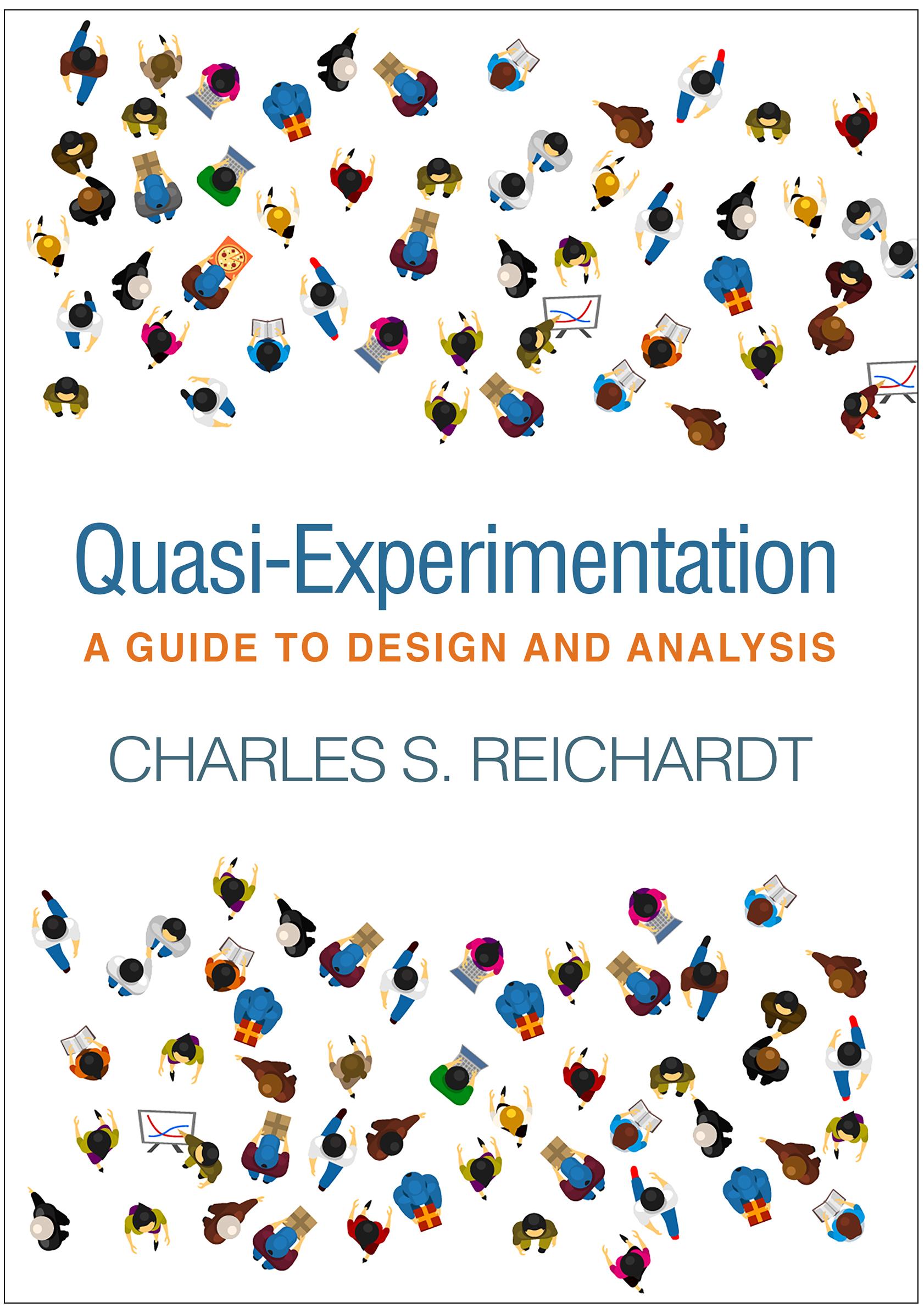
Featuring engaging examples from diverse disciplines, this book explains how to use modern approaches to quasi-experimentation to derive credible estimates of treatment effects under the demanding constraints of field settings. Foremost expert Charles S. Reichardt provides an in-depth examination of the design and statistical analysis of pretest–posttest, nonequivalent groups, regression discontinuity, and interrupted time-series designs. He details their relative strengths and weaknesses and offers practical advice about their use. Comparing quasi-experiments to randomized experiments, Reichardt discusses when and why the former might be a better choice than the latter in the face of the contingencies that are likely to arise in practice. Modern methods for elaborating a research design to remove bias from estimates of treatment effects are described, as are tactics for dealing with missing data and noncompliance with treatment assignment. Throughout, mathematical equations are translated into words to enhance accessibility. Adding to its discussion of prototypical quasi-experiments, the book also provides a complete typology of quasi-experimental design options to help the reader craft the best research design to fit the circumstances of a given study.
Betal nemt med kort, Klarna, Apple Pay eller Google Pay. Ikke tilfreds? Du har altid 14 dages fortrydelsesret. Læs mere i vores vilkår. Har du spørgsmål, så send os en mail på hello@memmo.org.
Memmo gør det nemmere at studere – uanset hvor du er i verden. Hos os samler du dine kursusbøger og smarte studieværktøjer ét sted: resuméer, quizzer, podcasts og flashcards. Og så er der Ted, din studieven, der svarer på alt, du undrer dig over. Over 50 000 studerende studerer allerede her – bygget til at hjælpe dig med at lære hurtigere og stresse mindre.
Du kan måske også lide
Køb bogen0