
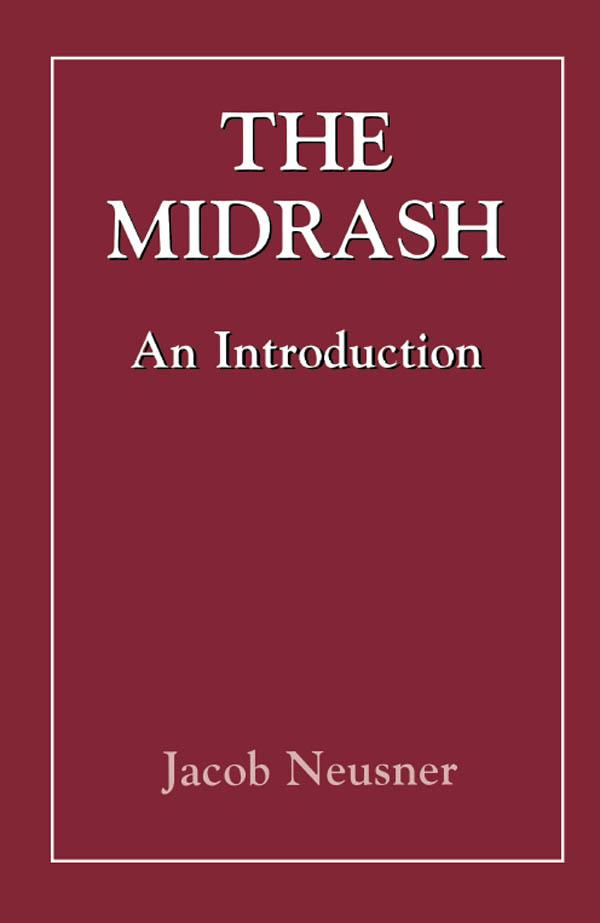
The Midrash: An Introduction sets forth the way in which Judaism reads the Hebrew Bible. In this masterful presentation, the reader is introduced to the classics of Jewish Bible interpretation, with special attention to the way in which the ribbis of Talmudic times read the Pentateuch, the Book of Ruth, and Song of Songs. The seven Midrash compilations are introduced with a lucid account of their main points, accompanied by selections that give the reader a direct encounter, in English, with the Bible as Judaism understands it.
The word midrash, based on the Hebrew root DaRaSH (“search”), means “interpretation” or “exegesis.” Midrash also more formally refers to the compilations of such interpretations of Scripture. As Dr. Jacob Neusner explains, these compilations “reached closure and conclusion in the formative stage of Judaism, that is, the first seven centuries of the Common Era, the time in which the Mishnah (ca. 200), Talmud of the Land of Israel (ca. 400), and Talmud of Babylonia (ca. 600) were written.”
Midrash is not so much about Scripture as it is a subordinate part of Scripture: “They did not write about Scripture,” Dr. Neusner says. “They wrote with Scripture … much as painters paint with a palette of colors.”
The Midrash: An Introduction is the second volume in Dr. Jacob Neusner’s series of introductory volumes on classical rabbinic literature. As with the first volume – The Mishnah: An Introduction – this book offers the layperson a concise description of the religious literature and, drawing on Dr. Neusner’s own translations of the texts, walks readers through the selections, providing them with firsthand experience with the document itself.
As Dr. Neusner says in his preface to The Midrash: An Introduction, “In these pages I mean to make it possible for readers to know one such compilation from the other and so to begin studying their own.”
The word midrash, based on the Hebrew root DaRaSH (“search”), means “interpretation” or “exegesis.” Midrash also more formally refers to the compilations of such interpretations of Scripture. As Dr. Jacob Neusner explains, these compilations “reached closure and conclusion in the formative stage of Judaism, that is, the first seven centuries of the Common Era, the time in which the Mishnah (ca. 200), Talmud of the Land of Israel (ca. 400), and Talmud of Babylonia (ca. 600) were written.”
Midrash is not so much about Scripture as it is a subordinate part of Scripture: “They did not write about Scripture,” Dr. Neusner says. “They wrote with Scripture … much as painters paint with a palette of colors.”
The Midrash: An Introduction is the second volume in Dr. Jacob Neusner’s series of introductory volumes on classical rabbinic literature. As with the first volume – The Mishnah: An Introduction – this book offers the layperson a concise description of the religious literature and, drawing on Dr. Neusner’s own translations of the texts, walks readers through the selections, providing them with firsthand experience with the document itself.
As Dr. Neusner says in his preface to The Midrash: An Introduction, “In these pages I mean to make it possible for readers to know one such compilation from the other and so to begin studying their own.”
Sider: 246
Kategori: Religion & Teologi
e-ISBN: 9781461631583
Forsendelsesvægt: 1.2 kg
Sendes inden for: 1-2 dage
Betal nemt med kort, Klarna, Apple Pay eller Google Pay. Ikke tilfreds? Du har altid 14 dages fortrydelsesret. Læs mere i vores vilkår. Har du spørgsmål, så send os en mail på hello@memmo.org.
Memmo gør det nemmere at studere – uanset hvor du er i verden. Hos os samler du dine kursusbøger og smarte studieværktøjer ét sted: resuméer, quizzer, podcasts og flashcards. Og så er der Ted, din studieven, der svarer på alt, du undrer dig over. Over 50 000 studerende studerer allerede her – bygget til at hjælpe dig med at lære hurtigere og stresse mindre.