
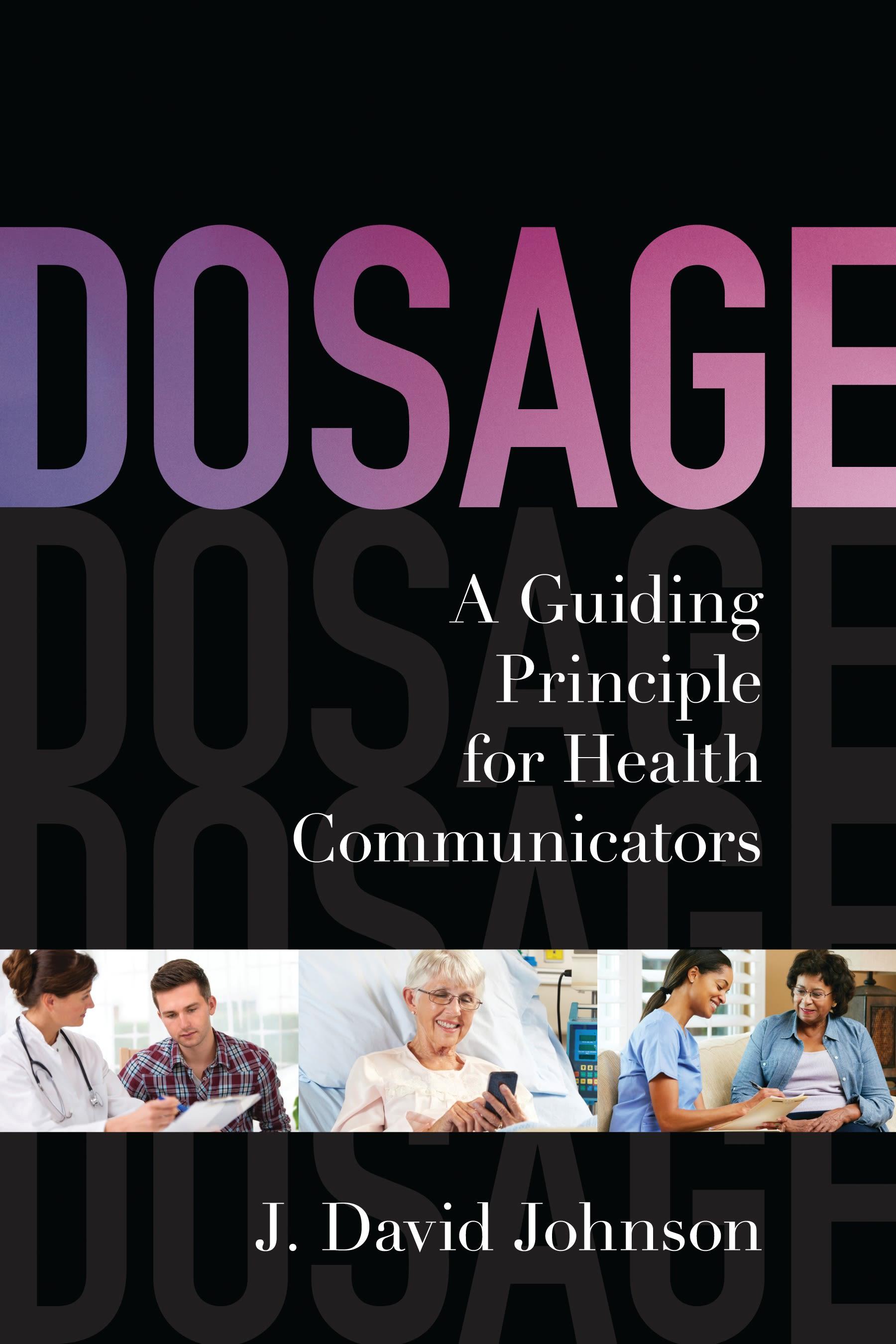
Dosage: A Guiding Principle for Health Communicators uses “dosage” as a metaphor to help all healthcare professionals apply basic communication principles to their work.
After a general overview of communication and its paramount importance in the health care setting, J. David Johnson, a professor of communications and former media research analyst for the U.S. Information Agency and author of five previous books, outlines the best practices for
Interpersonal communication in health care relationships, including that between physician and patient. He answers questions such as “How Much Do I Reveal and When?”;Interprofessional teams, including teamwork, interdependence, stress and burnout, and communication in decision-making;Mass Media, including searching for information and gaps in knowledge;Knowledge diffusion and dissemination;Change in communication, including social media;Health information technology and how to handle the flood of communications we receive today.
Johnson effectively expands his metaphor of dosage, detailing its many elements (amount, frequency, delivery system, sequencing, interaction with what other agents, and contraindications) as well as discussing the use and limits of metaphor generally. He explicitly addresses the following contexts: interpersonal communication, with a focusing on health professional-client interactions; inter-professional teams; mass media that are increasingly important for broader approaches to public health; how change is adopted and implemented within health care organizations and individuals; and the new technologies for health communication.
The book’s final chapter turns to broader policy issues raised by application of the metaphor of dosage as well as detailing its implications for methods of communication research. It concludes with a discussion of how dosage can serve as a bridging metaphor to close the gap between researchers and practitioners which is fundamental to clinical and translational science.
After a general overview of communication and its paramount importance in the health care setting, J. David Johnson, a professor of communications and former media research analyst for the U.S. Information Agency and author of five previous books, outlines the best practices for
Interpersonal communication in health care relationships, including that between physician and patient. He answers questions such as “How Much Do I Reveal and When?”;Interprofessional teams, including teamwork, interdependence, stress and burnout, and communication in decision-making;Mass Media, including searching for information and gaps in knowledge;Knowledge diffusion and dissemination;Change in communication, including social media;Health information technology and how to handle the flood of communications we receive today.
Johnson effectively expands his metaphor of dosage, detailing its many elements (amount, frequency, delivery system, sequencing, interaction with what other agents, and contraindications) as well as discussing the use and limits of metaphor generally. He explicitly addresses the following contexts: interpersonal communication, with a focusing on health professional-client interactions; inter-professional teams; mass media that are increasingly important for broader approaches to public health; how change is adopted and implemented within health care organizations and individuals; and the new technologies for health communication.
The book’s final chapter turns to broader policy issues raised by application of the metaphor of dosage as well as detailing its implications for methods of communication research. It concludes with a discussion of how dosage can serve as a bridging metaphor to close the gap between researchers and practitioners which is fundamental to clinical and translational science.
Betal nemt med kort, Klarna, Apple Pay eller Google Pay. Ikke tilfreds? Du har altid 14 dages fortrydelsesret. Læs mere i vores vilkår. Har du spørgsmål, så send os en mail på hello@memmo.org.
Memmo gør det nemmere at studere – uanset hvor du er i verden. Hos os samler du dine kursusbøger og smarte studieværktøjer ét sted: resuméer, quizzer, podcasts og flashcards. Og så er der Ted, din studieven, der svarer på alt, du undrer dig over. Over 50 000 studerende studerer allerede her – bygget til at hjælpe dig med at lære hurtigere og stresse mindre.