
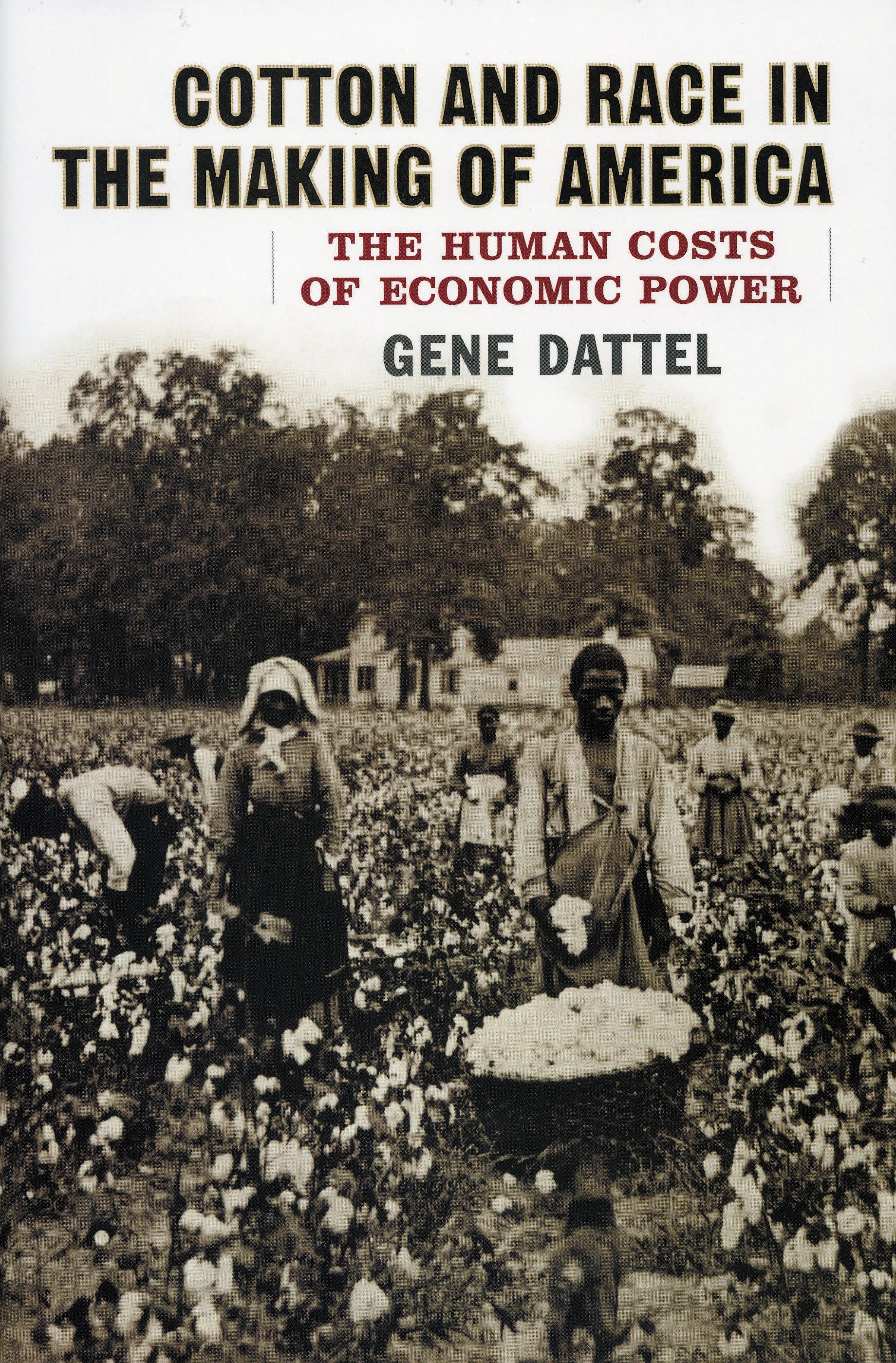
Since the earliest days of colonial America, the relationship between cotton and the African-American experience has been central to the history of the republic. America's most serious social tragedy, slavery and its legacy, spread only where cotton could be grown. Both before and after the Civil War, blacks were assigned to the cotton fields while a pervasive racial animosity and fear of a black migratory invasion caused white Northerners to contain blacks in the South.
Gene Dattel's pioneering study explores the historical roots of these most central social issues. In telling detail Mr. Dattel shows why the vastly underappreciated story of cotton is a key to understanding America's rise to economic power. When cotton production exploded to satiate the nineteenth-century textile industry's enormous appetite, it became the first truly complex global business and thereby a major driving force in U.S. territorial expansion and sectional economic integration. It propelled New York City to commercial preeminence and fostered independent trade between Europe and the United States, providing export capital for the new nation to gain its financial "sea legs" in the world economy. Without slave-produced cotton, the South could never have initiated the Civil War, America's bloodiest conflict at home.
Mr. Dattel's skillful historical analysis identifies the commercial forces that cotton unleashed and the pervasive nature of racial antipathy it produced. This is a story that has never been told in quite the same way before, related here with the authority of a historian with a profound knowledge of the history of international finance. With 23 black-and-white illustrations.
Gene Dattel's pioneering study explores the historical roots of these most central social issues. In telling detail Mr. Dattel shows why the vastly underappreciated story of cotton is a key to understanding America's rise to economic power. When cotton production exploded to satiate the nineteenth-century textile industry's enormous appetite, it became the first truly complex global business and thereby a major driving force in U.S. territorial expansion and sectional economic integration. It propelled New York City to commercial preeminence and fostered independent trade between Europe and the United States, providing export capital for the new nation to gain its financial "sea legs" in the world economy. Without slave-produced cotton, the South could never have initiated the Civil War, America's bloodiest conflict at home.
Mr. Dattel's skillful historical analysis identifies the commercial forces that cotton unleashed and the pervasive nature of racial antipathy it produced. This is a story that has never been told in quite the same way before, related here with the authority of a historian with a profound knowledge of the history of international finance. With 23 black-and-white illustrations.
Betal nemt med kort, Klarna, Apple Pay eller Google Pay. Ikke tilfreds? Du har altid 14 dages fortrydelsesret. Læs mere i vores vilkår. Har du spørgsmål, så send os en mail på hello@memmo.org.
Memmo gør det nemmere at studere – uanset hvor du er i verden. Hos os samler du dine kursusbøger og smarte studieværktøjer ét sted: resuméer, quizzer, podcasts og flashcards. Og så er der Ted, din studieven, der svarer på alt, du undrer dig over. Over 50 000 studerende studerer allerede her – bygget til at hjælpe dig med at lære hurtigere og stresse mindre.