
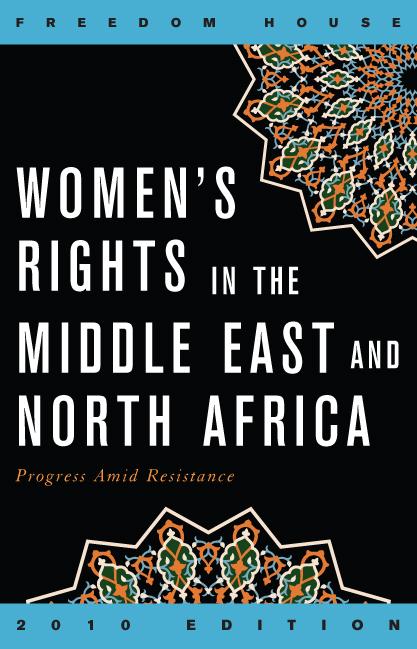
Freedom House's innovative publication Women's Rights in the Middle East and North Africa: Progress Amid Resistance analyzes the status of women in the region, with a special focus on the gains and setbacks for women's rights since the first edition was released in 2005. The study presents a comparative evaluation of conditions for women in 17 countries and one territory: Algeria, Bahrain, Egypt, Iran, Iraq, Jordan, Kuwait, Lebanon, Libya, Morocco, Oman, Palestine (Palestinian Authority and Israeli-Occupied Territories), Qatar, Saudi Arabia, Syria, Tunisia, United Arab Emirates, and Yemen. The publication identifies the causes and consequences of gender inequality in the Middle East, and provides concrete recommendations for national and international policymakers and implementers.
Freedom House is an independent nongovernmental organization that supports democratic change, monitors freedom, and advocates for democracy and human rights.
The project has been embraced as a resource not only by international players like the United Nations and the World Bank, but also by regional women's rights organizations, individual activists, scholars, and governments worldwide. Women's rights in each country are assessed in five key areas: (1) Nondiscrimination and Access to Justice; (2) Autonomy, Security, and Freedom of the Person; (3) Economic Rights and Equal Opportunity; (4) Political Rights and Civic Voice; and (5) Social and Cultural Rights. The methodology is based on the Universal Declaration of Human Rights, and the study results are presented through a set of numerical scores and analytical narrative reports.
Freedom House is an independent nongovernmental organization that supports democratic change, monitors freedom, and advocates for democracy and human rights.
The project has been embraced as a resource not only by international players like the United Nations and the World Bank, but also by regional women's rights organizations, individual activists, scholars, and governments worldwide. Women's rights in each country are assessed in five key areas: (1) Nondiscrimination and Access to Justice; (2) Autonomy, Security, and Freedom of the Person; (3) Economic Rights and Equal Opportunity; (4) Political Rights and Civic Voice; and (5) Social and Cultural Rights. The methodology is based on the Universal Declaration of Human Rights, and the study results are presented through a set of numerical scores and analytical narrative reports.
Betal nemt med kort, Klarna, Apple Pay eller Google Pay. Ikke tilfreds? Du har altid 14 dages fortrydelsesret. Læs mere i vores vilkår. Har du spørgsmål, så send os en mail på hello@memmo.org.
Memmo gør det nemmere at studere – uanset hvor du er i verden. Hos os samler du dine kursusbøger og smarte studieværktøjer ét sted: resuméer, quizzer, podcasts og flashcards. Og så er der Ted, din studieven, der svarer på alt, du undrer dig over. Over 50 000 studerende studerer allerede her – bygget til at hjælpe dig med at lære hurtigere og stresse mindre.