
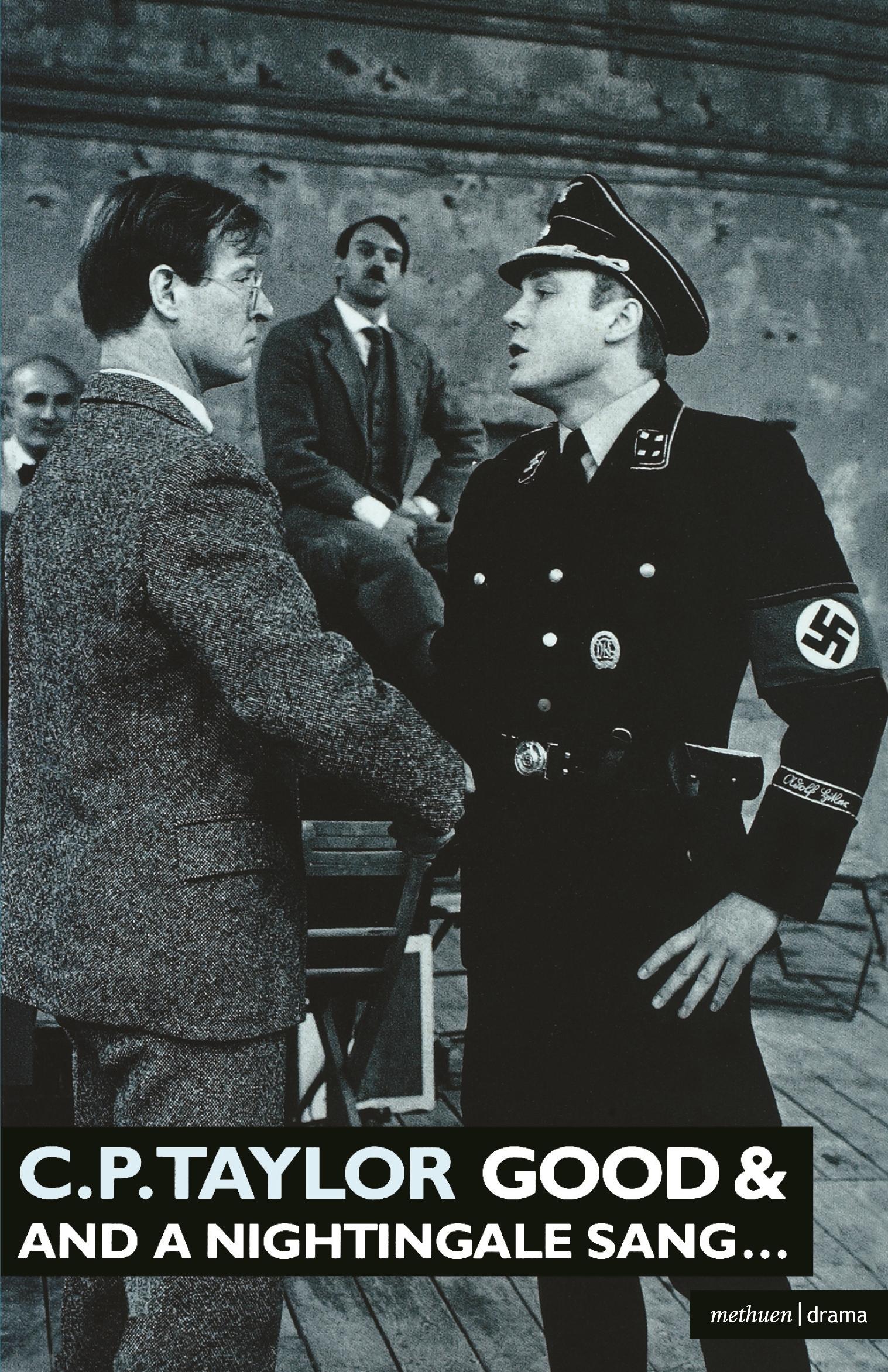
Good is a story about a liberal-minded university professor who drifts well-meaningly into a position in the upper reaches of the Nazi administration. It is a profound and alarming examination of passivity and the rationalisation of evil.
John Halder, a professor of literature, seems to be a good man; he diligently visits his blind and senile mother and looks after his vacant wife and three children. He is unremarkable, other than an unusual neurotic tic: the imaginary sound of band music plays in the background of his life, particularly at moments of high emotion. But by writing a book – the result of his own experience – discussing euthanasia for senile elderly people and by lecturing on the delicacy of German literary culture, John has unintentionally made himself a very desirable acquisition for the Nazi party.
By rationalised and intellectually reasoned steps he is absorbed into the direction of the death camps, a transformation all the more chilling because it does not seem dramatic, until the last horrible resounding note of the play.
Good is a structured stream of consciousness, punctured by the musical medley that plays inside Halder's head. The first production was staged at the London Warehouse in 1982.
And A Nightingale Sang . . . opens on a house in Newcastle-Upon-Tyne filled with well-meant and bustling domestic chaos. Set just before the beginning of the war, the scenes are partly related by Helen, who is stoical and self-deprecating and walks with a limp. Her grandfather Andie is recruiting mourners to attend the burial of his dog; her devout Catholic mother is fretting about the health of the local priest; her father is serenading an unwilling audience with the popular songs that light up the whole play. Joyce, Helen's younger, prettier sister is dithering over whether to accept a marriage proposal from Eric, who is being deployed to France. Helen, depended on for guidance by the whole family, has never had any attention from men – until she meets Norman, who shows her that she can waltz and fall in love. But for all the family, nothing can be the same after the war.
And A Nightingale Sang . . . was first staged in 1977 by Live Theatre in Newcastle-Upon-Tyne, and was presented in this version at the Queen's Theatre, London, in 1979.
John Halder, a professor of literature, seems to be a good man; he diligently visits his blind and senile mother and looks after his vacant wife and three children. He is unremarkable, other than an unusual neurotic tic: the imaginary sound of band music plays in the background of his life, particularly at moments of high emotion. But by writing a book – the result of his own experience – discussing euthanasia for senile elderly people and by lecturing on the delicacy of German literary culture, John has unintentionally made himself a very desirable acquisition for the Nazi party.
By rationalised and intellectually reasoned steps he is absorbed into the direction of the death camps, a transformation all the more chilling because it does not seem dramatic, until the last horrible resounding note of the play.
Good is a structured stream of consciousness, punctured by the musical medley that plays inside Halder's head. The first production was staged at the London Warehouse in 1982.
And A Nightingale Sang . . . opens on a house in Newcastle-Upon-Tyne filled with well-meant and bustling domestic chaos. Set just before the beginning of the war, the scenes are partly related by Helen, who is stoical and self-deprecating and walks with a limp. Her grandfather Andie is recruiting mourners to attend the burial of his dog; her devout Catholic mother is fretting about the health of the local priest; her father is serenading an unwilling audience with the popular songs that light up the whole play. Joyce, Helen's younger, prettier sister is dithering over whether to accept a marriage proposal from Eric, who is being deployed to France. Helen, depended on for guidance by the whole family, has never had any attention from men – until she meets Norman, who shows her that she can waltz and fall in love. But for all the family, nothing can be the same after the war.
And A Nightingale Sang . . . was first staged in 1977 by Live Theatre in Newcastle-Upon-Tyne, and was presented in this version at the Queen's Theatre, London, in 1979.
Sider: 160
Kategori: Drama, Teater & Scenkonst
e-ISBN: 9781408162040
Forsendelsesvægt: 1.2 kg
Sendes inden for: 1-2 dage
Betal nemt med kort, Klarna, Apple Pay eller Google Pay. Ikke tilfreds? Du har altid 14 dages fortrydelsesret. Læs mere i vores vilkår. Har du spørgsmål, så send os en mail på hello@memmo.org.
Memmo gør det nemmere at studere – uanset hvor du er i verden. Hos os samler du dine kursusbøger og smarte studieværktøjer ét sted: resuméer, quizzer, podcasts og flashcards. Og så er der Ted, din studieven, der svarer på alt, du undrer dig over. Over 50 000 studerende studerer allerede her – bygget til at hjælpe dig med at lære hurtigere og stresse mindre.