
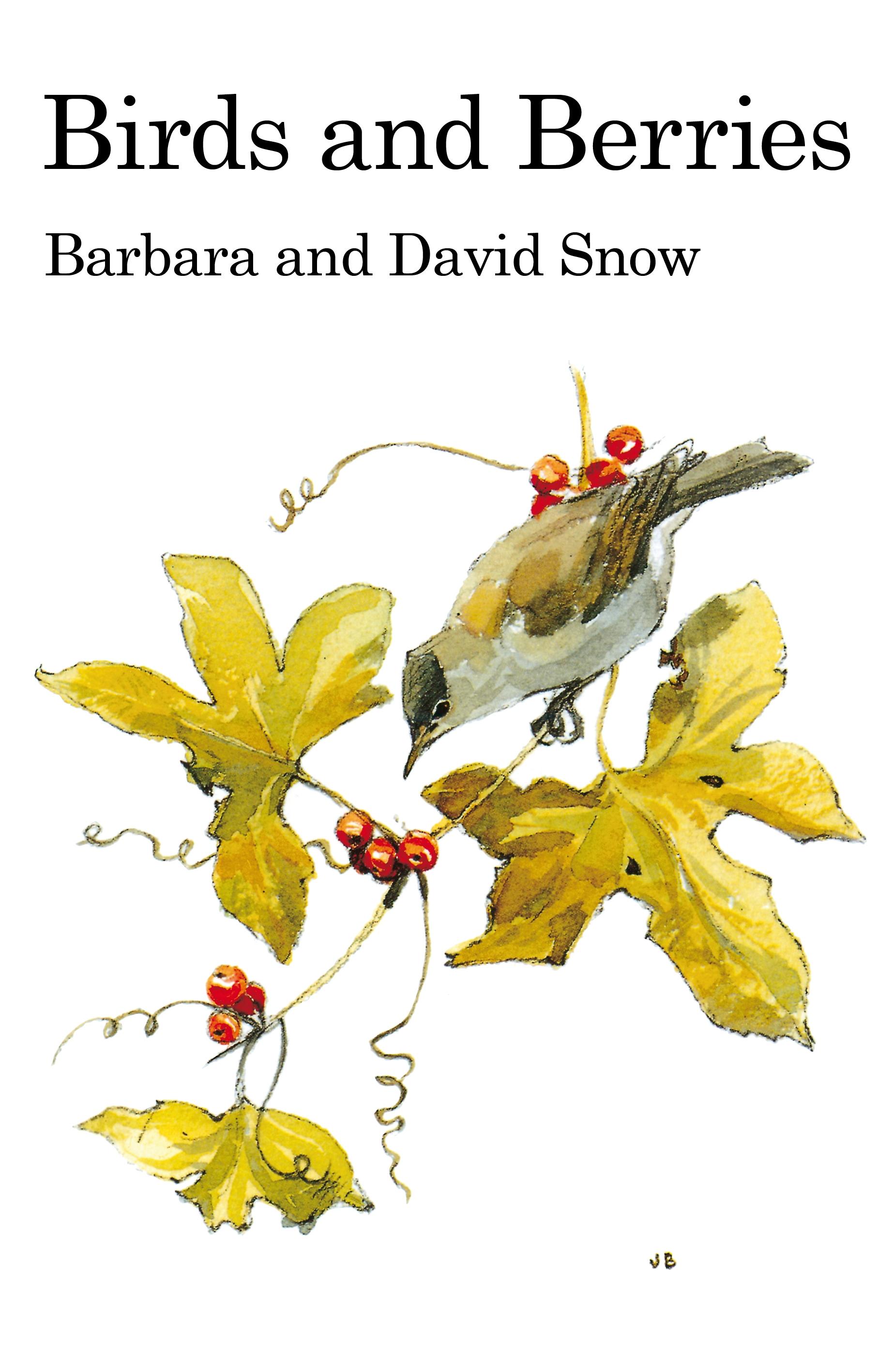
This thought-provoking text offers many insights not generally perceived by ornithologist or botanist and is illustrated in masterly fashion by John Busby's lively drawings.
The book's subtitle - A study of an ecological interaction - properly reflects the author's theme but may tend to hide the fact that the relationships between birds and berries can be much more than the simple, mutually advantageous systems ('eat my fruits, spread my seeds' ) they may seem at first to be.
Therein lies the core of the book - the less obvious intricacies and implications of plant/bird associations, the co-evolution of species in some cases and the adaptation of a species (bird or plant) to further its own advantage. To complicate the scene, too, there are the 'exploiters', the pulp-predators and seed-predators that feed at the plant's expense.
In Part I of the book the authors provide accounts by species of the trees and shrubs they observed over many years in their study area of southern England; similarly, Part 2 records the bird species they watched feeding, or attempting to feed, or preventing other birds from feeding, on the fruits. Part 3 ranges widely and is not confined to Britain and Europe. It investigates the strategies and adaptations evolved and employed by plants to ensure their success, and their attempts at defence against the bird 'predators'.
It looks at the birds themselves, their foraging techniques and fruit preferences, the limitations of a fruit diet and adaptations to it, the time and energy budgets of fruit-eaters and, finally, the intriguing question of co-evolution of plants and birds.
The book's subtitle - A study of an ecological interaction - properly reflects the author's theme but may tend to hide the fact that the relationships between birds and berries can be much more than the simple, mutually advantageous systems ('eat my fruits, spread my seeds' ) they may seem at first to be.
Therein lies the core of the book - the less obvious intricacies and implications of plant/bird associations, the co-evolution of species in some cases and the adaptation of a species (bird or plant) to further its own advantage. To complicate the scene, too, there are the 'exploiters', the pulp-predators and seed-predators that feed at the plant's expense.
In Part I of the book the authors provide accounts by species of the trees and shrubs they observed over many years in their study area of southern England; similarly, Part 2 records the bird species they watched feeding, or attempting to feed, or preventing other birds from feeding, on the fruits. Part 3 ranges widely and is not confined to Britain and Europe. It investigates the strategies and adaptations evolved and employed by plants to ensure their success, and their attempts at defence against the bird 'predators'.
It looks at the birds themselves, their foraging techniques and fruit preferences, the limitations of a fruit diet and adaptations to it, the time and energy budgets of fruit-eaters and, finally, the intriguing question of co-evolution of plants and birds.
Betal nemt med kort, Klarna, Apple Pay eller Google Pay. Ikke tilfreds? Du har altid 14 dages fortrydelsesret. Læs mere i vores vilkår. Har du spørgsmål, så send os en mail på hello@memmo.org.
Memmo gør det nemmere at studere – uanset hvor du er i verden. Hos os samler du dine kursusbøger og smarte studieværktøjer ét sted: resuméer, quizzer, podcasts og flashcards. Og så er der Ted, din studieven, der svarer på alt, du undrer dig over. Over 50 000 studerende studerer allerede her – bygget til at hjælpe dig med at lære hurtigere og stresse mindre.