
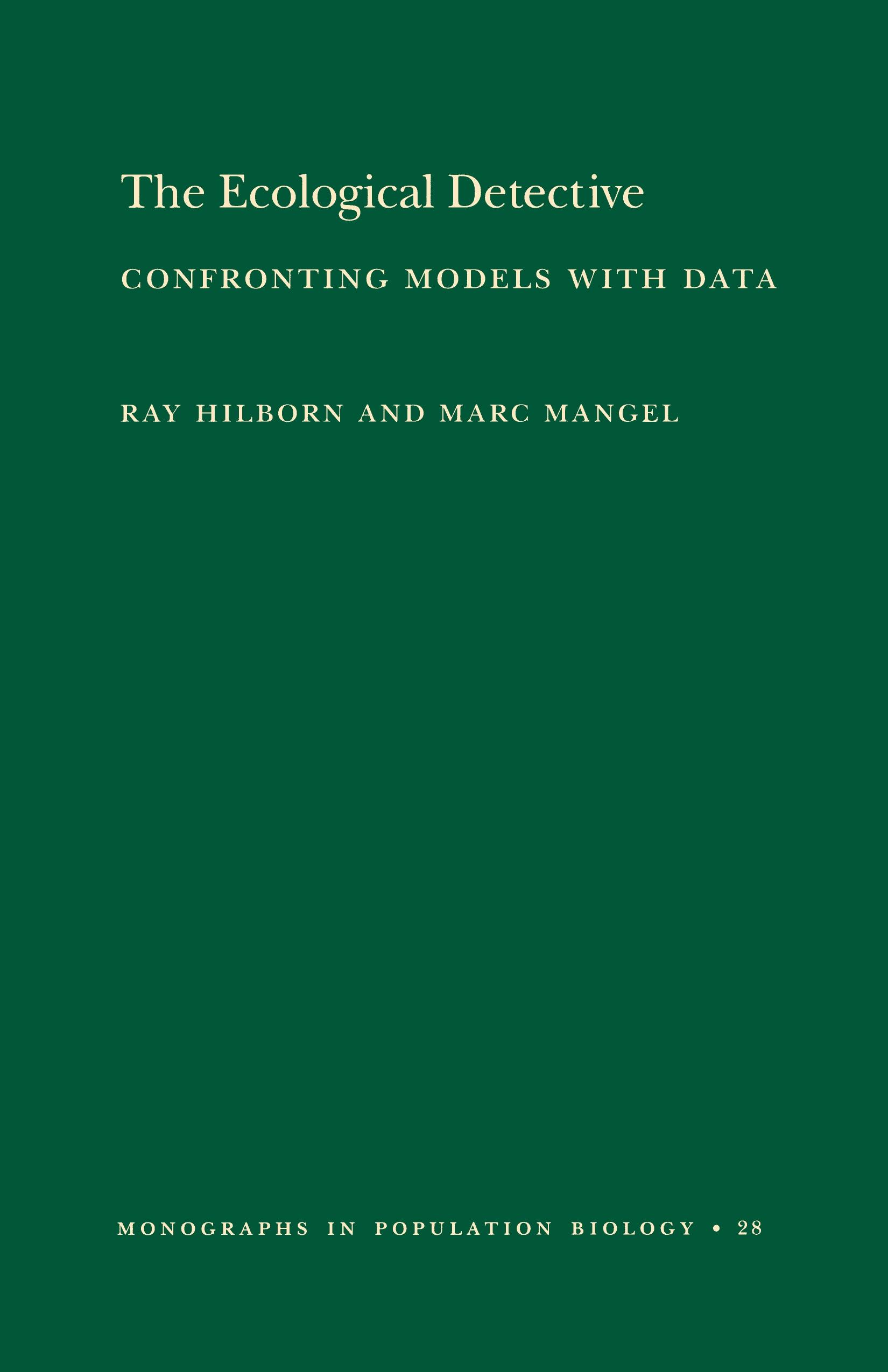
The modern ecologist usually works in both the field and laboratory, uses statistics and computers, and often works with ecological concepts that are model-based, if not model-driven. How do we make the field and laboratory coherent? How do we link models and data? How do we use statistics to help experimentation? How do we integrate modeling and statistics? How do we confront multiple hypotheses with data and assign degrees of belief to different hypotheses? How do we deal with time series (in which data are linked from one measurement to the next) or put multiple sources of data into one inferential framework? These are the kinds of questions asked and answered by The Ecological Detective.
Ray Hilborn and Marc Mangel investigate ecological data much as a detective would investigate a crime scene by trying different hypotheses until a coherent picture emerges. The book is not a set of pat statistical procedures but rather an approach. The Ecological Detective makes liberal use of computer programming for the generation of hypotheses, exploration of data, and the comparison of different models. The authors' attitude is one of exploration, both statistical and graphical. The background required is minimal, so that students with an undergraduate course in statistics and ecology can profitably add this work to their tool-kit for solving ecological problems.
Betal nemt med kort, Klarna, Apple Pay eller Google Pay. Ikke tilfreds? Du har altid 14 dages fortrydelsesret. Læs mere i vores vilkår. Har du spørgsmål, så send os en mail på hello@memmo.org.
Memmo gør det nemmere at studere – uanset hvor du er i verden. Hos os samler du dine kursusbøger og smarte studieværktøjer ét sted: resuméer, quizzer, podcasts og flashcards. Og så er der Ted, din studieven, der svarer på alt, du undrer dig over. Over 50 000 studerende studerer allerede her – bygget til at hjælpe dig med at lære hurtigere og stresse mindre.