
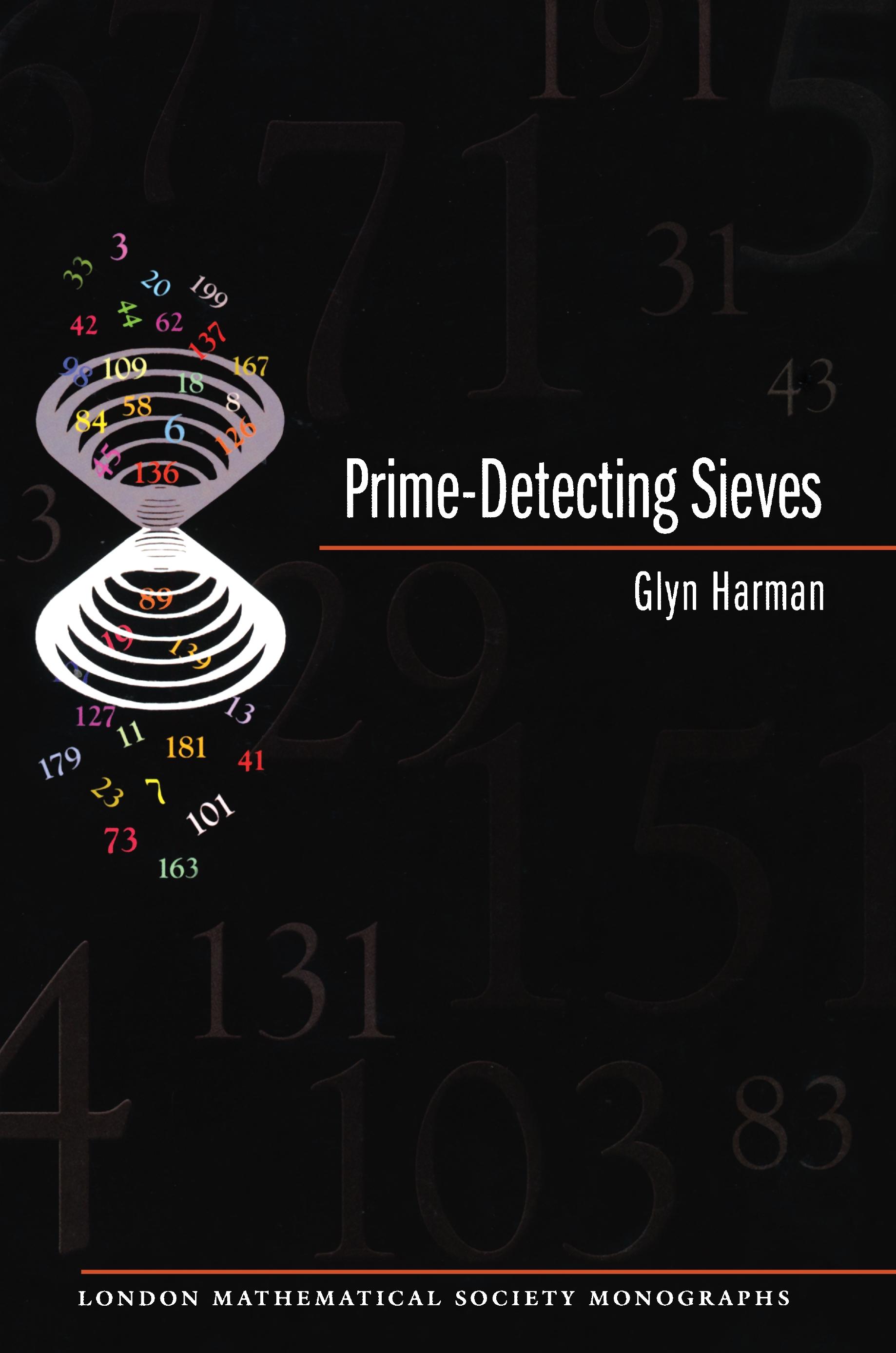
This book seeks to describe the rapid development in recent decades of sieve methods able to detect prime numbers. The subject began with Eratosthenes in antiquity, took on new shape with Legendre's form of the sieve, was substantially reworked by Ivan M. Vinogradov and Yuri V. Linnik, but came into its own with Robert C. Vaughan and important contributions from others, notably Roger Heath-Brown and Henryk Iwaniec. Prime-Detecting Sieves breaks new ground by bringing together several different types of problems that have been tackled with modern sieve methods and by discussing the ideas common to each, in particular the use of Type I and Type II information.
No other book has undertaken such a systematic treatment of prime-detecting sieves. Among the many topics Glyn Harman covers are primes in short intervals, the greatest prime factor of the sequence of shifted primes, Goldbach numbers in short intervals, the distribution of Gaussian primes, and the recent work of John Friedlander and Iwaniec on primes that are a sum of a square and a fourth power, and Heath-Brown's work on primes represented as a cube plus twice a cube. This book contains much that is accessible to beginning graduate students, yet also provides insights that will benefit established researchers.
Betal nemt med kort, Klarna, Apple Pay eller Google Pay. Ikke tilfreds? Du har altid 14 dages fortrydelsesret. Læs mere i vores vilkår. Har du spørgsmål, så send os en mail på hello@memmo.org.
Memmo gør det nemmere at studere – uanset hvor du er i verden. Hos os samler du dine kursusbøger og smarte studieværktøjer ét sted: resuméer, quizzer, podcasts og flashcards. Og så er der Ted, din studieven, der svarer på alt, du undrer dig over. Over 50 000 studerende studerer allerede her – bygget til at hjælpe dig med at lære hurtigere og stresse mindre.