
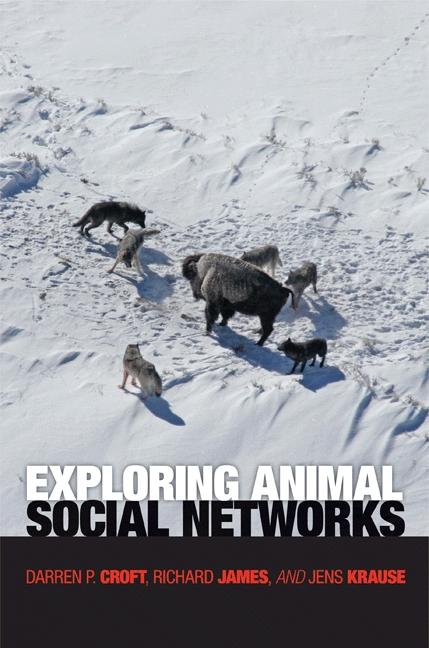
Social network analysis is used widely in the social sciences to study interactions among people, groups, and organizations, yet until now there has been no book that shows behavioral biologists how to apply it to their work on animal populations. Exploring Animal Social Networks provides a practical guide for researchers, undergraduates, and graduate students in ecology, evolutionary biology, animal behavior, and zoology.
Existing methods for studying animal social structure focus either on one animal and its interactions or on the average properties of a whole population. This book enables researchers to probe animal social structure at all levels, from the individual to the population. No prior knowledge of network theory is assumed. The authors give a step-by-step introduction to the different procedures and offer ideas for designing studies, collecting data, and interpreting results. They examine some of today's most sophisticated statistical tools for social network analysis and show how they can be used to study social interactions in animals, including cetaceans, ungulates, primates, insects, and fish. Drawing from an array of techniques, the authors explore how network structures influence individual behavior and how this in turn influences, and is influenced by, behavior at the population level. Throughout, the authors use two software packages--UCINET and NETDRAW--to illustrate how these powerful analytical tools can be applied to different animal social organizations.
Betal nemt med kort, Klarna, Apple Pay eller Google Pay. Ikke tilfreds? Du har altid 14 dages fortrydelsesret. Læs mere i vores vilkår. Har du spørgsmål, så send os en mail på hello@memmo.org.
Memmo gør det nemmere at studere – uanset hvor du er i verden. Hos os samler du dine kursusbøger og smarte studieværktøjer ét sted: resuméer, quizzer, podcasts og flashcards. Og så er der Ted, din studieven, der svarer på alt, du undrer dig over. Over 50 000 studerende studerer allerede her – bygget til at hjælpe dig med at lære hurtigere og stresse mindre.