
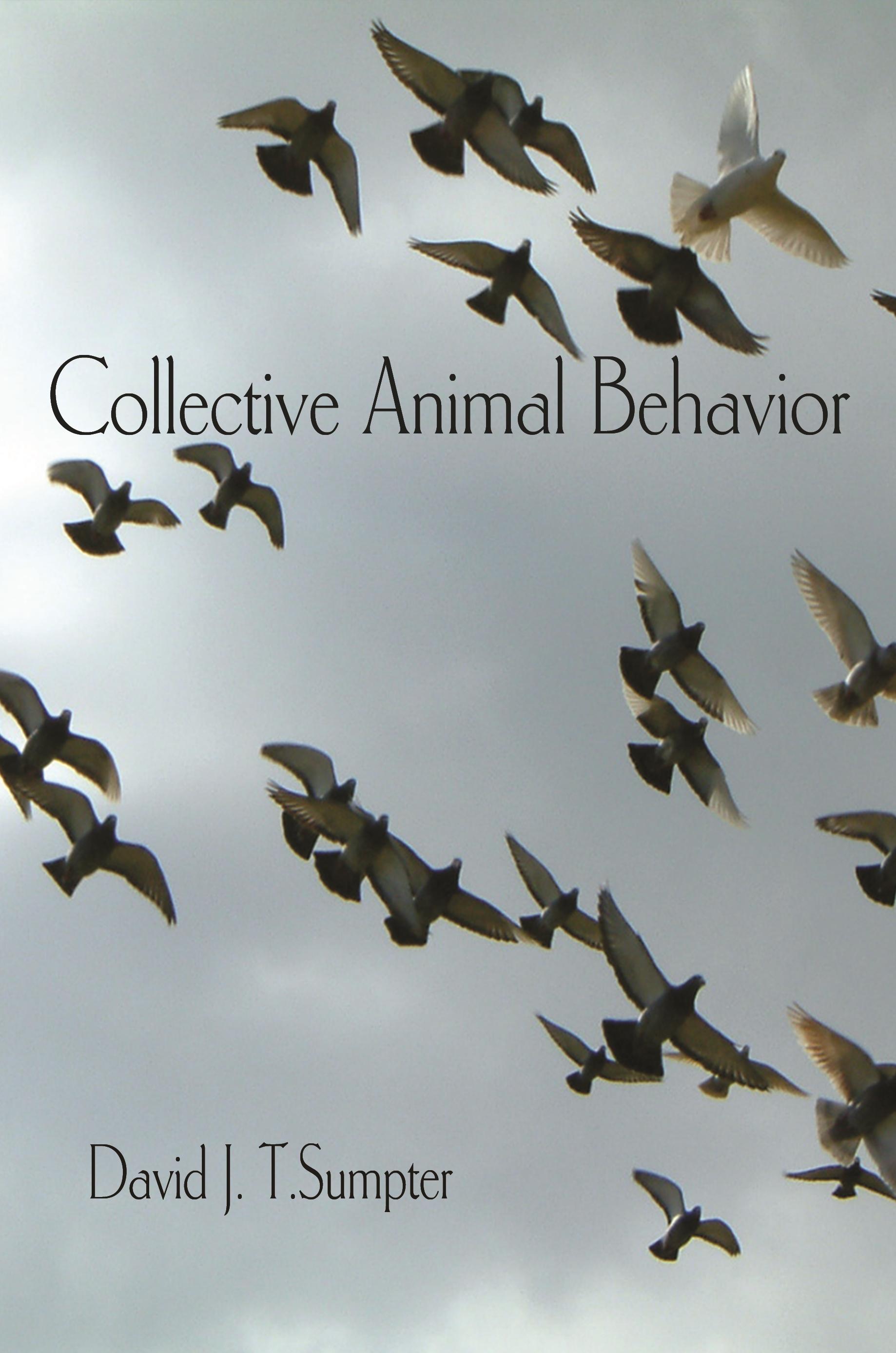
How and why animals produce group behaviors
Fish travel in schools, birds migrate in flocks, honeybees swarm, and ants build trails. How and why do these collective behaviors occur? Exploring how coordinated group patterns emerge from individual interactions, Collective Animal Behavior reveals why animals produce group behaviors and examines their evolution across a range of species.
Providing a synthesis of mathematical modeling, theoretical biology, and experimental work, David Sumpter investigates how animals move and arrive together, how they transfer information, how they make decisions and synchronize their activities, and how they build collective structures. Sumpter constructs a unified appreciation of how different group-living species coordinate their behaviors and why natural selection has produced these groups. For the first time, the book combines traditional approaches to behavioral ecology with ideas about self-organization and complex systems from physics and mathematics. Sumpter offers a guide for working with key models in this area along with case studies of their application, and he shows how ideas about animal behavior can be applied to understanding human social behavior.
Containing a wealth of accessible examples as well as qualitative and quantitative features, Collective Animal Behavior will interest behavioral ecologists and all scientists studying complex systems.
Betal nemt med kort, Klarna, Apple Pay eller Google Pay. Ikke tilfreds? Du har altid 14 dages fortrydelsesret. Læs mere i vores vilkår. Har du spørgsmål, så send os en mail på hello@memmo.org.
Memmo gør det nemmere at studere – uanset hvor du er i verden. Hos os samler du dine kursusbøger og smarte studieværktøjer ét sted: resuméer, quizzer, podcasts og flashcards. Og så er der Ted, din studieven, der svarer på alt, du undrer dig over. Over 50 000 studerende studerer allerede her – bygget til at hjælpe dig med at lære hurtigere og stresse mindre.