
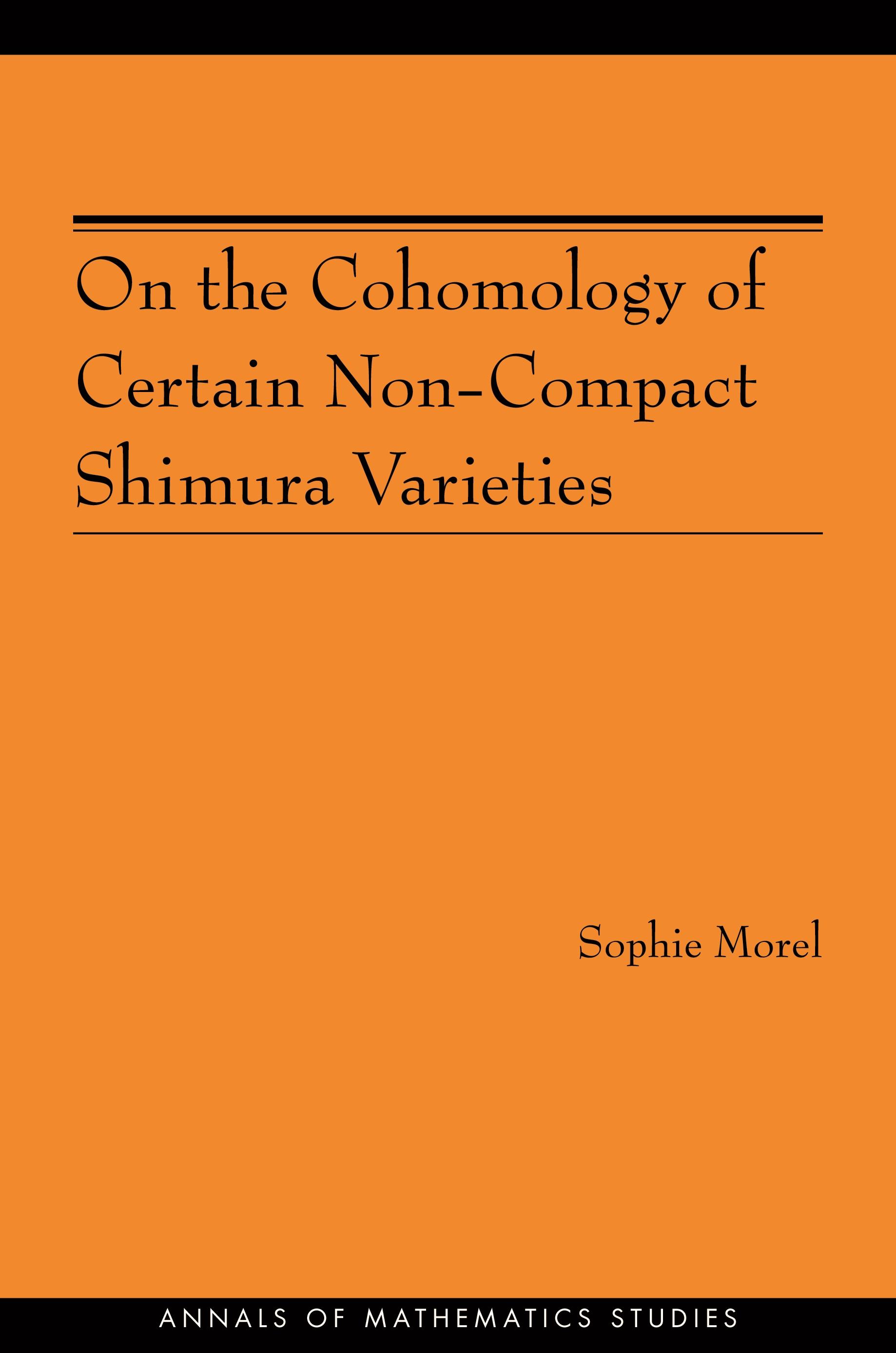
This book studies the intersection cohomology of the Shimura varieties associated to unitary groups of any rank over Q. In general, these varieties are not compact. The intersection cohomology of the Shimura variety associated to a reductive group G carries commuting actions of the absolute Galois group of the reflex field and of the group G(Af) of finite adelic points of G. The second action can be studied on the set of complex points of the Shimura variety. In this book, Sophie Morel identifies the Galois action--at good places--on the G(Af)-isotypical components of the cohomology.
Morel uses the method developed by Langlands, Ihara, and Kottwitz, which is to compare the Grothendieck-Lefschetz fixed point formula and the Arthur-Selberg trace formula. The first problem, that of applying the fixed point formula to the intersection cohomology, is geometric in nature and is the object of the first chapter, which builds on Morel's previous work. She then turns to the group-theoretical problem of comparing these results with the trace formula, when G is a unitary group over Q. Applications are then given. In particular, the Galois representation on a G(Af)-isotypical component of the cohomology is identified at almost all places, modulo a non-explicit multiplicity. Morel also gives some results on base change from unitary groups to general linear groups.
Betal nemt med kort, Klarna, Apple Pay eller Google Pay. Ikke tilfreds? Du har altid 14 dages fortrydelsesret. Læs mere i vores vilkår. Har du spørgsmål, så send os en mail på hello@memmo.org.
Memmo gør det nemmere at studere – uanset hvor du er i verden. Hos os samler du dine kursusbøger og smarte studieværktøjer ét sted: resuméer, quizzer, podcasts og flashcards. Og så er der Ted, din studieven, der svarer på alt, du undrer dig over. Over 50 000 studerende studerer allerede her – bygget til at hjælpe dig med at lære hurtigere og stresse mindre.