
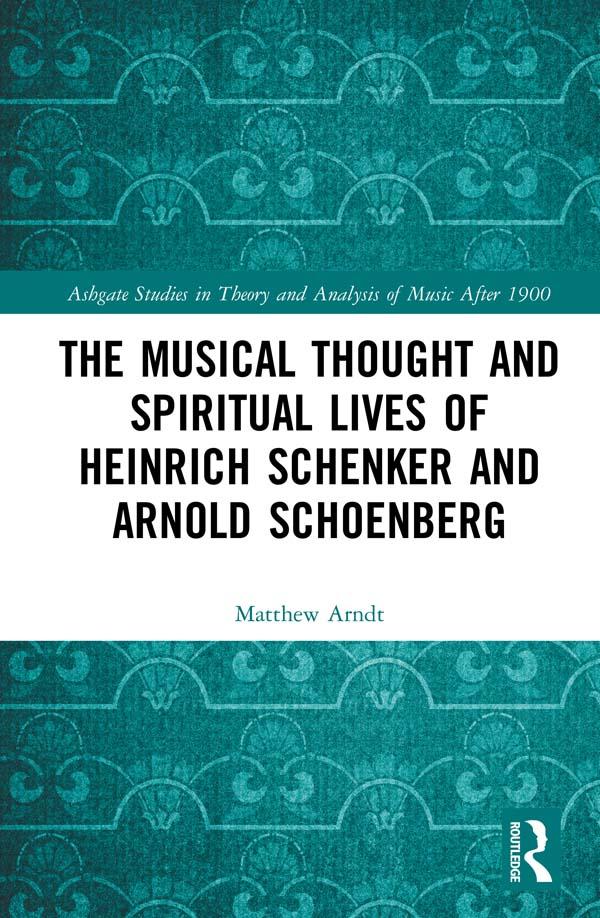
This book examines the origin, content, and development of the musical thought of Heinrich Schenker and Arnold Schoenberg. One of the premises is that Schenker’s and Schoenberg’s inner musical lives are inseparable from their inner spiritual lives. Curiously, Schenker and Schoenberg start out in much the same musical-spiritual place, yet musically they split while spiritually they grow closer. The reception of Schenker’s and Schoenberg’s work has sidestepped this paradox of commonality and conflict, instead choosing to universalize and amplify their conflict. Bringing to light a trove of unpublished material, Arndt argues that Schenker’s and Schoenberg’s conflict is a reflection of tensions within their musical and spiritual ideas. They share a particular conception of the tone as an ideal sound realized in the spiritual eye of the genius. The tensions inherent in this largely psychological and material notion of the tone and this largely metaphysical notion of the genius shape both their musical divergence on the logical (technical) level in theory and composition, including their advocacy of the Ursatz versus twelvetone composition, and their spiritual convergence, including their embrace of Judaism. These findings shed new light on the musical and philosophical worlds of Schenker and Schoenberg and on the profound artistic and spiritual questions with which they grapple.
Betal nemt med kort, Klarna, Apple Pay eller Google Pay. Ikke tilfreds? Du har altid 14 dages fortrydelsesret. Læs mere i vores vilkår. Har du spørgsmål, så send os en mail på hello@memmo.org.
Memmo gør det nemmere at studere – uanset hvor du er i verden. Hos os samler du dine kursusbøger og smarte studieværktøjer ét sted: resuméer, quizzer, podcasts og flashcards. Og så er der Ted, din studieven, der svarer på alt, du undrer dig over. Over 50 000 studerende studerer allerede her – bygget til at hjælpe dig med at lære hurtigere og stresse mindre.