
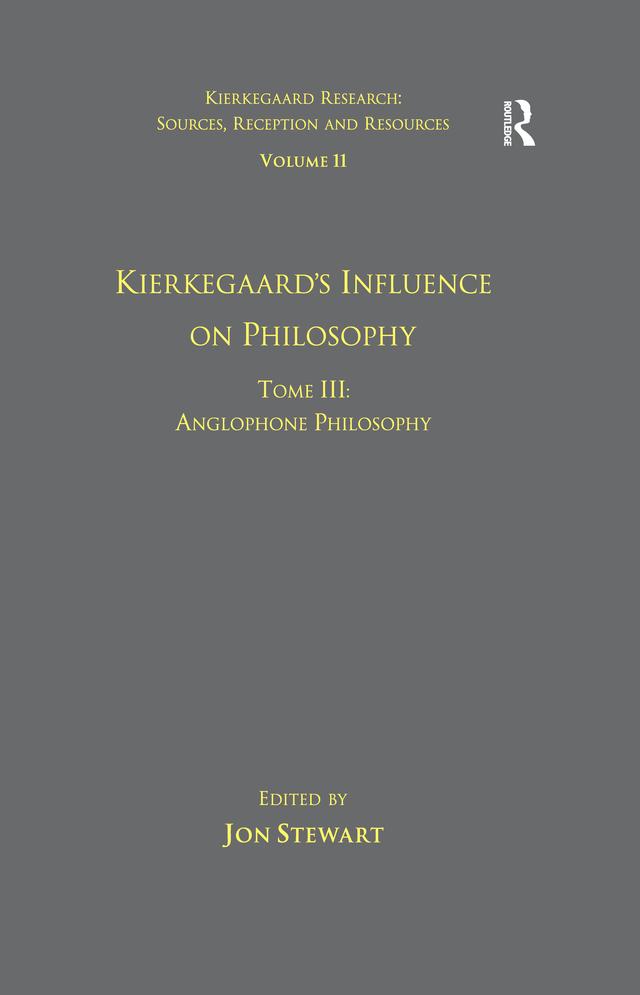
Kierkegaard's relation to the field of philosophy is a particularly complex and disputed one. He rejected the model of philosophical inquiry that was mainstream in his day and was careful to have his pseudonymous authors repeatedly disassociate themselves from philosophy. But although it seems clear that Kierkegaard never regarded himself as a philosopher, there can be no doubt that his writings contain philosophical ideas and insights and have been profoundly influential in a number of different philosophical traditions.The present volume attempts to document these different traditions of the philosophical reception of Kierkegaard's thought. Tome III traces Kierkegaard's influence on Anglophone philosophy. It has long been thought that Kierkegaard played no role in this tradition, which for years was dominated by analytic philosophy. In this environment it was common to dismiss Kierkegaard along with the then current European philosophers who were influenced by him. However, a closer look reveals that in fact there were several thinkers in the US, Canada and Great Britain who were inspired by Kierkegaard even during the heyday of analytic philosophy. Today it can be said that Kierkegaard has made some serious inroads into mainstream Anglophone philosophy, with many authors seeking inspiration in his works for current discussions concerning ethics, personal identity, philosophy of religion, and philosophical anthropology.
Betal nemt med kort, Klarna, Apple Pay eller Google Pay. Ikke tilfreds? Du har altid 14 dages fortrydelsesret. Læs mere i vores vilkår. Har du spørgsmål, så send os en mail på hello@memmo.org.
Memmo gør det nemmere at studere – uanset hvor du er i verden. Hos os samler du dine kursusbøger og smarte studieværktøjer ét sted: resuméer, quizzer, podcasts og flashcards. Og så er der Ted, din studieven, der svarer på alt, du undrer dig over. Over 50 000 studerende studerer allerede her – bygget til at hjælpe dig med at lære hurtigere og stresse mindre.
Du kan måske også lide
Køb bogen0