
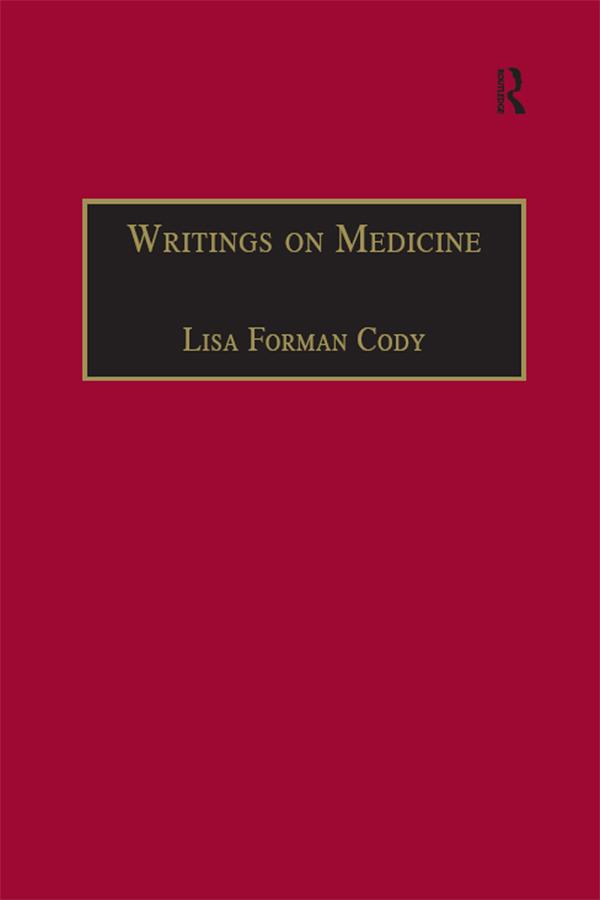
The four works in this volume are the only known exclusively medical texts written by women during the Restoration. Their importance is denoted by their dramatic challenge to the generalisations once made about medical practice and female healers in this period. Jane Sharp's The Midwives Book was the first and only midwifery manual to be printed in English before 1700, and continued to be influential into the early eighteenth century. The principal focus of Elizabeth Cellier's To Dr.--- (1688) is the attempt to legitimate the notion of a female corporation of midwives through historical precedent. To Dr.--- was in fact borne out of a previously unpublished effort, 'A Scheme for the Foundation of a Royal Hospital', sent to James II in 1687. In the document, Cellier outlined a specific scheme for training female midwives and supporting poor, pregnant women and abandoned children. Mary Trye began practising 'chymical physic' at her father's side in London in 1663. Her only known work, Medicatrix, was published in 1675. Trye claimed female medical authorship to be unique, in that women observed nature truly and administered genuine medical solutions to the sick. The writings of Sharp, Cellier and Trye have helped to overturn historians' assumptions about a woman's role in medicine and healing. These texts reveal their female authors to be as learned in the humanities and sciences as they were in medical matters.
Betal nemt med kort, Klarna, Apple Pay eller Google Pay. Ikke tilfreds? Du har altid 14 dages fortrydelsesret. Læs mere i vores vilkår. Har du spørgsmål, så send os en mail på hello@memmo.org.
Memmo gør det nemmere at studere – uanset hvor du er i verden. Hos os samler du dine kursusbøger og smarte studieværktøjer ét sted: resuméer, quizzer, podcasts og flashcards. Og så er der Ted, din studieven, der svarer på alt, du undrer dig over. Over 50 000 studerende studerer allerede her – bygget til at hjælpe dig med at lære hurtigere og stresse mindre.
Du kan måske også lide
Køb bogen0