
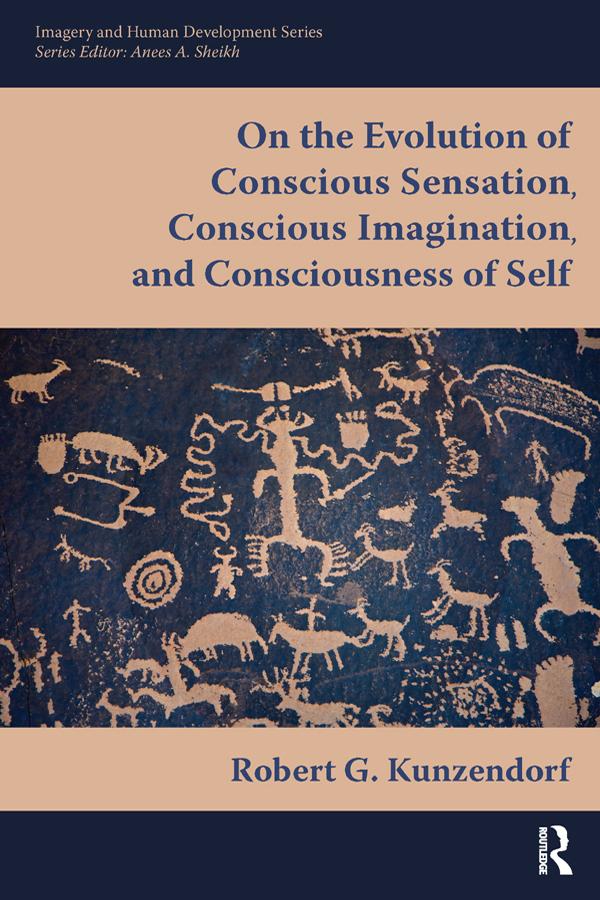
Philosophical 'thought experiments' invoking inverted spectra, zombies, et cetera suggest that conscious sensations have no function, and psychological studies finding no correlation between vivid visual imaging and visual problem solving suggest that conscious images have no function. Furthermore, both philosophical and psychological theories suggest that self-consciousness has no function. Countering such suggestions, the post-Darwinian double-aspect theory which Professor Robert Kunzendorf's introduces in the first chapter of his monograph On the Evolution of Conscious Sensation, Conscious Imagination, and Consciousness of Self points to evolutionary functions of certain sensations, youngling vivid images, and self-consciousness. Kunzendorf's second chapter presents evidence that the most primitive sensation-pain, the subjective aspect of free nerve endings or nociceptors-has a survival-promoting function. But as the pressure nociceptor mutates into a touch receptor, the heat nociceptor into temperature receptor, and the chemical nociceptor into a taste receptor, the painful qualia of these nociceptors evolve respectively into touch sensation, temperature sensation, or taste sensation-painless sensations that add no survival benefit to their receptor's physical aspect. Building on evidence that retinal receptors embodying visual qualia evolved from primitive eyespots responsive to injurious 'heat at a distance' or painful light, the third chapter presents evidence that visually imagined sensations are the subjective qualities of retinal receptors that are corticofugally innervated in warm-blooded animals-for the developmental purpose of testing cortically hypothesized sensory-motor rules that have greater survival value than cold-blooded stimulus-response associations. The fourth and final chapter focuses on self-conscious reality-testing and on visuo-spatial self-conceptualization, and presents evidence that such manifestations of self-awareness evolve only in those warm-blooded animals whose rule-developing youth lasts two years or longer-that is, those mammals and birds whose survival during the imaginal testing of rules is subjected to prolonged risk if self-consciousness that one is imaging sensations (rather than perceiving sensations) is absent.
Betal nemt med kort, Klarna, Apple Pay eller Google Pay. Ikke tilfreds? Du har altid 14 dages fortrydelsesret. Læs mere i vores vilkår. Har du spørgsmål, så send os en mail på hello@memmo.org.
Memmo gør det nemmere at studere – uanset hvor du er i verden. Hos os samler du dine kursusbøger og smarte studieværktøjer ét sted: resuméer, quizzer, podcasts og flashcards. Og så er der Ted, din studieven, der svarer på alt, du undrer dig over. Over 50 000 studerende studerer allerede her – bygget til at hjælpe dig med at lære hurtigere og stresse mindre.