
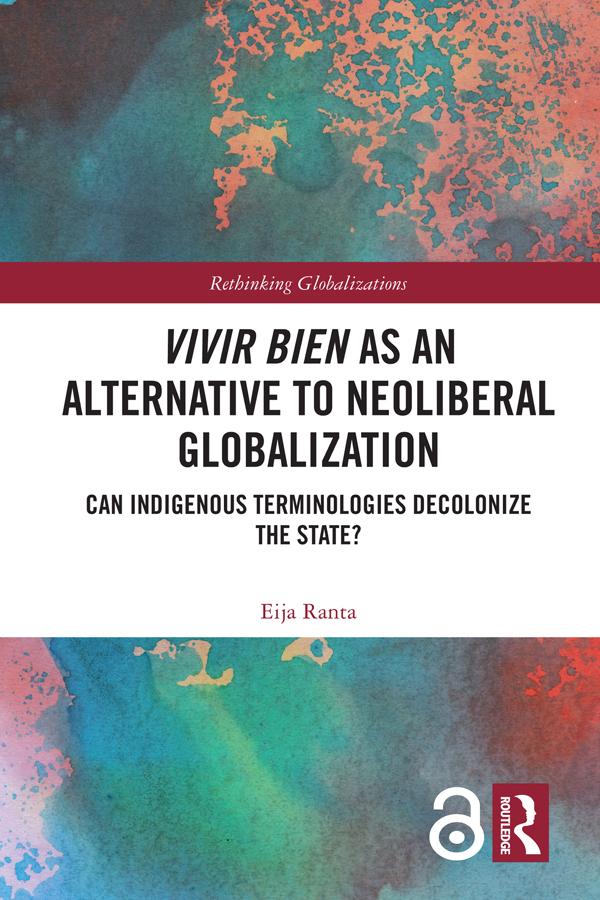
Presenting an ethnographic account of the emergence and application of critical political alternatives in the Global South, this book analyses the opportunities and challenges of decolonizing and transforming a modern, hierarchical and globally-immersed nation-state on the basis of indigenous terminologies.
Alternative development paradigms that represent values including justice, pluralism, democracy and a sustainable relationship to nature tend to emerge in response to – and often opposed to – the neoliberal globalization. Through a focus on the empirical case of the notion of Vivir Bien (‘Living Well’) as a critical cultural and ecological paradigm, Ranta demonstrates how indigeneity – indigenous peoples’ discourses, cultural ideas and worldviews – has become such a denominator in the construction of local political and policy alternatives. More widely, the author seeks to map conditions for, and the challenges of, radical political projects that aim to counteract neoliberal globalization and Western hegemony in defining development.
This book will appeal to critical academic scholars, development practitioners and social activists aiming to come to grips with the complexity of processes of progressive social change in our contemporary global world.
Betal nemt med kort, Klarna, Apple Pay eller Google Pay. Ikke tilfreds? Du har altid 14 dages fortrydelsesret. Læs mere i vores vilkår. Har du spørgsmål, så send os en mail på hello@memmo.org.
Memmo gør det nemmere at studere – uanset hvor du er i verden. Hos os samler du dine kursusbøger og smarte studieværktøjer ét sted: resuméer, quizzer, podcasts og flashcards. Og så er der Ted, din studieven, der svarer på alt, du undrer dig over. Over 50 000 studerende studerer allerede her – bygget til at hjælpe dig med at lære hurtigere og stresse mindre.