
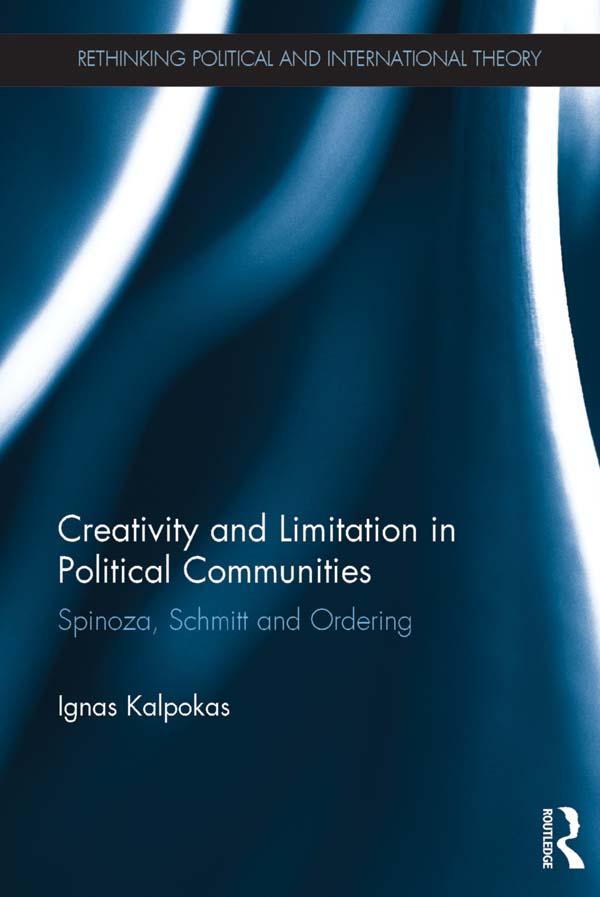
There is an inherent tension between popular and establishment powers in political communities. With anti-establishment sentiment on the rise across Western democracies, exploring the underpinnings of this dualism and rethinking theories of political life within states is of paramount importance. By combining the theories of Carl Schmitt and Benedict Spinoza, this book develops a framework of continuous reproduction, whereby the two powers simultaneously hold one another in tension and supersede one another. In the same vein, political communities are shown to be perpetually caught in a cycle of creativity/contestation, derived primarily from Schmitt (the tragic groundlessness of politics) and limitation (derived primarily from Spinoza as a quasi-theological belief in the status quo).
Providing a novel theoretical framework explaining the workings of democratic politics, this book also offers a non-traditional reading of Spinoza and Schmitt. Whereas traditionally both have been treated as almost polar opposites, here they are held in creative tension, providing equally important building blocks for the proposed theory. By furthering their analysis, the author creates a new theory of political action.
Betal nemt med kort, Klarna, Apple Pay eller Google Pay. Ikke tilfreds? Du har altid 14 dages fortrydelsesret. Læs mere i vores vilkår. Har du spørgsmål, så send os en mail på hello@memmo.org.
Memmo gør det nemmere at studere – uanset hvor du er i verden. Hos os samler du dine kursusbøger og smarte studieværktøjer ét sted: resuméer, quizzer, podcasts og flashcards. Og så er der Ted, din studieven, der svarer på alt, du undrer dig over. Over 50 000 studerende studerer allerede her – bygget til at hjælpe dig med at lære hurtigere og stresse mindre.