
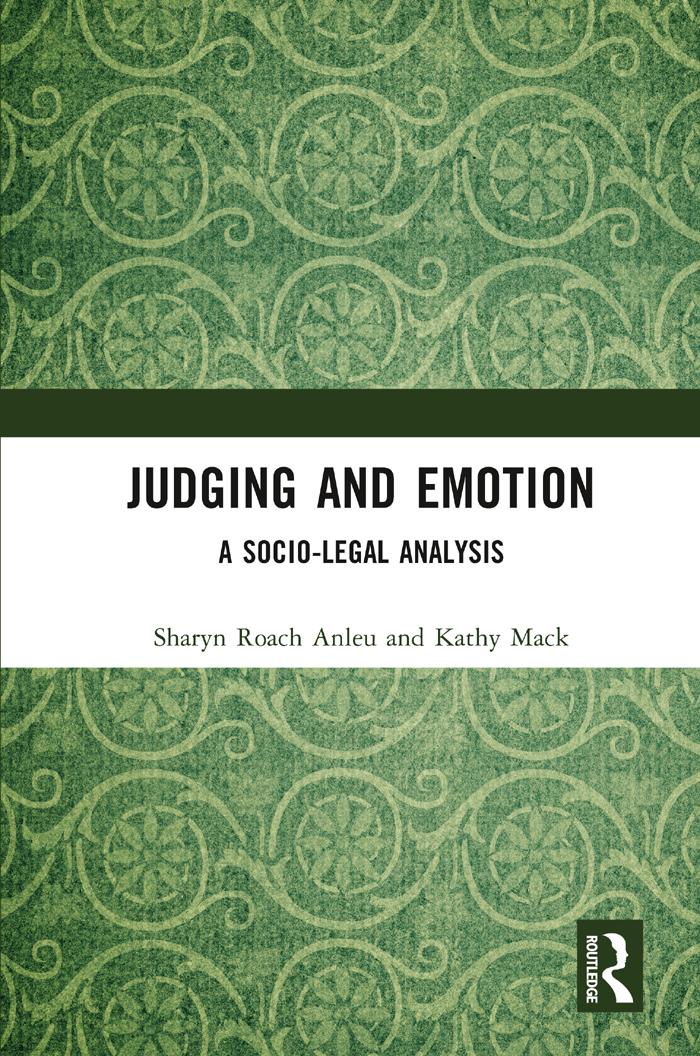
Judging and Emotion investigates how judicial officers understand, experience, display, manage and deploy emotions in their everyday work, in light of their fundamental commitment to impartiality.
Judging and Emotion challenges the conventional assumption that emotion is inherently unpredictable, stressful or a personal quality inconsistent with impartiality. Extensive empirical research with Australian judicial officers demonstrates the ways emotion, emotional capacities and emotion work are integral to judicial practice. Judging and Emotion articulates a broader conception of emotion, as a social practice emerging from interaction, and demonstrates how judicial officers undertake emotion work and use emotion as a resource to achieve impartiality. A key insight is that institutional requirements, including conceptions of impartiality as dispassion, do not completely determine the emotion dimensions of judicial work. Through their everyday work, judicial officers construct and maintain the boundaries of an impartial judicial role which necessarily incorporates emotion and emotion work.
Building on a growing interest in emotion in law and social sciences, this book will be of considerable importance to socio-legal scholars, sociologists, the judiciary, legal practitioners and all users of the courts.
Betal nemt med kort, Klarna, Apple Pay eller Google Pay. Ikke tilfreds? Du har altid 14 dages fortrydelsesret. Læs mere i vores vilkår. Har du spørgsmål, så send os en mail på hello@memmo.org.
Memmo gør det nemmere at studere – uanset hvor du er i verden. Hos os samler du dine kursusbøger og smarte studieværktøjer ét sted: resuméer, quizzer, podcasts og flashcards. Og så er der Ted, din studieven, der svarer på alt, du undrer dig over. Over 50 000 studerende studerer allerede her – bygget til at hjælpe dig med at lære hurtigere og stresse mindre.