
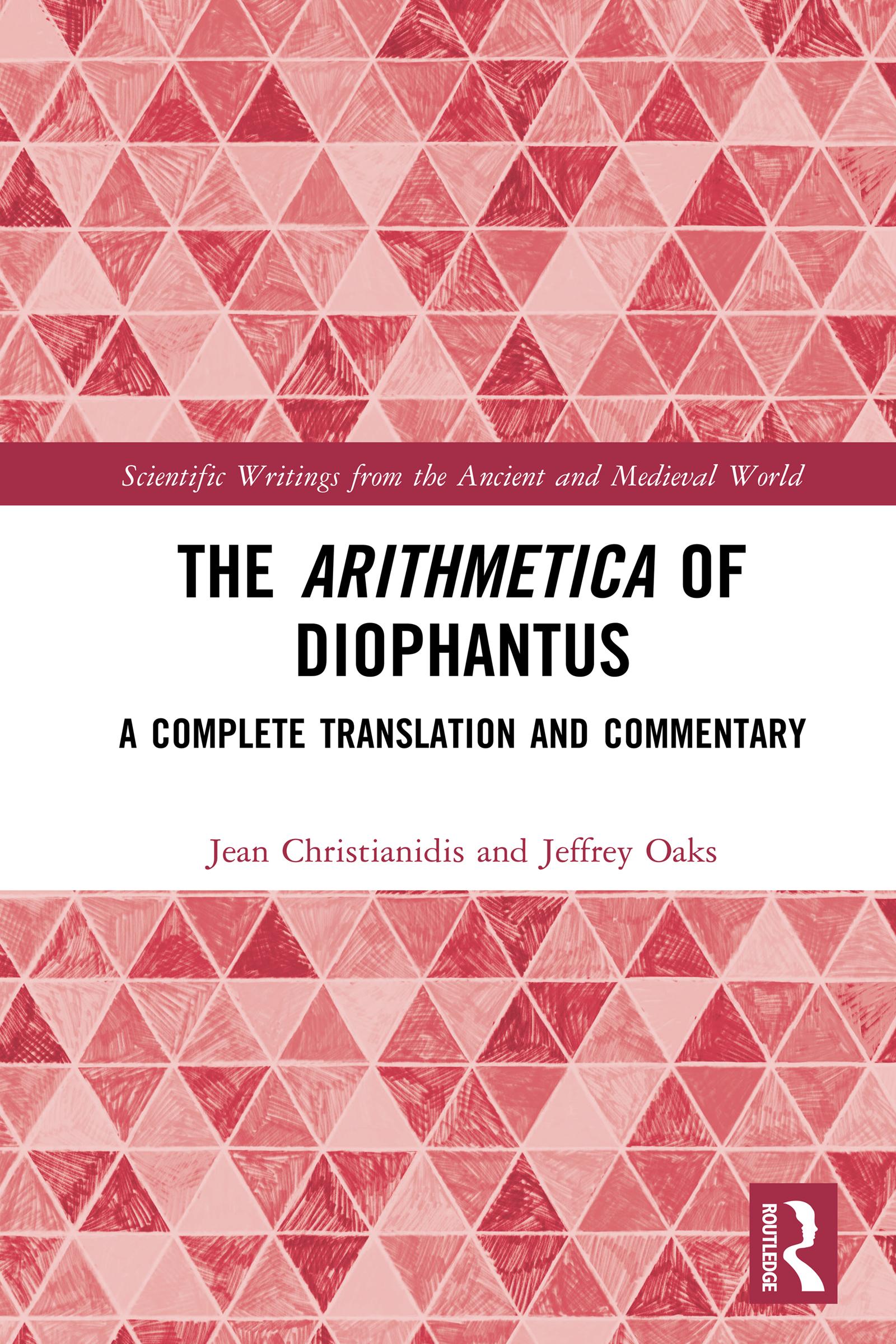
This volume offers an English translation of all ten extant books of Diophantus of Alexandria’s Arithmetica, along with a comprehensive conceptual, historical, and mathematical commentary.
Before his work became the inspiration for the emerging field of number theory in the seventeenth century, Diophantus (ca. 3rd c. CE) was known primarily as an algebraist. This volume explains how his method of solving arithmetical problems agrees both conceptually and procedurally with the premodern algebra later practiced in Arabic, Latin, and European vernaculars, and how this algebra differs radically from the modern algebra initiated by François Viète and René Descartes. It also discusses other surviving traces of ancient Greek algebra and follows the influence of the Arithmetica in medieval Islam, Byzantium, and the European Renaissance down to the 1621 publication of Claude-Gaspard Bachet’s edition. After the English translation the book provides a problem-by-problem commentary explaining the solutions in a manner compatible with Diophantus’s mode of thought.
The Arithmetica of Diophantus provides an invaluable resource for historians of mathematics, science, and technology, as well as those studying ancient Greek, medieval Islamic and Byzantine, and Renaissance history. In addition, the volume is also suitable for mathematicians and mathematics educators.
Betal nemt med kort, Klarna, Apple Pay eller Google Pay. Ikke tilfreds? Du har altid 14 dages fortrydelsesret. Læs mere i vores vilkår. Har du spørgsmål, så send os en mail på hello@memmo.org.
Memmo gør det nemmere at studere – uanset hvor du er i verden. Hos os samler du dine kursusbøger og smarte studieværktøjer ét sted: resuméer, quizzer, podcasts og flashcards. Og så er der Ted, din studieven, der svarer på alt, du undrer dig over. Over 50 000 studerende studerer allerede her – bygget til at hjælpe dig med at lære hurtigere og stresse mindre.