
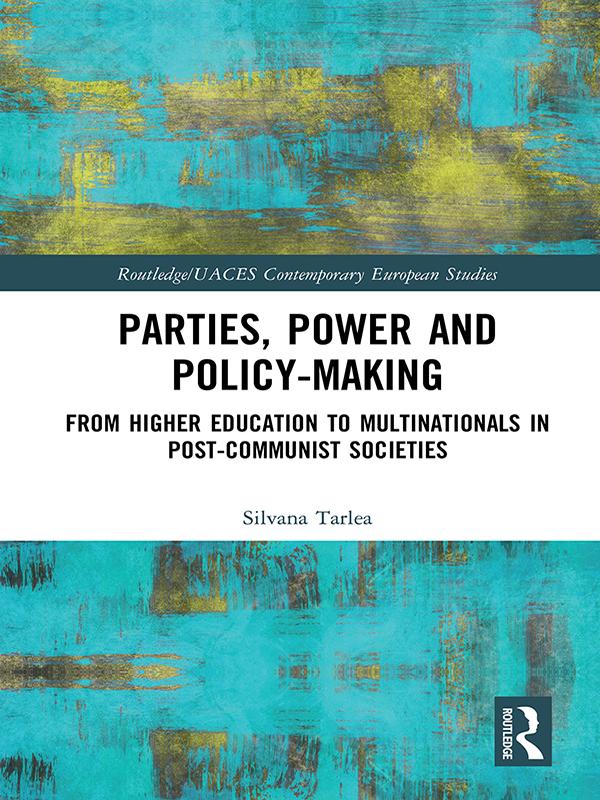
This book explains the conditions under which political parties in government were able to influence economic growth in post-communist European countries. It highlights higher education and international investment as the two essentially related areas that have been steered by governments.
The book illustrates how these countries have become reliant on multinational companies (MNCs), given their governments’ strategy to attract foreign capital, how political and economic factors are intertwined and how political parties in power can have a strong influence on the growth prospects of these economies. Furthermore, it illuminates the extent to which political parties use their space for manoeuvres when enacting policies and how they respond to their constituencies when doing so. It shows how structural conditions such as the dependence on MNCs influence policies, and how this pattern varies across Central and Eastern Europe. The book brings political parties back into the discussion on political economy and back into the analyses of welfare politics, varieties of capitalism, and democratic capitalism.
This text will be of key interest to scholars and students of comparative politics and comparative political economy, European policy-making, Central and Eastern Europe, trade, welfare and development, and higher education.
Betal nemt med kort, Klarna, Apple Pay eller Google Pay. Ikke tilfreds? Du har altid 14 dages fortrydelsesret. Læs mere i vores vilkår. Har du spørgsmål, så send os en mail på hello@memmo.org.
Memmo gør det nemmere at studere – uanset hvor du er i verden. Hos os samler du dine kursusbøger og smarte studieværktøjer ét sted: resuméer, quizzer, podcasts og flashcards. Og så er der Ted, din studieven, der svarer på alt, du undrer dig over. Over 50 000 studerende studerer allerede her – bygget til at hjælpe dig med at lære hurtigere og stresse mindre.