
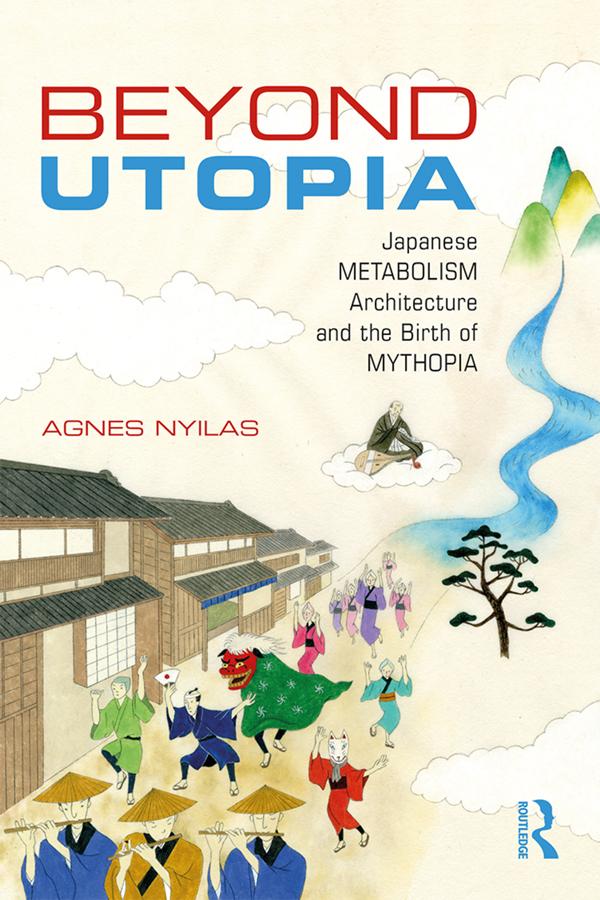
Megastructure proposals by the Japanese Metabolism group are commonly identified with the concept of utopia. Beyond this partial understanding, Agnes Nyilas suggests that rather than being merely utopian, the Megastructure of Metabolism represents a uniquely amalgam genre: the myth camouflaged as utopia. Although its Megastructure seemingly describes a desirable future condition as utopia does, it also comprises certain cultural images rooted in the collective (un)conscious of Japanese people, in accordance with the general interpretation of myth. The primary narrative of Beyond Utopia thus follows the gradual unfolding of the myth-like characteristics of its Megastructure.
Myth is dealt here as an interdisciplinary subject in line with contemporary myth theories. After expounding the mechanism underlying the growing demand for a new myth in architecture (the origin of the myth), Part I discovers the formal characteristics of the Megastructure of Metabolism to give a hint of the real intention behind it. Based on this, Part II is a reexamination of their design methods, which aims to clarify the function of the myth and to suggest the meaning behind it. Finally, Part III deals with the subject matter of the myth by disclosing the meaning unfolding in the story, and suggests a new reading of Metabolism urban theory: as an attempt to reconsider the traditional Japanese space concept.
Betal nemt med kort, Klarna, Apple Pay eller Google Pay. Ikke tilfreds? Du har altid 14 dages fortrydelsesret. Læs mere i vores vilkår. Har du spørgsmål, så send os en mail på hello@memmo.org.
Memmo gør det nemmere at studere – uanset hvor du er i verden. Hos os samler du dine kursusbøger og smarte studieværktøjer ét sted: resuméer, quizzer, podcasts og flashcards. Og så er der Ted, din studieven, der svarer på alt, du undrer dig over. Over 50 000 studerende studerer allerede her – bygget til at hjælpe dig med at lære hurtigere og stresse mindre.