
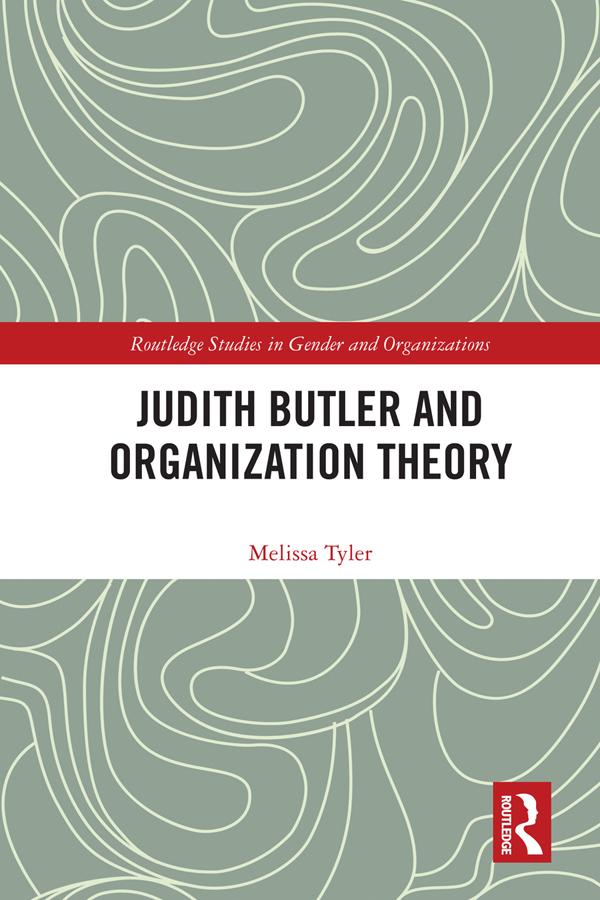
2020 will mark thirty years since the first publication of Judith Butler’s ground-breaking book, Gender Trouble. Here, and in subsequent work, Butler argues that gender and other forms of identity can best be understood as performative acts. These acts are what bring our subjectivities into existence, enabling us to be recognized as viable employable social beings, worthy of rights, responsibilities and respect. The three decades since the publication of Gender Trouble have witnessed Butler become one of the most widely cited and controversial figures in contemporary feminist thinking. While it is only in her most recent work that Butler has engaged directly with themes such as work and organization, her writing has profound implications for thinking, and acting, on the relationship between power, recognition and organization. Whilst her ideas have made important in-roads into work, organization and gender studies that are discussed here, there is considerable scope to explore further avenues that her concepts and theories open up. These inroads and avenues are the focus of this book.
Judith Butler and Organization Theory makes a substantial contribution to the analysis of gender, work and organization. It not only covers central issues in Butler’s work, it also offers a close reading of the complexities and nuances in her thought. It does so by ‘reading’ Butler as a theorist of organization, whose work resonates with scholars, practitioners and activists concerned to understand and engage with organizational life, organization and organizing. Drawing from a range of illustrative examples, the book examines key texts or ‘moments’ in the development of Butler’s writing to date, positing her as a thinker concerned to understand and address the ways in which our most basic desire for recognition comes to be organized within the context of contemporary labour markets and workplaces. It examines insights from Butler’s work, and the philosophical ideas she draws on, considering the impact of these on work, organization and management studies thus far; it also explores some of the many ways in which her thinking might be mobilized in future, considering what scope there is for a non-violent ethics of organization, and for a (re)assembling of the relationship between vulnerability and resistance within and through organizational politics.
Betal nemt med kort, Klarna, Apple Pay eller Google Pay. Ikke tilfreds? Du har altid 14 dages fortrydelsesret. Læs mere i vores vilkår. Har du spørgsmål, så send os en mail på hello@memmo.org.
Memmo gør det nemmere at studere – uanset hvor du er i verden. Hos os samler du dine kursusbøger og smarte studieværktøjer ét sted: resuméer, quizzer, podcasts og flashcards. Og så er der Ted, din studieven, der svarer på alt, du undrer dig over. Over 50 000 studerende studerer allerede her – bygget til at hjælpe dig med at lære hurtigere og stresse mindre.