
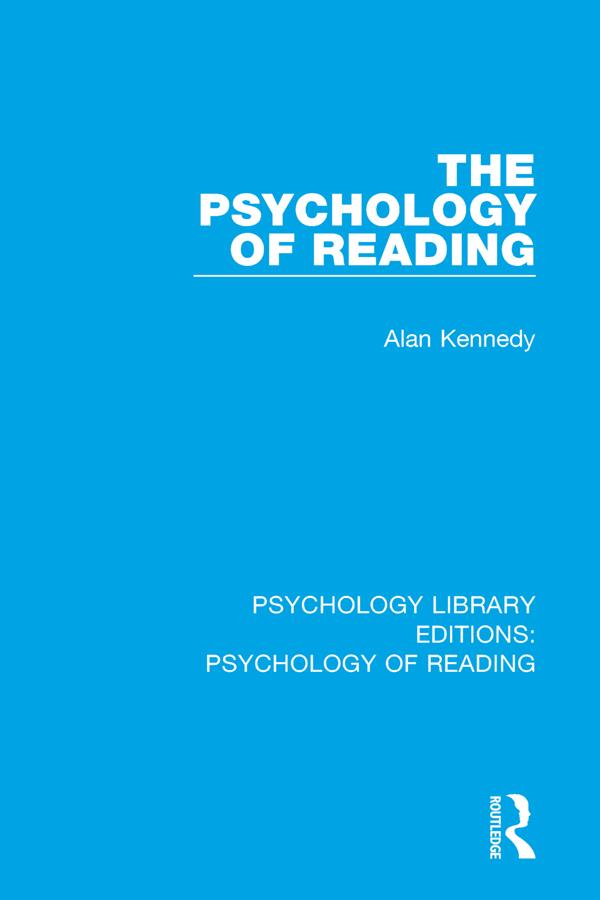
Originally published in 1984, this new introductory text fulfilled a need amongst both psychology and education students for a book which dealt with reading in a way that explored areas beyond the strictly practical question of how to teach children to read.
Previous books on the psychology of reading had often concentrated on the analytic approach, in which reading had been seen in terms of a set of interconnected sub-skills and the experimental study of these components had become an end in itself. As a result, although great advances had been made in our understanding of certain aspects of the process, psychological studies of reading had increasingly been seen by teachers and others as unduly abstract.
The Psychology of Reading goes back to first principles and attempts to set reading in its context alongside other cognitive activities, particularly those involving memory and perceptual processes. Professor Kennedy argues that it is wrong to set reading apart as a ‘skill’ when it needs to be understood against a background of work in cognitive psychology. Reading is a social phenomenon concerned with human communication, and in this context it must be seen in terms of an interaction between writer and reader. The book explores the nature of this interaction and the various stylistic and other devices which sustain the ‘contract’ between reader and writer. In particular, the psychological processes which allow a reader to make sensible assumptions about a writer’s intentions are dealt with in detail. No theory of reading, the author argues, should ignore the purpose of the enterprise. Similarly, explaining success and failure in teaching children to read may well hinge on an understanding of what children think reading is about.
The style of this book is concise and largely non-technical. The Psychology of Reading will be welcomed as stimulating and demanding by experts and non-specialist general readers alike.
Betal nemt med kort, Klarna, Apple Pay eller Google Pay. Ikke tilfreds? Du har altid 14 dages fortrydelsesret. Læs mere i vores vilkår. Har du spørgsmål, så send os en mail på hello@memmo.org.
Memmo gør det nemmere at studere – uanset hvor du er i verden. Hos os samler du dine kursusbøger og smarte studieværktøjer ét sted: resuméer, quizzer, podcasts og flashcards. Og så er der Ted, din studieven, der svarer på alt, du undrer dig over. Over 50 000 studerende studerer allerede her – bygget til at hjælpe dig med at lære hurtigere og stresse mindre.