
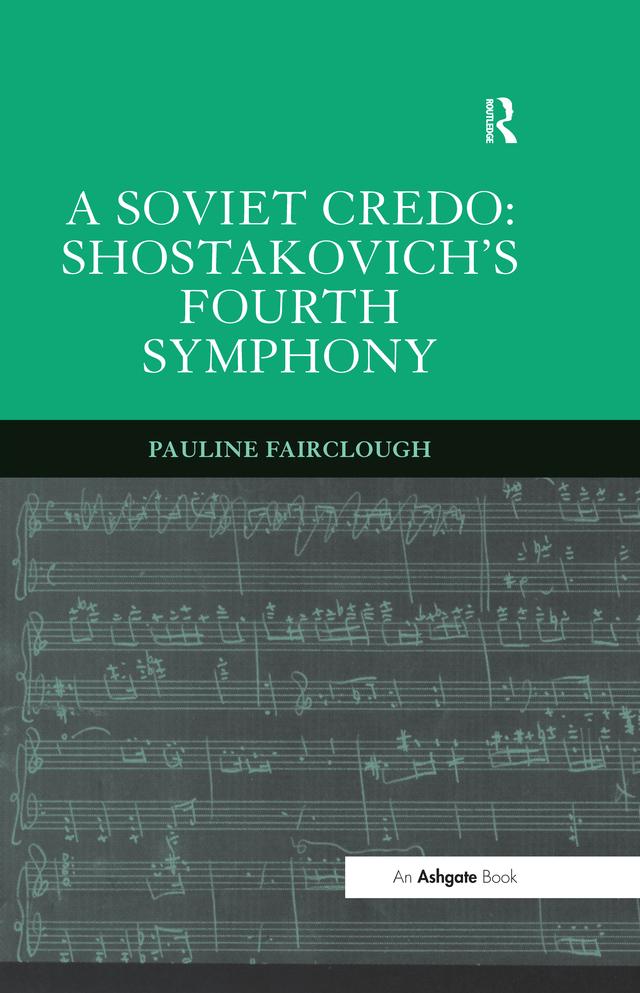
Composed in 1935-36 and intended to be his artistic 'credo', Shostakovich's Fourth Symphony was not performed publicly until 1961. Here, Dr Pauline Fairclough tackles head-on one of the most significant and least understood of Shostakovich's major works. She argues that the Fourth Symphony was radically different from its Soviet contemporaries in terms of its structure, dramaturgy, tone and even language, and therefore challenged the norms of Soviet symphonism at a crucial stage of its development. With the backing of prominent musicologists such as Ivan Sollertinsky, the composer could realistically have expected the premiere to have taken place, and may even have intended the symphony to be a model for a new kind of 'democratic' Soviet symphonism. Fairclough meticulously examines the score to inform a discussion of tonal and thematic processes, allusion, paraphrase and reference to musical types, or intonations. Such analysis is set deeply in the context of Soviet musical culture during the period 1932-36, involving Shostakovich's contemporaries Shebalin, Myaskovsky, Kabalevsky and Popov. A new method of analysis is also advanced here, where a range of Soviet and Western analytical methods are informed by the theoretical work of Shostakovich's contemporaries Viktor Shklovsky, Boris Tomashevsky, Mikhail Bakhtin and Ivan Sollertinsky, together with Theodor Adorno's late study of Mahler. In this way, the book will significantly increase an understanding of the symphony and its context.
Betal nemt med kort, Klarna, Apple Pay eller Google Pay. Ikke tilfreds? Du har altid 14 dages fortrydelsesret. Læs mere i vores vilkår. Har du spørgsmål, så send os en mail på hello@memmo.org.
Memmo gør det nemmere at studere – uanset hvor du er i verden. Hos os samler du dine kursusbøger og smarte studieværktøjer ét sted: resuméer, quizzer, podcasts og flashcards. Og så er der Ted, din studieven, der svarer på alt, du undrer dig over. Over 50 000 studerende studerer allerede her – bygget til at hjælpe dig med at lære hurtigere og stresse mindre.
Du kan måske også lide
Køb bogen0