
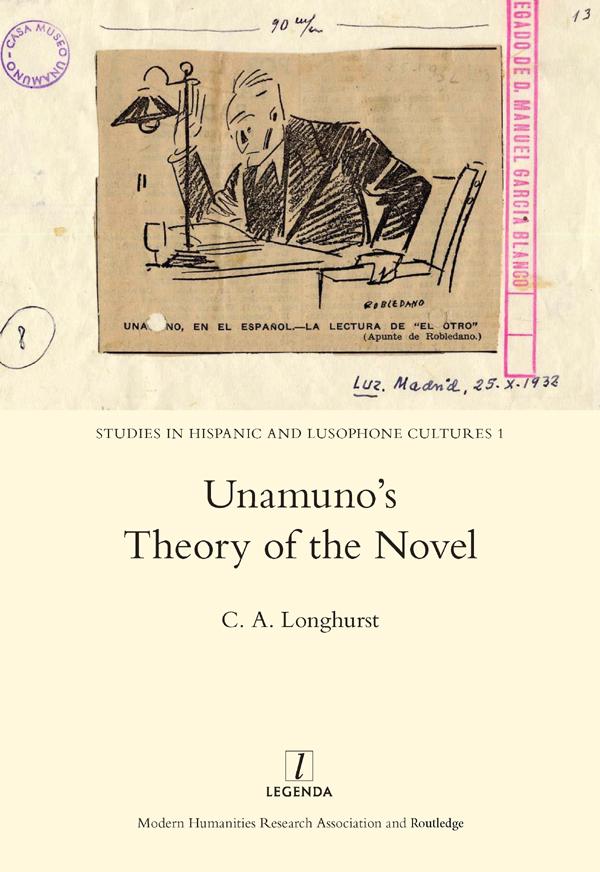
Miguel de Unamuno (1864-1936) is widely regarded as Spain's greatest and most controversial writer of the first half of the twentieth century. Professor of Greek, and later Rector, at the University of Salamanca, and a figure with a noted public profile in his day, he wrote a large number of philosophical, political and philological essays, as well as poems, plays and short stories, but it is his highly idiosyncratic novels, for which he coined the word nivola, that have attracted the greatest critical attention. Niebla (Mist, 1914) has become one of the most studied works of Spanish literature, such is the enduring fascination which it has provoked. In this study, C. A. Longhurst, a distinguished Unamuno scholar, sets out to show that behind Unamuno's fictional experiments there lies a coherent and quasi-philosophical concept of the novelesque genre and indeed of writing itself. Ideas about freedom, identity, finality, mutuality and community are closely intertwined with ideas on writing and reading and give rise to a new and highly personal way of conceiving fiction.
Betal nemt med kort, Klarna, Apple Pay eller Google Pay. Ikke tilfreds? Du har altid 14 dages fortrydelsesret. Læs mere i vores vilkår. Har du spørgsmål, så send os en mail på hello@memmo.org.
Memmo gør det nemmere at studere – uanset hvor du er i verden. Hos os samler du dine kursusbøger og smarte studieværktøjer ét sted: resuméer, quizzer, podcasts og flashcards. Og så er der Ted, din studieven, der svarer på alt, du undrer dig over. Over 50 000 studerende studerer allerede her – bygget til at hjælpe dig med at lære hurtigere og stresse mindre.
Du kan måske også lide
Køb bogen0