
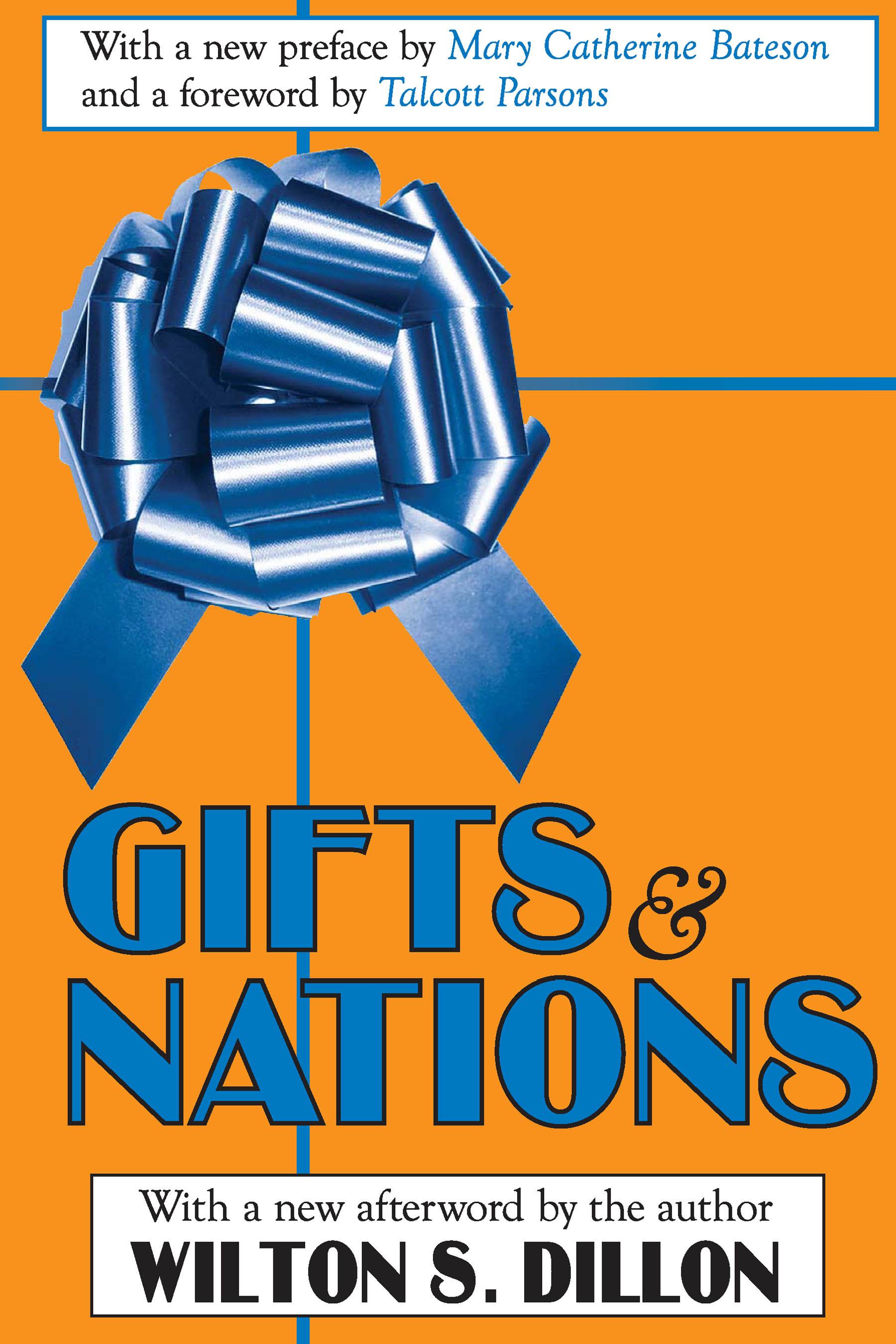
What can men in industrial nations learn from their "primitive" contemporaries, and the habits of earlier civilizations? This book by acclaimed cultural anthropologist Wilton S. Dillon suggests that modern political, religious, and scientific communities--and alliances--would be enhanced greatly if we understood how gift exchange and reciprocity helped to balance earlier institutions and societies.Using the example of the gift behavior of France and the United States during the Marshall Plan period, Gifts and Nations examines the troubles that arise between donors and recipients when a generous donor remains innocent of the recipient's desire to give back things or ideas to which both attach value. Such innocence may produce what the author calls "the Gaullist effect"--a quest for self-esteem, autonomy, and initiative by a person, or a nation, who feels burdened and controlled by undischarged obligations.Gifts and Nations is very much an historical footnote to the rise of PaxAmericana--the American empire having been launched in 1898, enlarged in the aftermath of World War II and the Cold War, and now the subject of global debate. This volume emphasizes that building coalitions and keeping alliances strong require multi-lateralism based on reciprocity.
Betal nemt med kort, Klarna, Apple Pay eller Google Pay. Ikke tilfreds? Du har altid 14 dages fortrydelsesret. Læs mere i vores vilkår. Har du spørgsmål, så send os en mail på hello@memmo.org.
Memmo gør det nemmere at studere – uanset hvor du er i verden. Hos os samler du dine kursusbøger og smarte studieværktøjer ét sted: resuméer, quizzer, podcasts og flashcards. Og så er der Ted, din studieven, der svarer på alt, du undrer dig over. Over 50 000 studerende studerer allerede her – bygget til at hjælpe dig med at lære hurtigere og stresse mindre.
Du kan måske også lide
Køb bogen0