
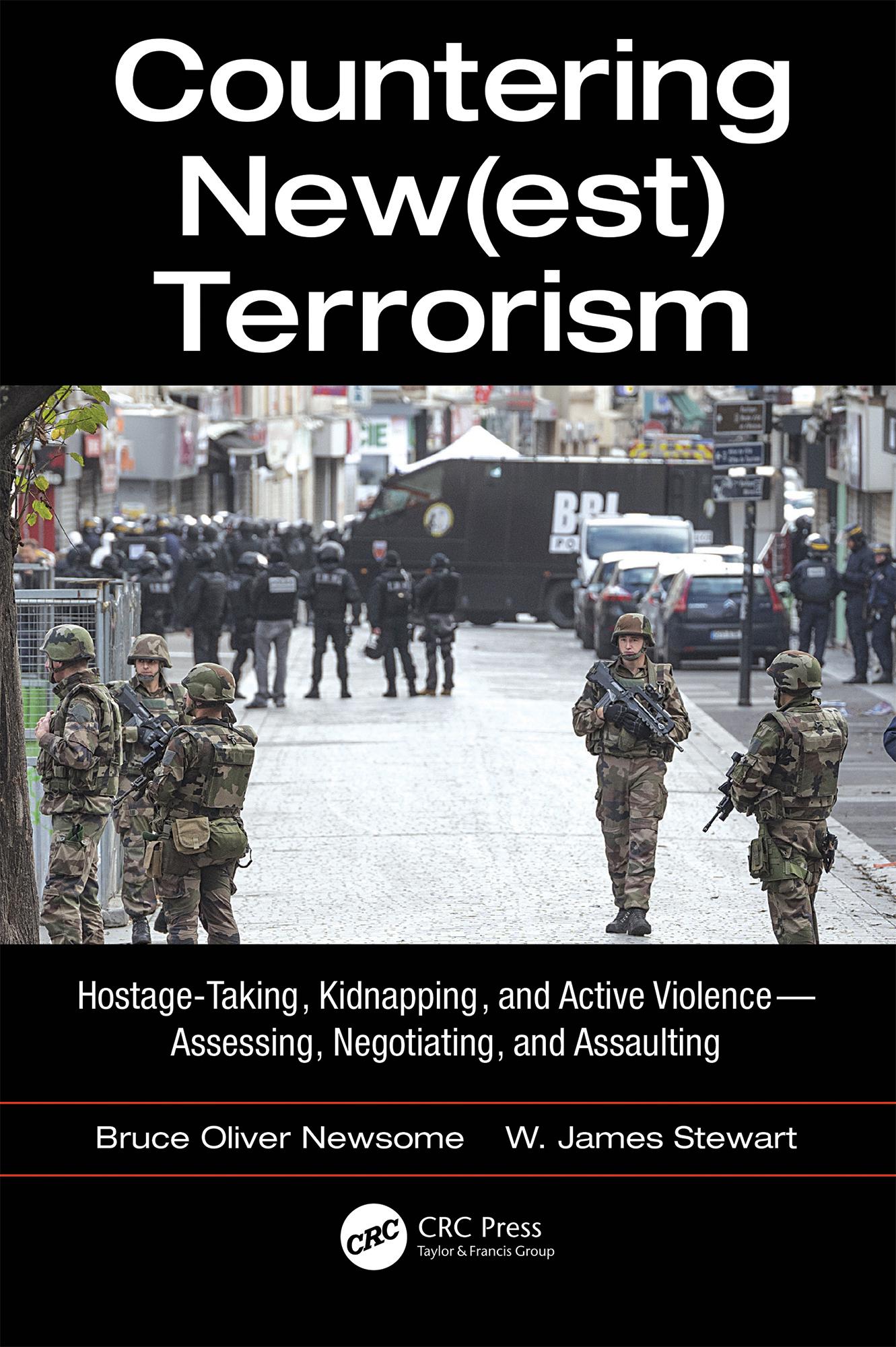
How should we analyze and assess new terrorist behaviors? What are the particular risks and challenges from new terrorism? Should we negotiate with terrorists, and, if so, how? When should we use force against terrorists? Countering New(est) Terrorism: Hostage-Taking, Kidnapping, and Active Violence—Assessing, Negotiating, and Assaulting improves our knowledge of new terrorist behaviors, and our skills in responding to such attacks.
The term "new terrorism" has been in circulation since the late 90’s. This book analyzes the "newest terrorism" that has emerged in recent years—characterized by increased hostage-taking, kidnapping, and active violence—and develops best practices for countering these emerging threats. Along the way, it challenges fashionable wishful thinking that all terrorists are open to rational negotiation or de-radicalization, that military responses always reflect badly on the official side, and that terrorists are not constrained by their own doctrines.
The new terrorists are dramatically more ideological, murderous, and suicidal. They are generally less reconcilable, less trusting of official negotiators, less likely to release detainees, and more likely to kill detainees. They are less likely to demand ransoms yet more likely to release hostages in cases in which they do demand ransom. They are more informed about the official side’s policies, tactics, techniques, and procedures. They are more likely to use new information and communication technologies against responding agencies and officials. They are more capable fighters—they kill more people despite deploying fewer fighters per hostage. Most disturbing is the fact that they take advantage of free-er societies to access easier targets.
Features:
- Includes evidence-based definitions and descriptions of political, religious, Jihadi, and new terrorism
- Presents the first large-n comparison of old and new terrorism, using an original extension of the Global Terrorism Database (GTD), with added codes for each of 10,735 hostage crises and more than 500,000 data points from 1970 through 2016
- Details a further extension of the GTD covering all terrorist events from 2004 through 2016, roughly 5 million data points.
- Offers prescriptive advice and visual decision trees on how to negotiate crises, assess the risk of terrorism, and how and when to assault terrorists
- Reviews official practices, interviews with experienced officials, and real-world simulations of recent terrorist events and attacks
Countering New(est) Terrorism will be of interest to researchers, students enrolled in terrorism and Homeland Security programs, crisis negotiators, and police, security, intelligence, and military authorities tasked with counterterrorism and anti-terrorism efforts.
Betal nemt med kort, Klarna, Apple Pay eller Google Pay. Ikke tilfreds? Du har altid 14 dages fortrydelsesret. Læs mere i vores vilkår. Har du spørgsmål, så send os en mail på hello@memmo.org.
Memmo gør det nemmere at studere – uanset hvor du er i verden. Hos os samler du dine kursusbøger og smarte studieværktøjer ét sted: resuméer, quizzer, podcasts og flashcards. Og så er der Ted, din studieven, der svarer på alt, du undrer dig over. Over 50 000 studerende studerer allerede her – bygget til at hjælpe dig med at lære hurtigere og stresse mindre.